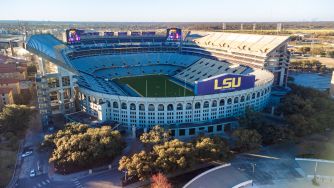
Photo Source: Adobe Stock Images by Chad Robertson
A Louisiana judge has expanded a temporary court order protecting college athletes seeking an additional season of eligibility, directly blocking the Southeastern Conference and Commissioner Greg Sankey from punishing schools that recruit certain players who previously pursued professional careers.
Judge William Jorden of Louisiana’s 19th Judicial District Court amended his earlier temporary restraining order Friday, August 28, adding the SEC and Sankey to the case. The move prevents the conference, at least temporarily, from using its newly adopted eligibility policy and accompanying penalties against schools that sign athletes protected by the court order.
The ruling has immediate implications for LSU, which has commitments from former NFL players Dae’Quan Wright and Zxavian Harris. Former LSU defensive end Jack Pyburn, who has been with the Tampa Bay Buccaneers, is also among the athletes seeking another college season and could return to LSU if his professional stint ends.
Jorden’s amended order does not strike down the SEC’s policy for all athletes or permanently decide whether former professional players must be allowed to return to college sports. It provides temporary protection to athletes involved in the Louisiana lawsuit while the court considers whether longer-lasting injunctive relief is warranted.
A hearing is scheduled for Thursday, September 3, in Baton Rouge, slightly more than two days before LSU opens its football season against Clemson.
The Louisiana case involves 33 athletes challenging NCAA eligibility restrictions. Jorden initially issued a temporary restraining order on August 19 after the NCAA adopted a new system generally allowing athletes five seasons of competition within a five-year eligibility period but excluded athletes who had already exhausted four seasons by the end of the 2025-26 academic year.
Several members of that group had already moved into professional football because, under the rules then in effect, their college eligibility appeared to be over.
Wright, a former Ole Miss tight end, signed with the Philadelphia Eagles as an undrafted free agent and later joined the Cleveland Browns. Harris, a former Ole Miss defensive lineman, spent time with the New Orleans Saints. Both have since committed to LSU.
Under the original Louisiana order, athletes who had professional contracts were required to terminate those agreements and repay professional compensation before participating in a college game. The order also temporarily reopened the transfer portal for covered players.
Their path back to college appeared to narrow again when the SEC responded to the court battles by adopting its own eligibility restrictions.
Earlier this week, the conference barred football and basketball players from competing at SEC schools if they had signed certain professional contracts, appeared on professional rosters or remained in professional drafts beyond the point permitted under NCAA rules.
The conference then approved sanctions for schools and coaches that violated the policy. LSU abstained from the vote authorizing penalties, which otherwise passed 15-0. Reported sanctions included suspending a head coach for half a season, imposing a fine equal to 50% of a sport’s annual operating budget and revoking certain conference voting rights.
That created an unusual conflict between the Louisiana court and the conference.
The NCAA had already been restrained from enforcing its rules against the athletes named in Jorden’s order. The SEC’s new policy could nevertheless have discouraged schools from signing those same players by exposing the institution and its coaches to substantial conference penalties.
Attorneys for the athletes responded by amending their complaint to add the SEC and Sankey. They argued that the conference could not effectively circumvent the court’s protection by imposing a separate set of penalties on schools willing to recruit the players.
Jorden’s Friday order now directly addresses that issue.
The amendment names the SEC and Sankey and prevents enforcement of the challenged penalties against schools in connection with the protected athletes. The court did not find the conference or Sankey in contempt. Reports concerning the amended order indicate they were added as defendants so the athletes could seek injunctive relief directly against them.
The ruling came one day after a Texas judge reached a similar result in a separate lawsuit involving 41 athletes.
Dallas County District Judge Martin Hoffman issued a 14-day temporary restraining order Thursday preventing the NCAA, SEC and Sankey from blocking the plaintiffs from pursuing another college season based on the disputed eligibility restrictions.
“As long as they would have been eligible to continue playing college sports in the following semester if they had a fifth year of eligibility, they are eligible today,” Hoffman wrote.
The Texas plaintiffs include athletes with unusually advanced professional ties. Among them are Dallas Cowboys receiver Jordon Hudson and Kansas City Chiefs players Wesley Bissainthe and Omari Evans. WNBA signees Bailey Maupin and Christeen Iwuala are also included in the case.
Hoffman also ordered the NCAA to reopen the transfer portal temporarily so covered athletes can seek college opportunities. His ruling does not require any university to offer a roster position, scholarship or other agreement to a player.
The Louisiana and Texas orders therefore have limits. Neither establishes a nationwide right for professional athletes to return to college, and neither represents a final judgment that the NCAA or SEC rules are unlawful.
They do, however, undercut the SEC’s attempt to create an additional enforcement barrier after courts began granting athletes relief from NCAA eligibility restrictions.
The issue has spread beyond the SEC. The Big Ten, Big 12 and ACC have also adopted policies restricting athletes from returning to college after entering professional sports, while the Mountain West has adopted a similar prohibition. The Louisiana and Texas orders do not automatically invalidate those conference rules.
The disputes are the latest result of the NCAA’s transition toward a five-season eligibility model.
Athletes who completed their fourth college season during the 2025-26 academic year have argued that they were placed in an unusual position: they exhausted their eligibility under the old four-season structure shortly before the NCAA moved toward allowing future athletes five seasons.
The nationwide portion of that fight initially produced a class-wide preliminary injunctionA preliminary injunction is a temporary court order issued before a case is finally decided that requires a party to take or stop an action while the litigation continues. Federal courts generally consider the likelihood of success, irreparable harm, the balance of equities, and the public interest before granting one.Read more → from U.S. District Judge Charlotte Sweeney in Colorado. The U.S. Court of Appeals for the Tenth Circuit stayed that injunction on August 21 while the NCAA appeals, leaving individual athletes to continue seeking relief through other courts.
The Louisiana litigation has moved beyond that original question. Courts are now being asked not only whether the NCAA can deny those athletes a fifth year, but also whether conferences can independently prevent schools from using players who obtain court-ordered eligibility.
For LSU, the answer is particularly urgent. Wright and Harris are seeking to join the Tigers as the football season begins, and other athletes could follow depending on NFL roster decisions.
Attorneys representing the athletes said Saturday that the SEC had communicated that it would comply with applicable court orders. That would allow schools to roster protected plaintiffs without facing the conference penalties threatened under the new policy while those orders remain effective.
The September 3 hearing could determine whether Jorden extends the protection through a preliminary injunction or allows the temporary restrictions to expire.
Whatever happens at that hearing, the litigation has already moved the eligibility dispute into new territory. Courts are no longer considering only whether the NCAA can keep former college athletes off the field. They are beginning to confront whether athletic conferences can impose their own restrictions when athletes have already obtained judicial protection from NCAA rules.
Share This Article
If you found this article insightful, consider sharing it with your network.
Lawrence is an attorney and CEO of Law Commentary. His legal background includes corporate and general business law, litigation, transactional matters, and law practice management. His litigation experience has included complex matters involving antitrust, insurance bad faith, and medical malpractice. On the transactional side, Lawrence has worked with buy-sell agreements, Regulation D disclosures, stock option plans, and business matters. Lawrence draws on his legal and business experience to help make court decisions, litigation, legislation, public policy, and other legal developments more accessible to the general public and to give readers clear context for understanding the law and how it affects businesses, consumers, and communities.
The Senate passed the Protect College Sports Act in a 77-22 bipartisan vote Monday, September 28, 2026, advancing legislation that would reshape how college athletes are paid and allowed to transfer while giving the NCAA federal protection from certain antitrust challenges.The legislation would establish national rules governing athlete compensation, transfers,...
Read
More »
LSU found a football player responsible for sexual assault and forcible rape through its Title IX process, then reduced his one-year suspension on appeal to two years of probation without restrictions, allowing him back on the team. The finding remained in place, and the case is now under criminal investigation.LSU...
Read
More »
The Southeastern Conference has sued LSU in federal court as a Louisiana judge cleared a path for former NFL players to return to college football, escalating an eligibility fight days before Lane Kiffin’s Tigers open their season against Clemson.The SEC filed its lawsuit just after midnight Thursday, September 3, in...
Read
More »
The Big 12 Conference has dropped its federal lawsuit against Texas Tech University and Texas Attorney General Ken Paxton, ending a legal fight triggered by quarterback Brendan Sorsby’s extensive sports betting violations and the conference’s effort to sanction one of its own schools.The conference filed a notice of voluntary dismissal...
Read
More »
LSU's place in the Southeastern Conference is now formally at risk after the SEC scheduled a Thursday meeting to consider expelling the university, escalating a legal fight over former NFL players seeking to return to college football.The SEC filed an amended federal lawsuit Tuesday asking a judge to protect its...
Read
More »
We use cookies and similar technologies to help our website function, understand how visitors use our site, and improve your experience. Some cookies are necessary for the website to operate, while others may be used for analytics or advertising.