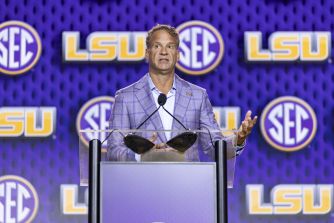
LSU's place in the Southeastern Conference is now formally at risk after the SEC scheduled a Thursday meeting to consider expelling the university, escalating a legal fight over former NFL players seeking to return to college football.
The SEC filed an amended federal lawsuit Tuesday asking a judge to protect its authority to hold the September 10 meeting and decide whether LSU should remain in the conference. Removing the university would require approval from at least two-thirds of the SEC's presidents and chancellors.
The filing expands the lawsuit the conference brought last week against LSU officials and head football coach Lane Kiffin. While an expulsion is not currently expected, the amendment puts the SEC's most severe membership sanction squarely into a dispute that began over the eligibility of former professional players.
The SEC's case centers on its First Amendment right of expressive association. The conference argues that member universities voluntarily agree to common rules and principles, and that LSU officials cannot use state authority to force the SEC to remain associated with conduct it says violates those standards.
The amended complaint also accuses LSU of a "lack of institutional control," including what the SEC described as a failure by university leadership to control Kiffin as the eligibility fight intensified.
Presidents and chancellors from the SEC's other 15 universities met without LSU last Friday to discuss the dispute. According to the filing, conference leaders concluded that LSU's conduct raised questions about whether its continued membership was consistent with SEC rules and called a special meeting for Thursday.
Kiffin's public comments have also become part of the conference's case.
During LSU's 51-10 victory over Clemson on Saturday, Kiffin was asked about the Tigers at halftime and responded, "Imagine if we had pro players," an apparent reference to Dae'Quan Wright and Zxavian Harris.
Wright and Harris, who played for Kiffin at Ole Miss before signing NFL contracts, were not on LSU's roster for the Clemson game. Both remain enrolled at the university and could potentially be added later.
Louisiana state court Judge William Jorden granted a preliminary injunctionA preliminary injunction is a temporary court order issued before a case is finally decided that requires a party to take or stop an action while the litigation continues. Federal courts generally consider the likelihood of success, irreparable harm, the balance of equities, and the public interest before granting one.Read more → last week covering Wright, Harris and 40 other athletes seeking an additional season of college eligibility. The order temporarily prevents the SEC and NCAA from enforcing rules that would keep the athletes from competing during the 2026-27 school year.
The SEC had adopted separate penalties for schools that placed former professional players on their rosters. Those sanctions included suspending a head coach for half a season and imposing a fine equal to half of the school's athletic budget for the sport.
The measure was approved 15-0, with LSU abstaining.
The federal lawsuit now raises a broader question than whether those penalties can be imposed. The SEC is asking the Alabama court to protect its ability to govern its own membership when a state court order limits how it can discipline one of its schools.
The SEC is not asking the federal judge to determine whether Wright or Harris can play. Its amended complaint instead seeks protection for the conference's internal process, including its authority to decide whether LSU should remain a member.
The conference said Tuesday that its universities have the right to establish rules through agreed-upon governance procedures and expect member schools to follow them.
LSU has been part of the SEC since the conference was formed in 1933, making the possibility of expulsion a major escalation in a dispute that began over two players' eligibility.
Thursday's meeting is expected to consider LSU's membership even if the university abandons its effort to add the former NFL players to its roster.
Before then, the federal court could rule on the SEC's request for temporary relief. Conference presidents and chancellors will then confront a question that would have seemed extraordinary only days ago: whether LSU should remain in the SEC.
Share This Article
If you found this article insightful, consider sharing it with your network.
Alexandra Agraz is a former Diplomatic Aide with firsthand experience in facilitating high-level international events, including the signing of critical economic and political agreements between the United States and Mexico. She holds dual associate degrees in Humanities, Social and Political Sciences, and Film, blending a diverse academic background in diplomacy, culture, and storytelling. This unique combination enables her to provide nuanced perspectives on global relations and cultural narratives.
Cornell University President Michael Kotlikoff is facing a faculty no-confidence vote after admitting he knew about a student's report of an alleged gang rape at a fraternity house in 2024 but never followed up on her case, fueling criticism of the university's response to sexual assault allegations.The Faculty Senate confronted...
Read
More »
The Southeastern Conference has sued LSU in federal court as a Louisiana judge cleared a path for former NFL players to return to college football, escalating an eligibility fight days before Lane Kiffin’s Tigers open their season against Clemson.The SEC filed its lawsuit just after midnight Thursday, September 3, in...
Read
More »
LSU found a football player responsible for sexual assault and forcible rape through its Title IX process, then reduced his one-year suspension on appeal to two years of probation without restrictions, allowing him back on the team. The finding remained in place, and the case is now under criminal investigation.LSU...
Read
More »
The Senate passed the Protect College Sports Act in a 77-22 bipartisan vote Monday, September 28, 2026, advancing legislation that would reshape how college athletes are paid and allowed to transfer while giving the NCAA federal protection from certain antitrust challenges.The legislation would establish national rules governing athlete compensation, transfers,...
Read
More »
CNN, Politico and MS NOW sued President Donald Trump and members of his administration Monday after the White House revoked their journalists’ credentials and barred them from White House grounds, setting up a new constitutional fight over whether a president can exclude news organizations because he objects to their coverage.The...
Read
More »
We use cookies and similar technologies to help our website function, understand how visitors use our site, and improve your experience. Some cookies are necessary for the website to operate, while others may be used for analytics or advertising.