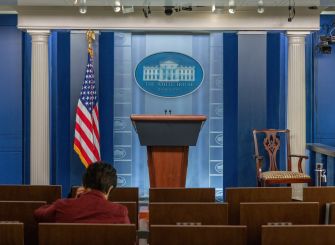
CNN, Politico and MS NOW sued President Donald Trump and members of his administration Monday after the White House revoked their journalists’ credentials and barred them from White House grounds, setting up a new constitutional fight over whether a president can exclude news organizations because he objects to their coverage.
The three outlets filed their lawsuit September 21 in federal court in Washington, D.C., alleging violations of the First Amendment’s protections for speech and freedom of the press and the Fifth Amendment’s guarantee of due process. They are seeking a temporary restraining order that would restore their reporters’ White House access while the case proceeds. Emergency hearings could occur as soon as this week.
The lawsuit followed Trump’s announcement Friday that CNN, MS NOW and Politico would be barred from the White House because of reporting he described as “fake news.” By Saturday, reporters from all three organizations were being turned away from the White House complex, including CNN senior White House reporter Betsy Klein, MS NOW correspondent Akayla Gardner and Politico reporter Cheyenne Haslett.
The organizations say the decision was made without advance notice, a hearing or a formal process allowing them to challenge the loss of access. In a joint statement Monday, they said they filed the lawsuit to protect their First Amendment rights and the broader principle that the government does not decide what the press may report or publish.
Trump has defended the ban and said the administration was targeting what he called “FAKE NEWS,” rather than the free press. He also described media reporting he considered false as a national-security threat, although Reuters reported that he offered no evidence supporting that characterization.
The dispute now presents a familiar but difficult constitutional question. The press has no general right to enter every part of the White House, but once the government creates a system that gives bona fide journalists access, courts have placed limits on how that access may be withdrawn.
CNN, Politico and MS NOW argue that the White House crossed that line by punishing them because of their reporting. Their First Amendment claim centers on viewpoint discrimination, which occurs when the government treats speakers differently because of the ideas or opinions they express.
Government officials generally have broad discretion over interviews, press conferences, and limited-access events. Constitutional concerns become more serious when access otherwise available to qualified journalists is withdrawn because officials object to the substance of a news organization’s coverage.
The D.C. Circuit addressed that issue nearly 50 years ago in Sherrill v. Knight. Journalist Robert Sherrill challenged the denial of a White House press pass, and the appeals court recognized that the public does not have a constitutional entitlement to enter White House press facilities. Once those facilities were opened to bona fide journalists, however, the court held that access could not be denied arbitrarily.
The court also imposed procedural protections. When a journalist is denied a White House press pass, the government must provide notice of the factual basis for the decision, give the journalist an opportunity to respond, and issue a written explanation of the final denial.
The D.C. Circuit further concluded that a journalist’s First Amendment interest in White House access can qualify as a liberty interest protected by the Fifth Amendment’s Due Process Clause. That precedent could be especially important because CNN, MS NOW and Politico say their reporters already held valid credentials when the administration abruptly revoked them.
The organizations allege that their journalists were removed because Trump disliked their reporting rather than because of security concerns, space limitations or violations of credentialing rules. They also say there was no formal notice explaining a recognized basis for the revocations and no opportunity to contest the decision beforehand.
CNN has fought a similar legal battle before. During Trump’s first term, the White House revoked correspondent Jim Acosta’s press credentials after a contentious 2018 news conference, prompting CNN and Acosta to sue under the First and Fifth Amendments.
U.S. District Judge Timothy Kelly ordered Acosta’s pass temporarily restored after concluding that CNN was likely to succeed on its due-process claim under Sherrill. Kelly noted that the analysis could be different if a reporter were excluded for genuine safety or security reasons, and the new lawsuit has also been assigned to him, according to the Associated Press.
Another recent dispute involving The Associated Press could complicate the legal landscape. The White House restricted AP access in 2025 after the news organization continued using “Gulf of Mexico” in its reporting while also noting Trump’s decision to rename the body of water the “Gulf of America.”
A federal district judge initially ruled that the government could not punish the AP for that editorial choice and ordered the White House to restore equal access to certain presidential events. The judge concluded that when the government opens an event to some journalists, it cannot treat another news organization worse because of its viewpoint.
The D.C. Circuit later paused that order while the appeal continued, giving the White House greater discretion over access to tightly controlled spaces such as the Oval Office and Air Force One. A majority of that appellate panel reasoned that presidents retain substantial authority over whom they allow into limited-access settings.
The lawsuit filed Monday is broader in one important respect. CNN, MS NOW and Politico say their organizations have been excluded from White House grounds altogether, rather than simply denied places in individual press-pool events or highly restricted presidential spaces.
That distinction could become important as Kelly considers the request for emergency relief. The government can argue that access to the president remains discretionary, while the plaintiffs are likely to emphasize that they already held credentials and were excluded because of the substance of their journalism.
Trump’s own statements could also become part of the court’s analysis. He publicly tied the ban to his objections to the organizations’ reporting and said Friday that no single incident prompted the decision, while also mentioning The New York Times and The Washington Post as other outlets whose coverage he considers “fake news.”
The consequences have already extended beyond the three plaintiffs. CNN was scheduled to handle television pool coverage for Trump’s Monday trip to New York for the United Nations General Assembly, but it could not perform that assignment because its reporters remained barred.
ABC, CBS, Fox News and NBC then suspended their participation in the television pool rather than replace CNN. Those networks normally rotate responsibility for filming presidential events and share the footage with other news organizations around the country, making the suspension significant for broader public access to presidential video.
The White House Correspondents’ Association, The Associated Press and other press organizations have also called for the credentials to be restored. Their support adds another layer to a dispute that reaches beyond the individual reporters named in the lawsuit.
The federal court is initially being asked to decide only whether immediate relief is warranted. A temporary restraining order would restore access while the case proceeds but would not finally determine whether the White House ban is unconstitutional.
Kelly will consider whether the news organizations are likely to succeed on their claims, whether they face irreparable harm without immediate relief, and how an order would affect the public interest. If he restores the credentials temporarily, the case could continue toward a preliminary injunction or a final ruling on the merits.
If the judge declines emergency relief, the organizations can continue litigating and seek appellate review. Either way, the case could help clarify how older White House press-access precedent applies when an administration excludes entire news organizations rather than individual reporters from specific events.
The larger issue reaches beyond CNN, Politico and MS NOW. Presidents have long disagreed sharply with journalists, and the Constitution does not require a president to grant interviews, answer particular questions, or provide every reporter access to every event.
The constitutional question becomes more difficult when the government creates a credentialing system and then allegedly uses those credentials to punish unfavorable coverage. Sherrill established that White House access can implicate both First Amendment and due-process protections, while more recent litigation has recognized broader presidential discretion over tightly controlled spaces and press pools.
The new lawsuit could help define where that line falls when entire news organizations are denied access to the White House itself. For now, CNN, Politico and MS NOW are asking the court to restore their journalists’ credentials and prevent the administration from excluding them while their constitutional claims are litigated.