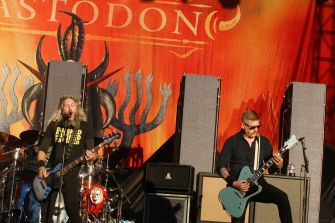
Mastodon is asking a Georgia judge to dismiss several claims brought by the estate of late guitarist Brent Hinds, arguing that its surviving members cannot be held personally responsible for disputed business dealings and that the estate has failed to establish a legal basis for compensation over the band's latest album artwork.
In a filing Monday, November 2, 2026, the Atlanta metal band's attorneys challenged allegations involving Hinds' 25% ownership interest, a proposed buyout and the use of his likeness on the cover of Marrow Deep. The motion seeks to narrow the lawsuit rather than dismiss it entirely.
The band's lawyers argue that Mastodon's business operates through limited liability companies and that individual members cannot automatically be held responsible for obligations belonging to those entities. They also dispute the estate's claims that Hinds was entitled to a completed buyout before his death.
According to the filing, a proposal to purchase Hinds' ownership interest never became a binding agreement because the parties had not established a purchase price or finalized the terms. The attorneys argue that the estate cannot require Mastodon to complete a transaction on terms that were never agreed upon.
The motion follows a September lawsuit brought by Hinds' estate, which alleges that the guitarist still held a 25% stake in Mastodon-related businesses when he died in August 2025. His father, Billy Hinds, who represents the estate, claims the band subsequently offered an $80,000 payment that did not adequately account for the value of those interests. The estate declined to cash the check.
Mastodon also challenges allegations that it wrongfully deprived the estate of Hinds' ownership stake. Its attorneys argue that the complaint does not identify any actual seizure or transfer of property representing his interest, which they contend is necessary to support the estate's conversion claim.
A separate dispute concerns the band's use of imagery allegedly resembling Hinds on the cover of Marrow Deep. The estate claims the artwork commercially exploits his likeness without authorization, while Mastodon's attorneys argue that the complaint does not establish a fiduciary duty requiring compensation for that use.
The band further disputes the estate's request for a court declaration governing future uses of Hinds' likeness, arguing that the proposed relief would improperly direct Mastodon's conduct rather than clarify the estate's existing legal rights.
Hinds left Mastodon in March 2025 after more than two decades with the group. Although both sides described the separation as mutual, the estate alleges that the business arrangements surrounding his departure remained unresolved when he died five months later.
The court has yet to rule on Mastodon's partial dismissal request. The estate's claims concerning Hinds' ownership interests and the disputed album artwork remain before the judge as the parties await a decision on which allegations may proceed.