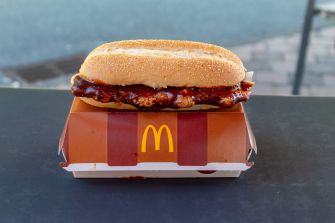
A federal judge has rejected McDonald’s bid to dismiss a proposed class-action lawsuit accusing the fast-food giant of misleading customers into believing its McRib sandwich contains actual pork rib meat.
U.S. District Judge April Perry in Chicago ruled Friday, October 30, 2026, that consumers could reasonably interpret the sandwich’s name, rib-shaped patty, and advertising as suggesting it contains a more expensive cut of pork. The decision allows several consumer deception, fraud, and unjust enrichment claims to move forward.
Four customers who sued McDonald’s in December 2025 allege the company deliberately molded the McRib’s boneless pork patty to resemble a rack of ribs while using less expensive cuts of meat. They say the sandwich’s appearance, marketing, and premium price led them to pay more than they otherwise would have.
The lawsuit alleges the patty contains restructured pork products, including shoulder, heart, tripe and stomach. McDonald’s disputes those allegations, specifically denying the use of heart, tripe or scalded stomach, and maintains that the sandwich contains 100% pork sourced from American farmers and suppliers.
Two surveys submitted by the consumers also drew Perry’s attention. One found that 72% of respondents expected the McRib to contain rib meat, while another found that 67% considered rib meat important or very important when deciding whether to buy the sandwich.
McDonald’s argued that reasonable customers would understand the McRib’s name as a reference to its flavor and presentation rather than a promise of a particular cut of meat. The company also pointed to its publicly available ingredient information, which identifies pork as the sandwich’s primary ingredient.
Perry was not persuaded that customers should be expected to research ingredients before buying a fast-food sandwich costing about $7. She also noted that other McDonald’s products, including the McChicken and Egg McMuffin, use names that identify what customers can expect to find in them.
The judge also found that the McRib’s distinctive shape, particularly when featured in advertisements, could support the consumers’ claim that McDonald’s presentation created a misleading impression about the meat they were buying. The ruling does not determine whether the company’s marketing was deceptive, and the customers will still need evidence to prove their claims.
Perry dismissed five other claims without prejudice, giving the customers an opportunity to revise them. The proposed class has not yet been certified, leaving both the scope of the case and the underlying allegations to be resolved as the litigation continues.
The ruling comes as McDonald’s brings back the McRib for another limited-time offering at select U.S. restaurants beginning the week of October 26. The surviving claims now move forward with the customers seeking evidence about the sandwich’s ingredients, advertising and whether its presentation led consumers to pay more for something they believed contained rib meat.