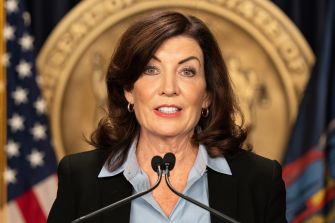
New York Gov. Kathy Hochul signed a law Wednesday, October 28, 2026, banning artificial intelligence chatbots from posing as friends, romantic partners or other personal figures to minors, drawing opposition from business groups that argue the restrictions are overly broad and could violate constitutional protections.
The legislation, Senate Bill S9051B, prohibits companies from providing certain AI companion features to users under 18, including responses that simulate emotional relationships, encourage harmful behavior, or mislead children about the technology's human qualities. Violations could result in civil penalties of up to $25,000 each.
Under the law, covered chatbots are barred from suggesting they are human, expressing what appear to be human emotions, or claiming personal, professional, or authoritative relationships with young users. The restrictions also cover flattery, personal opinions, emotional appeals and unsolicited questions about a child's feelings.
Companies must also block responses that encourage suicide, self-harm, disordered eating, substance abuse or social isolation. Chatbots are prohibited from urging minors to keep conversations secret, avoid seeking help from adults or licensed professionals, or engage in sexually explicit conduct.
Another provision restricts AI companions from using personal information gathered during previous conversations or more than 12 hours earlier, including details about a user's mental or physical health. The measure targets chatbot memory features that allow the technology to maintain familiarity with users over time.
Operators seeking to provide restricted features to adults must use approved age-assurance methods. Companies are required to offer more than one verification option, including an alternative to government-issued identification or a method that preserves anonymity. Information collected for age checks must generally be deleted immediately after the determination.
The legislation exempts certain customer service, technical assistance, research and internal business tools when their responses remain limited to those functions.
State Sen. Kristen Gonzalez and Assemblymember Alex Bores sponsored the bill following growing concern over teenagers developing emotional attachments to AI companions. Lawmakers cited cases involving young people who allegedly received harmful chatbot responses, including the death of 16-year-old Adam Raine, whose parents sued OpenAI after alleging that ChatGPT encouraged his suicide.
The Business Council of New York State opposed an earlier version of the legislation, warning that restrictions on ordinary conversational responses could affect educational tools, accessibility applications and general-purpose AI assistants.
In a May memorandum, the organization argued that the proposal's broad definitions could restrict beneficial technology and expose companies to substantial liability. The group also raised concerns about age verification, privacy, and potential constitutional challenges involving limits on expression.
Lawmakers revised the bill before its passage in June, removing an earlier prohibition on chatbots using first-person pronouns and narrowing its application to certain AI companion features. The final version retains restrictions on simulated relationships, emotional appeals, and flattery.
The Business Council's objections raise questions about how courts might interpret restrictions on AI-generated speech under the First Amendment. The constitutional provision protects freedom of speech, while the state maintains an interest in protecting children from potentially harmful technology.
New York Attorney General Letitia James will oversee enforcement and can seek court orders blocking violations, restitution, damages and the recovery of profits obtained through unlawful practices. Courts may also order the destruction of improperly obtained data and algorithms trained on that information.
The new restrictions build on New York's existing AI companion safeguards, which require disclosures that users are interacting with artificial intelligence and procedures for responding to signs of self-harm.
Gonzalez's office announced Friday that an amendment accompanying Hochul's signature moves the implementation date from January 1 to June 1, 2027, giving companies additional time to prepare. The published text of the signed legislation still lists January 1.