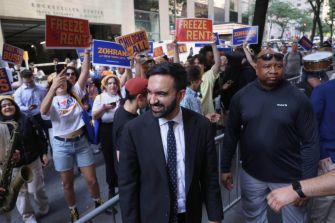
A group of seven New York City landlords has sued to block a rent freeze for nearly 1 million rent-stabilized apartments, arguing that the city’s Rent Guidelines Board failed to fulfill its legal duties independently and instead reached an outcome that Mayor Zohran Mamdani had promoted during his campaign.
The case, filed Wednesday in Richmond County Supreme Court, asks a judge to throw out the board’s June 25 vote setting rent increases at 0% for both one-year and two-year renewal leases beginning Oct. 1. The landlords also want the issue returned to the board for a new decision and are seeking to keep the current increases of 3% for one-year leases and 4.5% for two-year leases in place during that process.
The new guidelines are scheduled to apply through Sept. 30, 2027. The decision marks the first time the Rent Guidelines Board has approved a freeze covering two-year renewal leases, extending the policy beyond earlier freezes that applied only to one-year agreements.
At the center of the challenge is the landlords’ claim that the board’s decision was predetermined rather than reached through an independent review of the financial and housing data required by city law. Mamdani appointed five new members and reappointed a tenant representative in February, giving his selections six of the board’s nine seats. All six later voted for the freeze.
New York City law gives the mayor authority to appoint all nine members, so the appointments themselves are not the basis of the challenge. Instead, the lawsuit claims the administration went further by using city resources and mayoral offices to help build support for a rent freeze. The filing points to efforts encouraging tenants and property owners to participate in board hearings, along with a presentation from the Mayor’s Office of Equity and Racial Justice about New Yorkers’ cost of living.
The landlords also rely heavily on the resignation of property owner representative Christina Smyth shortly before the final vote. Smyth accused the board of working toward a result that had already been decided. Her resignation left eight members to participate in the June 25 vote, which passed 7 to 1.
City law requires the Rent Guidelines Board to consider the financial condition of the residential real estate industry when setting annual rent adjustments. Section 26-510 of the Administrative Code directs members to examine factors including operating costs, taxes, insurance, financing conditions, housing supply and vacancy rates. The board may also consider cost of living information and other available data.
Those requirements are important to the landlords’ second major argument. The board’s Price Index of Operating Costs found that expenses increased 5.3%, including an 11% rise in fuel costs and a 10.5% increase in insurance. The report projected another 4.1% increase in operating expenses.
Other board data pointed in a different direction. Net operating income rose 6.2% among buildings containing at least one rent-stabilized apartment. The landlords claim that figure gave an overly favorable picture of owners’ finances because the group included properties with market-rate apartments and other sources of income. Net operating income increased 2.4% among buildings that were fully rent-stabilized.
The dispute over those figures does not necessarily turn on which side can point to the more favorable number. The law requires the board to consider specified economic conditions, but it does not establish a formula that automatically produces a rent increase when owners’ expenses rise. Courts have generally recognized that the board has considerable discretion to decide how much weight to give the different factors before it.
The landlords brought their challenge under Article 78, a New York law that allows courts to review decisions made by government agencies and public bodies. One of their central claims is that the rent freeze was “arbitrary and capricious,” a legal standard used to determine whether a government decision had a reasonable basis in the facts and the law.
That standard also limits what the court is being asked to decide. A judge does not simply determine whether a rent freeze was the best economic policy or replace the board’s judgment with another preferred outcome. The question is whether the board followed its legal duties and had a rational basis for the decision it made.
New York courts have previously given the Rent Guidelines Board broad discretion in setting annual adjustments. In 2017, a judge dismissed a challenge to an earlier rent freeze after property owners argued that the board improperly focused on tenant affordability. The court found that the rent stabilization law allowed members considerable freedom to decide what information to consider and how much weight different factors should receive.
The landlords now argue that their case presents a different problem. Rather than claiming only that the board gave too much weight to tenant affordability or too little weight to rising expenses, they allege that the board failed to genuinely weigh the evidence because the outcome had effectively been decided beforehand.
One member who opposed the freeze has publicly challenged part of that account. Arpit Gupta, an appointee of former Mayor Eric Adams who cast the only vote against the measure, said he did not observe the Mamdani administration interfering with individual board members’ decisions.
The Mamdani administration has said the Rent Guidelines Board acted independently and that the city Law Department is prepared to defend its decision. Richmond County Supreme Court Justice Ralph Porzio has scheduled a virtual hearing for Sept. 2.
The new rent guidelines remain scheduled to take effect Oct. 1 while the landlords’ Article 78 challenge remains pending.