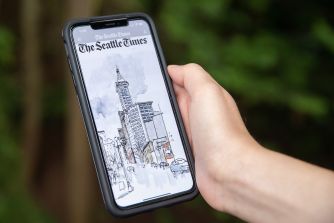
The Seattle Times and Newsday have sued OpenAI and Microsoft, accusing the companies of copying hundreds of thousands of articles without permission to train AI systems and asking a federal court to destroy models and training datasets that incorporate their journalism.
The copyright infringement lawsuit, filed September 4 in the U.S. District Court for the Southern District of New York, targets the use of the newspapers' work in products including ChatGPT, Microsoft Copilot and AI features in Bing. The publishers say OpenAI and Microsoft scraped stories from their websites, including articles behind paywalls, and incorporated the material into their AI systems.
The complaint cites The Seattle Times' Pulitzer Prize-winning coverage of the Boeing 737 MAX crashes as evidence that the material can surface in AI-generated responses. The newspapers say ChatGPT reproduced 88 consecutive words from one article after receiving its headline and URL.
The publishers argue that AI-generated answers can reproduce or closely paraphrase their reporting while reducing the need for readers to visit their websites or pay for subscriptions. OpenAI has defended training its models on publicly available material as protected by fair use, while Microsoft said it was surprised by the lawsuit and was willing to discuss possible solutions.
The newspapers are seeking damages and an injunction, but their request involving the models themselves could carry broader implications. Federal copyright law allows courts in infringement cases to order the destruction of infringing copies and certain materials used to create them, and The Seattle Times and Newsday want that authority applied to copies of their journalism, training datasets and AI models containing their work.
Whether a court could order the destruction of a trained large language model is a newer legal question. AI models are built from enormous collections of material, making that type of remedy more complicated than destroying an unauthorized copy of a book, photograph or other copyrighted work.
No destruction order has been entered. The publishers would first have to prove their claims and persuade the court that the requested relief is warranted, with fair use expected to be a central issue.
OpenAI and Microsoft argue that AI training is transformative because models analyze large collections of material to learn patterns and generate new content. Publishers and authors contend that protected works were copied to build commercial products that can compete with the original material.
The same issue is already before a federal judge in another major case in the Southern District of New York. OpenAI, Microsoft, The New York Times and groups of authors have asked U.S. District Judge Sidney Stein to rule on whether copyrighted books and journalism can be used to train AI models without permission under the fair use doctrine.
A ruling in that litigation could influence how courts approach similar claims from The Seattle Times and Newsday. It could also provide an early indication of how far copyright owners can go in challenging the material used to build generative AI systems.
The newspapers also have a prior relationship with the companies they are now suing. In 2024, The Seattle Times and Newsday joined an artificial intelligence fellowship organized by the Lenfest Institute for Journalism with support from OpenAI and Microsoft, which provided funding and technology credits for news organizations experimenting with AI tools.
The publicly described initiative was not a blanket license allowing OpenAI or Microsoft to use the newspapers' journalism for model training.
Seattle Times President and CEO Alan Fisco told employees that filing the lawsuit was a difficult decision, saying the company spends millions of dollars each year producing journalism and needed to protect that work from being used without consent or compensation.
The lawsuit could test how far copyright remedies can reach when protected journalism has already been incorporated into the development of an AI model. For The Seattle Times and Newsday, the fight is over both whether their work was used unlawfully and what a court can do about it if they prove their case.