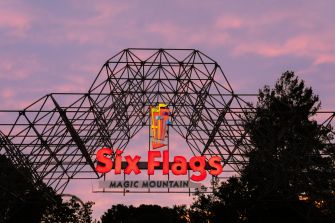
More than 100 people now allege they suffered brain injuries after riding X2 at Six Flags Magic Mountain, as three newly filed lawsuits intensify scrutiny of one of the Southern California park’s most recognizable roller coasters and raise broader questions about when amusement parks and ride manufacturers can be held liable for serious injuries.
The new cases allege catastrophic brain damage suffered by Pamela Guillen, Naomi Greer-Wilkinson and Michael Wick. Attorneys at Dordick Law Corporation say the firm has also been retained by more than 100 additional people who report varying degrees of brain injury after riding X2 and expects to file more lawsuits in the coming weeks. Those numbers are representations by plaintiffs’ counsel and have not been established in court.
Six Flags has declined to comment on the pending litigation. X2 has remained closed since the evening of July 12 while California regulators investigate the ride.
The allegations arrive after years of earlier litigation involving X2. A 2022 wrongful-death case brought by the family of Christopher Hawley was settled this summer for an undisclosed amount. Hawley, 22, had difficulty walking and later lost consciousness after riding X2; his family’s complaint cited a coroner’s finding that he died from blunt head trauma sustained in a “park ride accident.” A separate case alleges that Hilda Farias developed a brain bleed after riding X2 in 2010 and later died.
Two other cases remain particularly important because they could shape how courts evaluate the current wave of claims.
Sheila Katerelos alleges that she suffered a traumatic brain injury and multiple subdural hematomas after riding X2 in 2020. Her lawsuit included negligence, strict product liability, and negligent product liability claims against companies involved in designing and manufacturing the X2 ride vehicles. A California Court of Appeal revived those claims against S&S Worldwide and related defendants in February, finding factual disputes over whether X2 caused or contributed to her injuries and whether the ride was defectively designed.
The appeals court did not rule that X2 caused Katerelos’ injuries or that the ride was defective. It ruled that those questions could not be resolved against her as a matter of law before trial.
That distinction is likely to become central to the new lawsuits.
Plaintiffs suing an amusement park after a serious ride injury generally must do more than show that an injury happened shortly after riding. They must connect the injury to legally actionable conduct or a defective product and establish that the defendant’s conduct or product was a substantial factor in causing the harm.
In the Katerelos litigation, defense experts argued that X2’s acceleration forces were too low to cause a subdural hematoma or traumatic brain injury and that its headrest padding was adequate. The appellate court nevertheless concluded that the evidence left factual questions for trial, including testimony that Katerelos was violently thrown around, struck her head on the restraint system, and immediately experienced severe pain.
The same battle over causation is likely to dominate the new cases.
Guillen says she became disoriented after riding X2 on July 5, vomited, and lost consciousness before undergoing emergency surgery for a subdural hematoma and brain compression. Six days later, Greer-Wilkinson lost consciousness after riding X2 and underwent emergency brain surgery at the same hospital. Wick’s attorneys say he has required two brain surgeries and is no longer able to practice law because of his injuries.
Plaintiffs’ attorneys say doctors treating Guillen and Greer-Wilkinson attributed their injuries to rapid acceleration and deceleration during the ride. Whether that medical conclusion can establish legal causation will depend on expert testimony, ride data and other evidence developed through discovery.
California law gives injured roller-coaster riders several possible theories of liability, depending on what the evidence shows.
One is ordinary negligence: whether the park failed to use reasonable care in operating, inspecting, maintaining, or warning about the ride. But California law can impose an even higher duty on operators of roller coasters.
In Gomez v. Superior Court, the California Supreme Court held that operators of roller coasters and similar amusement rides can qualify as common carriers for reward. Under Civil Code section 2100, such carriers must use “the utmost care and diligence” for the safe carriage of passengers.
The reasoning is particularly significant for rides like X2 because passengers surrender control once the ride begins. The park determines the speed, drops, rotations, restraint system, and other movements while the rider is carried through the course.
Common-carrier status does not make an amusement park automatically liable whenever someone is injured. California courts have made clear that common carriers are not insurers of passenger safety. The heightened duty instead requires the degree of care, vigilance and foresight that can reasonably be exercised given the nature and operation of the ride.
The developing X2 litigation could therefore examine much more than whether the coaster passed a routine inspection on a particular morning. Plaintiffs may seek maintenance records, engineering data, prior accident reports, complaints from riders, medical incidents and evidence showing what Six Flags knew about earlier alleged injuries and when it knew it.
California’s permanent-amusement-ride regulations require owners and operators to maintain records of inspections, testing, repairs, accidents and certain other ride incidents for at least five years. Operators must also immediately report known accidents involving a death or serious injury to Cal/OSHA when the maintenance, operation or use of the ride caused the incident.
Cal/OSHA has authority to inspect permanent rides when it receives a reportable accident, learns of credible safety information or determines that a ride has a disproportionately high incidence of accidents compared with similar attractions. The agency may prohibit operation when it finds an imminent hazard or another unsafe condition.
The current investigation could become important evidence, although an agency investigation and a civil lawsuit serve different purposes. Cal/OSHA is examining ride safety and compliance with California regulations, while individual plaintiffs must prove the elements of their civil claims.
A proven violation of a safety regulation could also become relevant to a negligence case. California regulations establish minimum standards for the design, maintenance, operation, repair, and inspection of amusement rides and require operators to provide patrons with safety instructions, restrictions, and warnings considered necessary for safe use.
Another major legal issue is assumption of risk.
Riding a roller coaster obviously involves voluntarily accepting some level of speed, acceleration, drops, and physical movement. But California law does not necessarily treat every injury occurring during a recreational activity as a risk the participant has legally agreed to bear.
The California Supreme Court examined that doctrine in Nalwa v. Cedar Fair, involving a woman who broke her wrist on a bumper-car ride. The court held that primary assumption of risk can apply to amusement rides when an injury results from a risk inherent in the recreational activity. An operator generally has a limited duty in that context not to increase the danger beyond what is inherent in the activity.
The court also drew an important distinction between bumper cars and roller coasters.
Bumper-car riders control their own steering and decide when to accelerate and collide. Roller-coaster passengers do not. The California Supreme Court noted that roller-coaster riders surrender their freedom of movement to the operator, which is one reason the heightened common-carrier duty recognized in Gomez can apply.
That distinction could matter if Six Flags argues that X2 riders voluntarily accepted the forces inherent in an extreme coaster.
A rider may assume the ordinary sensations that make a roller coaster thrilling. The legal question becomes considerably different when a plaintiff alleges that a design defect, excessive force, inadequate head protection, improper maintenance or a known dangerous condition created risks beyond those reasonably inherent in riding the attraction.
Contractual assumption of risk creates a separate issue.
Six Flags’ current ticket terms, last updated August 5, 2026, contain broad language stating that visitors assume known and unknown risks associated with rides and attractions. The terms also include a release that purports, to the fullest extent allowed by law, to cover claims based on ordinary negligence, along with an arbitration agreement and class-action waiver.
Those provisions do not automatically determine the outcome of the pending X2 cases.
The first question in any individual case would be which version of the ticket terms applied when that rider purchased or used admission and whether a valid agreement was formed. The new July injuries occurred before the current August 5 version of the terms, so courts would need to examine the terms actually in effect for those riders rather than simply applying the current language.
California also places limits on liability releases.
The California Supreme Court has held that recreational releases can generally protect a provider against future claims of ordinary negligence under appropriate circumstances, but an agreement purporting to release future liability for gross negligence is unenforceable as a matter of public policy. Gross negligence involves an extreme departure from ordinary standards of conduct or a failure to exercise even slight care.
California Civil Code section 2175 separately provides that a common carrier cannot contract away liability for its own gross negligence, fraud, or willful wrongdoing.
Plaintiffs therefore may attempt to show conduct extending beyond an inherent ride risk or ordinary negligence, particularly if discovery uncovers evidence of prior similar injuries, unresolved design concerns or continued operation despite knowledge of a serious danger. Whether the facts support such an allegation remains to be proven.
Product liability provides another path, particularly against companies involved in designing and manufacturing X2’s trains, restraints, and head-protection systems.
California recognizes strict liability for defective products. A design can be considered defective when it fails to perform as safely as an ordinary consumer reasonably expects during an intended or reasonably foreseeable use, or when the risks created by the design outweigh its benefits under California’s risk-benefit test.
The Katerelos case shows how that theory could apply to X2.
Her complaint focused in part on the occupant restraint and headrest systems. The Court of Appeal held that S&S had not eliminated factual questions over whether those systems were defective, noting that the defendants had offered no evidence showing that the benefits of the challenged design outweighed its risks for purposes of the risk-benefit analysis.
Failure-to-warn claims could also arise if plaintiffs contend the manufacturer or operator knew, or should have known, about a particular danger that was not adequately communicated to riders.
California strict-liability law permits failure-to-warn claims for risks that were known or knowable based on the scientific and medical knowledge available when a product was manufactured or distributed. Those cases often turn on exactly when the risk became knowable and whether the warning provided was adequate.
The reported history of injuries could become particularly important to such claims.
The Los Angeles Times identified X2-related lawsuits involving Farias in 2010, Katerelos in 2020, Lucy Alvarez in 2021 and Hawley in 2022. CNN separately reported more than a dozen serious injuries and hospitalizations associated with X2 over nearly two decades.
A history of earlier complaints does not by itself establish that later injuries were caused by a defective ride. It can, however, become relevant to questions of notice, foreseeability, warnings and whether an operator responded reasonably to information it had received.
The Hawley settlement also carries limited legal significance on its own.
Six Flags and S&S Worldwide settled the family’s wrongful-death lawsuit without a trial and without an admission that X2 was defective or caused Hawley’s death. Settlements often reflect litigation risk, cost and uncertainty and do not amount to judicial findings of liability.
The same caution applies to the more than 100 newly reported injury claims.
Those riders’ allegations will have to be evaluated individually. Medical history, when symptoms began, the severity and type of injury, where each person sat on the train, the condition of the ride at the time and expert analysis of the forces involved could all affect causation.
The defendants are likely to emphasize how many people have ridden X2 without serious injury, compliance with industry standards, inspection records and medical or biomechanical evidence challenging the claim that normal operation can produce the alleged brain trauma. Defense experts have already made similar arguments in earlier litigation.
Plaintiffs, meanwhile, are likely to focus on patterns.
If a large number of medically documented brain injuries can be linked to similar forces, seating conditions or components, the cases could begin to move beyond isolated accident claims and toward a broader challenge to X2’s design or continued operation.
X2 is an unusual coaster even by thrill-ride standards. Its seats rotate independently of the track, turning riders forward and backward as the train moves through large drops and other elements. That design can make questions involving acceleration, head movement and restraint performance especially dependent on engineering and medical testimony.
The state investigation remains open, and Six Flags has not announced when or whether X2 will reopen. California regulations allow Cal/OSHA to keep a ride out of operation when an inspection identifies an unsafe condition requiring correction.
The new lawsuits will now proceed separately from that regulatory review.
For Six Flags, the cases could test how far assumption-of-risk language and recreational releases protect an amusement park when riders allege injuries far more severe than the ordinary physical effects people expect from a roller coaster.
For manufacturers, the litigation could put the design of the X2 trains, restraints and head-protection systems under renewed scrutiny through California product-liability law.
And for the injured riders, the central question will ultimately be one of proof: whether they can establish that X2 caused their brain injuries and that the harm resulted from negligence, a defective product, inadequate warnings or another legally actionable condition rather than an inherent risk of riding an extreme roller coaster.
With three new lawsuits already filed, more than 100 additional clients represented by plaintiffs’ counsel and a state investigation still underway, X2 could become one of the most consequential amusement-ride liability disputes California has seen in years.