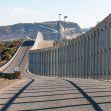
The U.S. Supreme Court cleared the way Thursday for the Trump administration to potentially revive an asylum policy that limited how many migrants could be processed each day at the U.S.-Mexico border, ruling that people stopped on the Mexico side of a port of entry have not yet “arrived in the United States” under federal immigration law.
The 6-to-3 decision in Mullin v. Al Otro Lado overturned a lower court ruling that had blocked the practice, known as metering. The policy was used under the Obama administration and expanded during President Donald Trump’s first term as border officials faced rising numbers of asylum seekers.
Metering allows federal agents to turn away migrants at official border crossings when officials say a port lacks capacity to process more people that day. Migrants who are turned away may be told to wait in Mexico and return later.
At the center of the case was not whether asylum remains available under federal law, but when the legal right to seek it begins. Federal law allows a noncitizen who is physically present in the United States or who arrives in the United States to apply for asylum. The court’s majority said that language does not cover a person standing in Mexico who has not crossed the border.
Justice Samuel Alito, writing for the majority, said an individual “arrives in the United States” only after crossing into the country. Under that reading, the Immigration and Nationality Act does not require immigration officers to inspect a person who remains on the Mexico side of the border, even if the person is seeking asylum at an official port of entry.
The case began in 2017, when asylum seekers and Al Otro Lado, an immigrant advocacy organization, sued the federal government in the Southern District of California. The challengers claimed that Customs and Border Protection unlawfully denied inspection and asylum processing to people who came to ports of entry along the southern border seeking protection.
A federal district judge sided with the challengers, and the Ninth Circuit later affirmed key parts of that ruling. The appeals court concluded that a person could be treated as having arrived in the United States for asylum purposes when the person was standing on the Mexico side of the border and encountered a U.S. official at a port of entry.
The Supreme Court rejected that interpretation. The majority said Congress could have written the law to cover people who arrive near the border or attempt to enter, but instead used language tied to arrival in the United States.
The lawsuit relied heavily on the Immigration and Nationality Act, the federal law that governs asylum and inspection at the border. The challengers also argued that the government’s conduct violated the Administrative Procedure Act, which allows courts to review certain federal agency actions, and due process principles under the Fifth Amendment. Their broader claim was that border officials could not avoid asylum duties by physically stopping people before they stepped into the country.
The administration argued that metering was a lawful border management tool, not a denial of asylum. Federal attorneys said people turned away at ports of entry could return later and that the law did not require officers to process someone who had not crossed into U.S. territory.
Advocacy groups said the policy had a different effect on the ground. They argued that metering forced thousands of migrants to wait for days, weeks or months in Mexico, often in unsafe makeshift camps near border crossings. During earlier use of the policy, long waitlists developed at several ports of entry along the southern border.
The ruling gives the federal government more room to control access to the first step of asylum processing at ports of entry.
Justice Sonia Sotomayor dissented, joined by the court’s other liberal justices. The dissent argued that the majority’s reading weakens protections Congress created for people who seek refuge at the border and gives officials a way to prevent asylum seekers from reaching the process at all.
The decision came during a term in which the Supreme Court considered several major immigration disputes involving presidential authority, border control and humanitarian protections. On the same day, the court also allowed the administration to end deportation protections for some migrants fleeing instability and armed conflict.
Metering is not currently in place. DHS has not announced whether it will revive the policy following the Supreme Court’s decision.