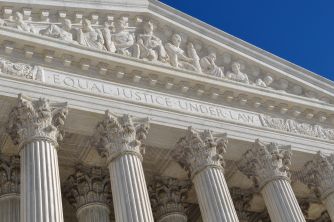
The U.S. Supreme Court ruled June 25 that federal courts cannot hear most legal challenges to the Trump administration’s decision to end Temporary Protected Status for immigrants from Haiti and Syria, a decision that narrows the path for TPS holders seeking to keep the humanitarian program in place during litigation.
The 6-to-3 decision reversed lower court orders from New York and Washington, D.C., that had paused the terminations while lawsuits moved forward. Haitian and Syrian nationals brought the cases after the Department of Homeland Security moved to end protections that allow qualifying immigrants to live and work legally in the United States when their home countries are deemed unsafe for return.
Justice Samuel Alito wrote the opinion for the Court. Chief Justice John Roberts and Justices Clarence Thomas, Neil Gorsuch, Brett Kavanaugh and Amy Coney Barrett joined the main portions of the ruling. Justice Elena Kagan dissented, joined by Justices Sonia Sotomayor and Ketanji Brown Jackson.
Temporary Protected Status, known as TPS, was created by Congress in 1990 for people already in the United States who cannot safely return to their home countries because of armed conflict, natural disaster or other extraordinary conditions. Once a country is designated for TPS, qualifying nationals may receive protection from removal and work authorization.
Syria was designated for TPS in 2012 amid the country’s civil war and violence under Bashar al-Assad’s regime. The Department of Homeland Security announced in September 2025 that Syria’s designation would end after concluding that conditions had changed, including the fall of the Assad government and the creation of a transitional government.
Haiti received TPS in 2010 after a catastrophic earthquake. The government later extended and redesignated Haiti for TPS, citing violence, human rights abuses, poverty, health care concerns and food insecurity. In November 2025, the department announced that Haiti’s designation would end on Feb. 3, 2026.
Syrian nationals sued in the Southern District of New York, arguing under the Administrative Procedure Act that the government’s decision was unlawful. Haitian nationals sued in federal court in Washington, D.C., raising similar administrative law claims and an equal protection claim that argued the Haiti termination was motivated by race.
Lower courts sided with the challengers at an early stage and put the terminations on hold. The Supreme Court said those orders should not have been issued.
The central legal issue was whether courts can review the way the Department of Homeland Security ends a country’s TPS designation. The TPS statute says there is “no judicial review” of any determination by the Homeland Security secretary with respect to the designation, termination or extension of TPS for a foreign country.
Alito wrote that the word “determination” can refer to a final decision or to the process that leads to one. Under either reading, the Court said, the law bars the challengers’ nonconstitutional claims, including arguments that the secretary did not properly consult other agencies or failed to follow required procedures.
That part of the ruling limits the role of federal courts in reviewing TPS decisions. The Court said Congress chose a different rule for TPS terminations by writing a review bar into the statute. The Justices also considered the Haiti equal protection claim and found that it was unlikely to succeed.
The Haitian nationals argued that the termination of Haiti’s TPS designation was tied to race, citing statements by President Donald Trump and former Homeland Security Secretary Kristi Noem. The Court assumed, without deciding, that the challengers could use a heightened equal protection standard that asks whether race was a motivating factor in the government’s decision.
Alito wrote that the cited statements were not overtly racial and could be understood as reflecting race-neutral views about immigration policy, TPS and conditions in countries covered by the program. The Court also pointed to the administration’s broader approach, noting that the government had terminated every TPS designation that came up for renewal under its policy.
Justice Kagan sharply disagreed. In dissent, she wrote that the challengers were likely to succeed on their administrative law claims because the government did not properly consult other agencies about country conditions before ending TPS. She also wrote that the Haiti challengers had shown enough evidence that race played a role in the decision to justify keeping the lower court order in place while the case continued.
Kagan said the decision could uproot hundreds of thousands of people who have lived and worked in the United States under TPS. The dissent also pointed to the loss of work authorization and protection from removal as immediate consequences for affected immigrants.
Justice Thomas wrote separately to say he would go further than the Court. In his view, the TPS statute also bars review of the equal protection claim. He also questioned whether noncitizens can bring that type of equal protection challenge against the federal government in an immigration status dispute.
The Supreme Court reversed the judgments of the U.S. District Court for the Southern District of New York and the U.S. District Court for the District of Columbia. The cases were remanded for further proceedings consistent with the opinion.