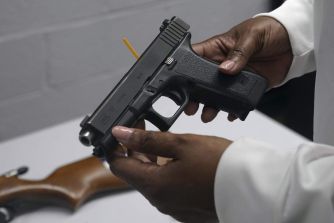
On June 23, 2022, the United States Supreme Court issued a landmark ruling significantly expanding individual gun ownership and carry rights, while severely limiting the authority of states to regulate firearms possession. According to the Court, the U.S. Constitution grants Americans the right to carry firearms in public for self-defense. States lack the authority to condition gun ownership on a specific “need” or “cause.” The decision came on the heels of a number of high-profile mass shootings, an epidemic which has continued in the weeks since.
The Supreme Court’s opinion in New York State Rifle & Pistol Association Inc. v. Bruen arose in response to New York State’s concealed carry laws. New York prohibits possession of a firearm without a license. To carry a concealed or loaded firearm outside of the home, New Yorkers must apply for a license. Existing law required the applicant to demonstrate they had “proper cause” for the need to carry outside the home, which required demonstrating “a special need for self-protection distinguishable from that of the general community.”
In a 6-3 decision split along ideological lines, the Court ruled that the “proper cause” requirement violated the Second and Fourteenth Amendments to the Constitution by infringing on the “right to keep and bear arms in public for self-defense.” Bruen represents the first time the Court has declared a constitutional right to carry a gun outside the home, following a landmark 2008 decision safeguarding the right to possess a firearm at home. Justice Thomas penned the opinion, writing: “We know of no other constitutional right that an individual may exercise only after demonstrating to government officers some special need.”
States with an agenda toward limiting gun violence have been quick to respond to the ruling. New York amended the now-invalid licensing scheme to remove the “proper cause” requirement, but added a number of additional provisions creating enhanced scrutiny at the application phase. Applicants for a carry permit must now meet with a licensing officer, presenting their social media accounts and character references. Guns are still prohibited in designated “sensitive spaces.”
California enacted a number of major gun control measures, including establishment of a “firearm industry standard of conduct,” limitations on firearm advertising to minors, and additional restrictions on ghost guns. California also established a right of action for gun violence survivors and the state to sue for violation of sales and marketing regulations. State lawmakers are working on a revised permit law, as legal experts assume that the existing “good cause” restriction would be ruled unconstitutional per Bruen.
Even the embattled Congress has found a pathway to passing legislation in the wake of abhorrent gun violence in Buffalo, New York, and Uvalde, Texas. On the same day as the high Court’s ruling, the Senate passed the most far-reaching federal gun bill in decades, with 15 Republicans joining their colleagues across the aisle. Although much milder than legislation Democrats and gun violence activists have sought for years, the Bipartisan Safer Communities Act is nevertheless an important step toward sensible gun control. If passed by the House, the law would strengthen background checks, limit sales to domestic violence perpetrators, and establish red flag laws permitting authorities to confiscate weapons from individuals determined to be dangerous.