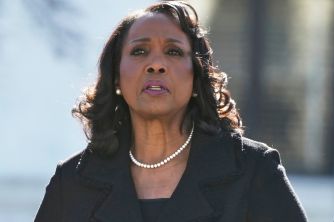
The Supreme Court on Monday gave presidents broader power to fire leaders of independent federal agencies, but drew a major line around the Federal Reserve, allowing Governor Lisa Cook to remain in office while she challenges President Donald Trump’s attempt to remove her.
The Court’s broader decision weakens long-standing job protections for many independent regulatory officials, a major shift in how much control the White House can exert over federal boards created by Congress to operate with some distance from direct political pressure.
Cook, who was appointed to the Federal Reserve Board in 2022 and later confirmed to a full 14-year term, became the first governor in the central bank’s 111-year history to face removal by a president. Her term was set to run until 2038.
The dispute began in August 2025, after Federal Housing Finance Agency Director William Pulte accused Cook of mortgage fraud in a letter posted on social media. The allegations centered on claims that Cook had identified two homes as her principal residence in mortgage documents. Cook has denied the allegations.
Trump later sent Cook a letter stating that he had reason to believe she may have made false statements on mortgage agreements and that he lacked confidence in her integrity. Cook sued, arguing that the attempted firing was not allowed under the Federal Reserve Act and that she was not given proper notice or a chance to respond before the president tried to remove her.
Chief Justice John Roberts, writing for the Court, said the administration had not shown that it was likely to win on the legal arguments it raised in seeking to remove Cook immediately. The Court denied the government’s request to pause the lower court order that kept Cook in office.
The case turned on a phrase in the Federal Reserve Act that allows governors to be removed only “for cause.” That language does not make a Fed governor impossible to remove. It means the president must have a legally valid reason, not just a policy disagreement or a desire to install someone else.
The Court said “cause” must carry real limits when applied to the Federal Reserve because Congress gave governors long, staggered terms to protect the central bank from political influence. The majority said the standard depends partly on the seriousness of the alleged misconduct and whether it is connected to the governor’s duties. The Court did not decide whether the mortgage allegations against Cook, if proven, would be enough to remove her.
Roberts wrote that accepting the government’s position would effectively turn the Fed’s for-cause protection into at-will employment. At-will workers can generally be fired for almost any reason, while for-cause officials are protected unless the stated reason meets a legal threshold.
The Court resolved the immediate dispute on narrower grounds. It held that Cook was entitled to at least some explanation of the evidence against her, a way to answer the allegations, and a deadline for her response before a final removal decision. A formal trial was not required, the Court said, but the process used against Cook was not enough.
Cook remains on the Board of Governors because the president tried to remove her without giving her the basic procedural steps the Court said the statute requires.
The broader agency ruling came in a separate case involving former Federal Trade Commission member Rebecca Slaughter, whom Trump removed without citing inefficiency, neglect of duty, or malfeasance in office, the standard listed in federal law. In that case, the Court largely overruled the 1935 precedent known as Humphrey’s Executor, which had helped shield some independent agency officials from direct removal by the president.
For nearly a century, Humphrey’s Executor supported the idea that Congress could create certain independent agencies whose leaders did not serve entirely at the president’s pleasure. Agencies such as the FTC, the National Labor Relations Board, the Merit Systems Protection Board, and the Consumer Product Safety Commission were built around versions of that model. Monday’s ruling sharply limits that protection for agencies that exercise executive power, while leaving the Federal Reserve in a separate category.
The Federal Reserve received different treatment because of its role in the national economy. The Court described the central bank as part of a long tradition of keeping monetary policy, including interest-rate decisions, separated from day-to-day political pressure. The majority said both the fact of independence and the appearance of independence are important to the Fed’s design.
Justice Brett Kavanaugh, who joined the majority, wrote separately to stress that the Court should not leave uncertainty around whether the Federal Reserve may remain independent after the broader agency ruling. Temporary doubt over that question, he said, could create confusion over whether the president could immediately remove multiple governors and could unsettle the U.S. and world economies.
In Cook’s case, Justice Ketanji Brown Jackson also joined the majority and wrote separately to emphasize the public interest in keeping the Fed insulated from political pressure while the case proceeds. She said the government had not shown a concrete injury from Cook remaining in office during the litigation.
The dissents showed deep disagreement over the Court’s handling of the case and the president’s removal authority. Justice Clarence Thomas argued that the alleged mortgage fraud was enough cause for removal, that the Federal Reserve Act does not require notice or a hearing, and that limits on the president’s power to remove executive officers violate Article II of the Constitution.
Justice Samuel Alito, joined by Justice Neil Gorsuch, said the Court should not have decided difficult legal questions at such an early stage of the case. Justice Amy Coney Barrett also dissented, warning that the Court had reached major conclusions about the Federal Reserve’s constitutional status even though the administration did not challenge the Fed’s removal protections in this case.
The Supreme Court denied the administration’s stay request, preserving the lower court order blocking Cook’s removal while the lawsuit continues.