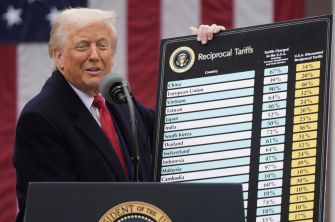
The Supreme Court is expected to rule as soon as Friday, January 9, on whether President Donald Trump had the power to impose sweeping, across-the-board tariffs by invoking a national-emergency statute typically used for sanctions and other economic restrictions. The decision could reshape how future presidents use emergency authorities to control trade and could trigger a sprawling battle over refunds that trade lawyers and importers say may take years to unwind.
At the center of the case is the International Emergency Economic Powers Act of 1977, or IEEPA. The Trump administration relied on that law to justify broad tariffs tied to declared emergencies, including measures linked to the southern border and drug trafficking, as well as “reciprocal” tariffs framed as a response to persistent trade deficits.
Lower courts rejected that approach, concluding IEEPA did not authorize tariffs of this kind. The U.S. Court of Appeals for the Federal Circuit affirmed a decision setting aside multiple executive orders that imposed tariffs “of unlimited duration” on imports from “nearly every country,” holding that IEEPA’s authority to “regulate” imports did not amount to authority to impose tariffs.
The Supreme Court agreed to take up the dispute on an expedited schedule. In the government’s petition, the administration framed the questions broadly: whether IEEPA authorizes the tariffs at all, and if it does, whether that reading would raise a constitutional problem by delegating Congress’s tariff-setting power too loosely to the president.
The stakes extend beyond trade policy. Analysts and market observers have warned that a ruling striking down the tariffs could force the government to confront refund demands that, in the aggregate, could reach into the hundreds of billions of dollars, while also injecting new uncertainty into how the executive branch can respond quickly to economic and foreign-policy shocks.
The underlying tariff program began soon after Trump returned to office on January 20, 2025, according to a detailed account in litigation at the U.S. Court of International Trade. That court described a sequence of emergency declarations and tariff actions, including an April 2, 2025, order imposing a general 10% duty on “all imports from all trading partners,” with higher rates slated for dozens of countries, alongside other measures tied to border and trafficking-related declarations.
The legal question is whether IEEPA, which allows a president, after declaring a national emergency based on an “unusual and extraordinary threat” with a substantial foreign source, to “regulate” a range of international economic transactions, includes the authority to impose tariffs. The Federal Circuit concluded it does not, emphasizing that when Congress intends to authorize tariff-setting, it typically does so explicitly, using terms like “duties,” and often pairing that authority with procedural and substantive limits.
If the Supreme Court agrees with the lower courts, attention will quickly turn to remedies. U.S. Customs and Border Protection has reported that more than $133.5 billion in IEEPA-related tariff collections were potentially exposed to refunds as of mid-December 2025, depending on how the Supreme Court rules and what it says about repayment.
Trade attorneys and customs specialists say even a clear loss for the government would not automatically translate into quick checks for companies. Importers often must preserve refund claims through protests, litigation, or other procedural steps, and any repayment system would likely be strained by the volume and complexity of entries. Reuters has reported that some companies have already filed lawsuits to protect their positions and that, in some cases, businesses have explored selling potential refund rights to investors to avoid waiting out a long administrative process.
A decision upholding the tariffs, however, would also carry consequences. It could cement a reading of IEEPA that critics argue would allow presidents to impose broad economic measures without the kind of tailored findings and time limits found in more traditional tariff statutes. That prospect has drawn scrutiny across ideological lines, with the Supreme Court hearing arguments over whether a sanctions-focused statute should be read as a general-purpose tariff tool, an issue that could outlast any one administration.
The dispute also sits alongside a larger, recurring fight over the separation of powers in trade. The Constitution gives Congress authority over tariffs, but modern trade law includes multiple delegations of limited tariff authority to the president under specific conditions. The administration itself pointed to those delegations in its filings, including national-security tariffs under Section 232 and retaliation tools under Section 301, while opponents argue that those frameworks underscore why IEEPA should not be stretched to cover generalized tariffs.
Whatever the Supreme Court does, it may not end the tariff story. Even supporters of invalidation have acknowledged that the White House could attempt to reimpose some tariffs through different statutory routes, though those alternatives often require more process, more tailoring, and, crucially, a clearer tie to Congress’s chosen framework.
For businesses, the practical reality is that the ruling is likely to be only the first step. If tariffs fall, companies may face a long and technical sprint to document payments, preserve claims, and navigate whatever refund process emerges. If the tariffs stand, importers may have to plan for continued volatility in trade policy and for the possibility that presidents of either party will view emergency economic statutes as a ready-made lever for broad trade action.