In a landmark ruling, the Supreme Court has reversed a New York gun law, enabling citizens to carry a concealed weapon without seeking approval first.
The ruling overturns a New York law that details that citizens who want to carry around their concealed firearm would have to provide law enforcement with a reason or “proper cause” proving that they need the firearm for their personal safety.
The High Court's ruling struck down this New York law and will have implications for five other states that have similar legislation. While only half a dozen states will be impacted by the Supreme Court's decision, the populations of these states account for 1/4 of the entire U.S. population.
This landmark ruling is the first major gun decision in over 10 years by the court. The 6-3 conservative majority ruling comes at a time when the national debate about gun control and gun safety has been more divisive than ever.
Conservative Justice Clarence Thomas wrote for the majority detailing that the Constitution protects “an individual’s right to carry a handgun for self-defense outside the home.” Referencing the Constitution’s second amendment, Thomas writes, “We know of no other constitutional right that an individual may exercise only after demonstrating to government officers some special need.”
Justice Stephen Breyer shared in his dissent the implications of gun violence. He wrote that since the start of the year “there have already been 277 reported mass shootings — an average of more than once per day.” He pushed back against the conservative majority accusing them of not “considering the potentially deadly consequences” of their decision. He added that the decision would “severely” burden states in their efforts to pass legislation that would “limit, in various ways, who may purchase, carry, or use firearms of different kinds.”
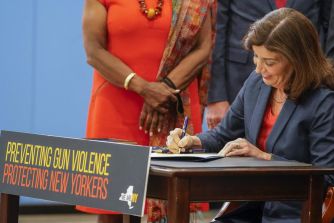
Unsurprisingly, lawmakers in New York have responded with disappointment about the measure. Democratic Governor of New York Kathy Hochul shares that the ruling is ill-timed considering the recent mass shooting at a Buffalo supermarket that claimed the lives of 10 individuals. “This decision isn’t just reckless. It’s reprehensible. It’s not what New Yorkers want,” she shares.
The High Court's decision will impact states including Hawaii, California, Maryland, Massachusetts, and Rhode Island. These states have similar legislation in place that requires individuals to provide a reason in order to obtain a concealed carry permit. New states will now have to amend these laws as they are expected to be challenged.
The High Court's decision comes after the U.S. Senate passed its own highly anticipated decision about gun reform. In a gun violence bill that has had bipartisan support, lawmakers have agreed to tighten restrictions on firearms. While the measure does not satisfy some of the major demands made by gun reform advocates, the measure will implement stricter background checks for younger individuals who are looking to purchase a firearm and creates restrictions for domestic violence offenders who are trying to obtain a firearm. The bill also addresses the efforts of states to implement red flag laws which could help prevent mass shootings throughout the nation. Funding for school safety, violence prevention, and mental health is also addressed in the bill. The measure will now go in front of Congress for final approval.
The Supreme Court's decision to move in the opposite direction of the federal government has disappointed gun safety activists, lawmakers, and other organizations who have continuously called for tighter gun restrictions in order to prevent horrific incidents like the recent Uvalde, Texas, elementary school shooting and the racially-motivated supermarket shooting in Buffalo, New York.