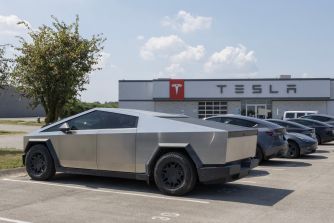
Tesla CEO Elon Musk announced Friday, November 6, 2026, that the company will wind down Cybertruck production at its Texas factory around mid-2027, shifting manufacturing capacity to its Cybercab robotaxi after the electric pickup struggled with declining sales, repeated safety recalls, and lawsuits over alleged design defects.
Musk said the move would free production capacity for the Cybercab, a two-seat autonomous vehicle central to Tesla's robotaxi plans. The announcement leaves open whether Cybertruck manufacturing will move to another facility or end entirely. Tesla's Austin plant is currently its only known production site for the pickup.
The decision follows a steep decline in demand for a vehicle Musk once expected to sell at a rate of 250,000 units annually. Tesla sold approximately 20,237 Cybertrucks in the United States in 2025, down 48% from 38,965 the previous year. Sales fell another 28% during the first nine months of 2026.
Cybertruck deliveries began in November 2023, four years after Musk unveiled the pickup and following repeated production delays. Since its launch, the vehicle has faced 11 recalls involving accelerator pedals, exterior body panels, lighting systems and braking components.
In March 2025, Tesla recalled 46,096 Cybertrucks because a stainless-steel exterior panel could detach while the vehicle was moving, creating a hazard for other drivers. Another recall in April 2026 affected 173 pickups after the company identified brake rotor defects that could cause wheel studs to separate, increasing the risk of losing vehicle control.
Families of two college students killed in a November 2024 Cybertruck crash in Piedmont, California, sued Tesla, alleging that defective electronic doors prevented their children from escaping as the vehicle burned.
The crash killed three people and seriously injured a fourth after the pickup struck a tree and caught fire. Investigators identified speeding and driver impairment as factors in the collision, while the families' lawsuits separately challenge whether the vehicle's doors and emergency escape mechanisms contributed to the deaths.
Jordan Miller, the only survivor, added Tesla to his lawsuit in March 2026, alleging that a loss of electrical power rendered the doors inoperable. His complaint states that a friend broke a window to pull him from the burning pickup. Miller suffered severe burns, spinal fractures and other injuries.
The lawsuits seek to hold Tesla responsible for alleged design defects that contributed to the injuries and deaths. Under federal vehicle safety law, automakers must continue providing required remedies for recalled vehicles already sold, even after production ends.
Tesla's shift toward Cybercab production also comes amid federal scrutiny of its autonomous vehicle program.
In September, the National Highway Traffic Safety Administration opened an investigation into Tesla's certification of the Cybercab after the company began deploying the driverless vehicle commercially in Austin.
Regulators are examining how Tesla determined that the robotaxi, which operates without conventional driver controls, complies with federal safety standards, including whether the automaker properly evaluated requirements that normally apply to vehicles equipped for human drivers.