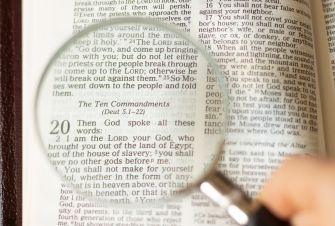
Texas’s law requiring Ten Commandments displays in public school classrooms faces a new state court challenge, with three Houston parents arguing that the mandate violates Texas religious freedom law and a voter-approved constitutional protection for parental rights.
Emily Roth, Audrey Rosa Nath and Sanjam Kaur Sohal filed the case in Harris County and are seeking an order removing the displays before classes begin in mid-August. The lawsuit shifts the legal fight over Senate Bill 10 from the U.S. Constitution to protections created under Texas law.
Senate Bill 10 requires every public elementary and secondary school classroom in the state to display a copy of the Ten Commandments. Each poster must be at least 16 by 20 inches, placed where students can easily see it and use the exact wording selected by lawmakers.
Classroom displays must be accepted when a compliant copy is donated, and school districts may use public funds to purchase them. The law does not require teachers to discuss the commandments or students to read or recite them.
The Houston families claim that the state-selected version places government support behind one religious message and interferes with how parents guide their children’s beliefs. Roth is raising her children without religion. Nath’s family includes Jain, Hindu, Jewish, and Quaker traditions, while Sohal is Sikh.
Religious traditions do not all number, translate, or interpret the Ten Commandments in the same way. Senate Bill 10 uses wording associated with the King James Bible tradition, which the challengers argue does not represent the beliefs of many students who must see it throughout the school day.
Roth has said the requirement signals that some religious views receive greater recognition in public schools than others. Megan Hassan, an attorney representing the families, said the parents want their children to attend class without a state-required religious message that conflicts with their faith or nonreligious upbringing.
One claim relies on the Texas Religious Freedom Restoration Act, which lawmakers passed in 1999. The law restricts government actions that place a substantial burden on a person’s religious exercise.
A conflict with government policy is not always enough to establish a violation. The families must show that the classroom requirement seriously interferes with their ability to practice their beliefs or direct the religious upbringing of their children.
If they establish a substantial burden, the state must prove that applying the display requirement serves a compelling public interest and is the least restrictive way to achieve that goal. Known as strict scrutiny, the standard gives the government a higher burden when its actions interfere with protected religious practices.
State lawyers have argued that Senate Bill 10 does not pressure students to worship or adopt a particular faith. Their position is that a poster is a passive display because students do not have to pray, recite the commandments, or accept their teachings.
The Houston challenge argues that the effect of a permanent classroom display cannot be measured only by whether students are ordered to participate. The families claim that requiring the text in every classroom gives one religious tradition official approval and places a conflicting message before children each school day.
Another claim is based on Proposition 15, a parental rights amendment approved by Texas voters in 2025. The amendment added language to the state Constitution recognizing a parent’s fundamental right to care for a child and make decisions concerning the child’s upbringing.
The provision does not give parents control over every book, lesson or display in a public school. The lawsuit instead asks whether the state interferes with that protected role when it requires schools to place a religious text in classrooms despite a family’s different beliefs.
Because the amendment is new, Texas courts have provided little guidance on how it applies to public education. The Harris County case asks the court to determine whether the right to direct a child’s upbringing includes protection from a state-mandated religious display.
The state-law claims distinguish the case from an earlier federal challenge to Senate Bill 10. Sixteen families sued 11 school districts in July 2025, arguing that the mandate violated the First Amendment’s protections against government establishment of religion and interference with religious exercise.
U.S. District Judge Fred Biery blocked the law in those districts the following month. A federal appeals court reversed that decision this spring and allowed Texas to enforce the classroom requirement.
The 5th U.S. Circuit Court of Appeals found that the displays did not violate the federal Constitution because students were not required to read, discuss or follow the commandments. The court also cleared the way for a similar classroom display law in Louisiana.
That ruling does not decide whether Senate Bill 10 complies with separate protections under Texas law. The Harris County court must consider the state religious freedom statute and parental rights amendment, although the effect of a passive classroom display remains central to both disputes.
Texas Attorney General Ken Paxton has defended the mandate as recognition of the Ten Commandments’ place in American history and tradition. Lawyers for the state have maintained that displaying the text is different from teaching it and does not require students to observe its religious commands.
The challengers are seeking an order blocking the displays before the 2026 school year begins.