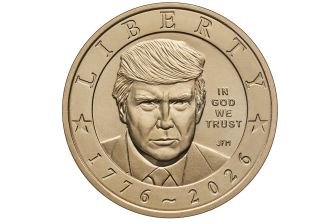
The U.S. Mint began selling new $1 coins bearing President Donald Trump’s portrait Wednesday, putting the image of a sitting president on legal tender as questions persist over how federal restrictions on living people appearing on U.S. money apply to the design.
The Trump coins went on sale September 2 as part of the nation’s 250th anniversary. Rolls of 25 are priced at $61, while bags containing 100 cost $154.50.
Trump appears on the front alongside the inscriptions “LIBERTY,” “IN GOD WE TRUST” and “1776 ~ 2026.” The back features the Presidential Seal and the words “UNITED STATES OF AMERICA” and “ONE DOLLAR.”
Trump’s portrait on the commemorative coin has drawn scrutiny because two federal laws address whose portraits may appear on U.S. money.
Congress authorized the anniversary designs through the Circulating Collectible Coin Redesign Act of 2020. That law bars portraits of living people from the back of coins created under the program but does not impose the same restriction on the front, where the Mint placed Trump.
Another federal law, 31 U.S.C. § 5114, says only the portrait of a deceased person may appear on U.S. “currency and securities.” The provision is part of a section dealing with the engraving and printing of currency and security documents, and no court has decided whether that restriction also bars Trump from appearing on a coin.
A legal challenge involving a different Trump coin reached federal court earlier this year.
Oregon coin collector James Rickher sued Treasury Secretary Scott Bessent and a U.S. Mint official in March over plans for a separate 24-karat gold coin featuring Trump. He argued that depicting a living president violated federal law and asked a judge to block the government from producing it.
U.S. District Judge Karin Immergut denied the request in June after finding that Rickher had not shown he would personally suffer the type of harm required to bring the challenge. Her ruling did not decide whether putting Trump on the proposed coin violated federal law.
Rickher later dismissed the case. Rickher’s case involved a nearly 20-ounce gold coin rather than the $1 version released Wednesday, but his lawsuit relied on the same federal restriction involving portraits of living people.
Treasury officials have also cited President Calvin Coolidge as a historical precedent. Coolidge appeared on a commemorative half dollar in 1926 while still in office, decades before the federal laws now governing the issue were enacted.
Despite their gold-colored appearance, the new Trump dollars contain no gold. The Mint says they are made mostly of copper, with smaller amounts of zinc, manganese and nickel.
Each has a face value of $1 and may be used as legal tender, although the rolls and bags are being marketed to collectors for more than their combined face value.
Production took place at the Philadelphia Mint. Another 250,000 coins struck there on July 4 carry a special “July 4th” mark and are being randomly mixed into rolls and bags offered for sale.