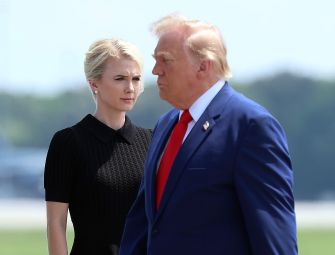
President Donald Trump gave Natalie Harp and two other White House aides $45,000 each in personal cash gifts, according to newly released financial disclosures, drawing scrutiny under a federal law that restricts private payments to government employees for their official work.
Harp, communications adviser Margo Martin and White House aide Chamberlain Harris each disclosed receiving $45,000 from Trump. All three earn $150,000 a year, making each gift equal to 30 percent of the recipient's annual government salary.
Walt Nauta, Trump's director of Oval Office operations, reported receiving a separate $20,000 gift from the president. He earns $175,000 annually.
The disclosures described the payments as "Cash Gift for Holidays."
A White House official said Trump has a longstanding practice of giving Christmas gifts to people close to him, including employees in his private businesses and government. The official said the payments were personal gifts, unrelated to the recipients' official duties and permitted under federal law and ethics rules.
Federal ethics rules do not generally bar a superior from giving a personal gift to a subordinate. The Office of Government Ethics clarified in 2024 that restrictions governing gifts between federal employees do not prohibit gifts flowing from a higher-paid superior to a subordinate employee.
A separate federal law can become an issue, however, if the money is tied to the employee's government work.
Section 209 of Title 18 bars executive branch employees from receiving private money as compensation for federal service. It covers payments that serve as a salary, contribution to salary, or supplement to government compensation.
The amount of the gifts alone would not determine whether Section 209 applies. The central issue is whether Trump gave the money as personal gifts or as compensation connected to the aides’ White House work.
The Office of Government Ethics has specifically warned that a supervisor who gives a subordinate a gift for performing official duties can raise concerns under Section 209. Past Justice Department guidance has similarly focused on what motivated a payment when determining whether it amounts to compensation for government service.
Richard Painter, who served as the White House's chief ethics lawyer under President George W. Bush, has said the size and circumstances of Trump's gifts raise concerns under the law. Painter argued that the payments effectively made it easier for the aides to remain in government service.
Don Fox, a former acting director of the U.S. Office of Government Ethics, has taken a different view. He said the information currently available does not show that the money was compensation for federal work, a connection required for Section 209 to apply.
Federal law can reach both an employee who accepts an unlawful salary supplement and the person who provides it. Violations can carry criminal and civil penalties, though no enforcement action related to Trump's gifts has been announced.
The size of the payments has also stood out to government ethics experts. Some said they were unaware of another president personally giving subordinate White House employees cash gifts on a comparable scale.
Harp is one of Trump's most visible aides and frequently accompanies him at White House events and during travel. She has become known for carrying a portable printer used to give the president hard copies of news stories, social media posts, and other material.
Martin serves as a special assistant to the president and communications adviser. Harris is a special assistant to the president, deputy director of Oval Office operations and executive assistant.
Whether Section 209 applies would ultimately turn on why Trump gave the aides the money and whether the payments were connected to their government service.