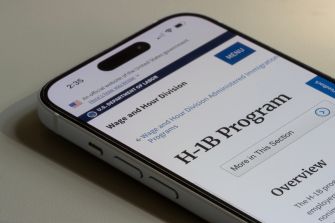
The Trump administration is proposing to eliminate a rule that gives many H-1B visa holders up to 60 days to remain in the United States after losing their jobs, potentially forcing thousands of foreign workers and their families to make immigration decisions almost immediately after employment ends.
The Department of Homeland Security unveiled the proposed regulation Thursday. It would remove the 60-day grace period available to workers in several employment-based nonimmigrant classifications, including H-1B visas widely used by technology companies and other employers seeking highly skilled workers.
The proposal is scheduled for publication in the Federal Register on September 11 and will then enter a 60-day public comment period. The current grace period remains in effect while the rulemaking process continues.
If the regulation is finalized as proposed, covered workers would generally begin failing to maintain their immigration status the day after their qualifying employment ends unless they have another legal basis to remain in the United States.
The Current Rule Gives Workers Time After a Job Loss
Since 2017, federal regulations have allowed certain employment-based visa holders whose jobs end before their authorized stay expires to remain in the country for up to 60 consecutive days, or until their existing authorized period ends, whichever comes first.
The rule covers H-1B workers along with people holding E-1, E-2, E-3, H-1B1, L-1, O-1, and TN status. Their dependent family members can also benefit from the grace period.
The protection is discretionary, not guaranteed. USCIS can shorten or eliminate the period based on circumstances including immigration-status violations, unauthorized employment, fraud, national-security concerns, or criminal convictions.
For workers who receive the full period, the time can be critical. A person who loses a job can use the window to pursue employment with another qualifying employer, apply to change immigration status, seek adjustment to permanent residence when eligible, or make arrangements to leave the country.
H-1B workers also have a special portability provision that lets eligible workers begin employment with a new employer once a qualifying H-1B petition has been filed, rather than waiting for USCIS to approve it.
Removing the grace period would sharply narrow the time available to reach that point.
DHS Wants Immigration Status Tied More Closely to Employment
DHS argues that the 60-day period separates a worker's legal status from the employment that originally justified admission to the United States.
Under the administration's reasoning, employment-based nonimmigrant classifications exist because the individual is performing the job or activity underlying the visa. When that employment ends, DHS says authorization to remain under that status should end unless another lawful basis for remaining in the country already exists.
The agency also points to the administrative work involved in applying the current rule.
USCIS says that from fiscal year 2018 through May 20, 2026, more than 1.9 million petitions and applications potentially required officers to determine if the grace period applied. Officers may have to establish exactly when employment ended and decide if circumstances support granting, shortening, or eliminating the discretionary period.
DHS now says those individualized determinations consume resources for a benefit that Congress did not expressly require.
The Proposal Would Reach Beyond H-1B Workers
Much of the attention surrounding the proposal will likely focus on H-1B visas because of their importance to the technology sector, but the regulatory change is substantially broader.
Workers covered by the proposal include treaty traders and investors, specialty occupation workers from Australia, Chile, and Singapore, intracompany transferees, individuals with extraordinary ability or achievement, and certain Canadian and Mexican professionals working in the United States under the TN classification.
Family members whose immigration status depends on the principal worker could also be affected.
DHS estimates that an average of about 65,752 covered workers per year experienced an employment cessation or employer change from fiscal years 2021 through 2025 based on the agency's proxy data. About 99 percent of that population held H-1B status.
The agency cautions that its records do not show precisely how many people actually relied upon the grace period.
Its data show that an average of 3,795 covered workers per year had a new employer submit a Form I-129 petition within the possible 60-day window. Others pursued adjustment of status, a change or extension of status, or certain employment authorization.
DHS Acknowledges Workers and Employers Have Relied on the Rule
One of the more significant portions of the proposal addresses what happens when a federal agency reverses a policy that people and businesses have organized their affairs around.
DHS acknowledges that foreign workers, employers, and family members may have made decisions based on the expectation that workers would have some time to respond after employment ends.
Employers may have recruited people who recently lost another job on the assumption that the worker could remain in the United States while a new petition was prepared. Workers may have bought homes, established families, enrolled children in schools or made career decisions knowing that losing a job would not ordinarily require an immediate departure.
DHS says it considered those reliance interests and concluded that the government's interests in changing the rule outweigh them.
That discussion could become important if a final regulation is challenged in federal court.
Supreme Court administrative-law precedent permits federal agencies to change policies, but an agency generally must acknowledge the change, provide a reasoned explanation, and account for serious reliance interests created by the earlier policy.
DHS cites that precedent directly in the proposed regulation, including FCC v. Fox Television Stations and Motor Vehicle Manufacturers Association v. State Farm.
The unusually detailed reliance discussion appears designed in part to establish the administrative record supporting the policy reversal before a final rule is issued.
Losing a Job Could Trigger Much Faster Immigration Consequences
Under the proposal, a covered worker whose qualifying employment ends would generally need to leave the United States immediately unless another legal basis permits the person to remain.
DHS states that the worker and dependent family members would be considered to be failing to maintain their nonimmigrant status beginning the day after the principal worker's employment or qualifying activity ends.
That would transform the immigration consequences of an ordinary layoff.
Under the existing system, an H-1B employee who suddenly loses a job has a limited period to search for another employer willing to file a petition. The proposed system could require the worker to pursue a new employment arrangement from outside the United States if another lawful status has not already been secured.
DHS acknowledges that the change could lead to more departures following job losses. The agency also recognizes that employers seeking to hire recently terminated foreign workers could experience delays or temporary productivity losses if those workers have to leave the country before returning through a new approved petition.
The proposal could have an especially visible effect during large corporate layoffs, where dozens or hundreds of visa-dependent employees may lose their jobs on the same day.
A Final Rule Could Face an Administrative Law Challenge
Publication of the proposal does not change the current immigration rules.
Interested parties will have 60 days after publication in the Federal Register to submit comments, including evidence concerning economic effects, employer reliance, family disruption, and other consequences of eliminating the grace period.
DHS will then have to consider significant comments before issuing any final regulation.
A legal challenge could follow if the administration adopts the rule. Opponents could seek review under the Administrative Procedure Act and argue that DHS failed to adequately justify its departure from the policy adopted in 2016 and implemented in 2017, particularly if the final administrative record does not sufficiently address reliance interests or the consequences identified during public comment.
DHS has already begun building its response to such arguments.
The proposed rule repeatedly emphasizes the Secretary of Homeland Security's statutory authority over the time and conditions of admission for nonimmigrants. It also expressly acknowledges the government's change in position and explains why DHS now believes the grace period conflicts with the structure of employment-based nonimmigrant status.
For now, H-1B workers who lose their jobs still have access to the existing discretionary grace period.
If DHS ultimately removes it, one of the most consequential moments for a foreign worker's immigration status could move from 60 days after a layoff to the day the job ends.