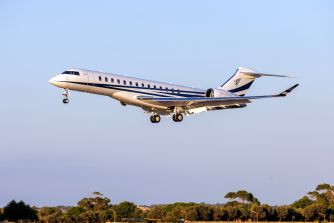
President Donald Trump says Canadian aircraft manufacturer Bombardier will no longer be allowed to sell jets in the United States unless it moves production to the country, raising a new legal question in the expanding U.S.-Canada trade dispute: Can a president simply ban a foreign company’s aircraft from the American market?
For now, no Bombardier ban has taken effect.
Trump announced the threat Monday, September 7, as trade tensions with Canada intensified, writing that there would be “NO MORE SELLING BOMBARDIER” in the United States and saying the company would have to manufacture its aircraft domestically if it wants access to the American market. The White House has not publicly identified the legal authority it would use or explained how it would implement a prohibition.
Bombardier’s aircraft are already approved by the Federal Aviation Administration, and aviation lawyers interviewed by Reuters questioned how the administration could simply prevent approved aircraft from being delivered to U.S. customers.
The absence of an announced legal mechanism does not mean the president lacks tools to restrict imports. Congress has delegated substantial trade authority to the executive branch under several federal statutes.
Two laws now stand out as possible routes for the administration: Section 338 of the Tariff Act of 1930 and Section 232 of the Trade Expansion Act of 1962.
Each comes with its own requirements, and either approach could lead to litigation.
Trump’s latest threat comes as Canada imposes retaliatory tariffs on approximately $20 billion of U.S. products following the collapse of trade negotiations with Washington. The administration has already used an obscure provision of the 1930 Tariff Act to impose tariffs on Canadian goods and, this week, moved beyond tariffs by ordering some Canadian products excluded from the United States altogether.
That law could provide one possible blueprint for Bombardier.
Section 338 allows the president to impose additional tariffs when a foreign country discriminates against U.S. commerce through unreasonable or unequal trade restrictions. Those additional duties can reach 50% of the value of the imported goods.
The statute goes further if the discrimination continues.
After the president issues an initial proclamation finding discrimination and the foreign country maintains or increases the challenged practice, Section 338 authorizes the president to issue another proclamation excluding products from that country from importation into the United States.
The Trump administration is already testing that power against Canada.
On September 8, Trump issued a proclamation excluding certain Canadian dairy products from importation beginning September 29. The administration said Canada had continued discriminatory practices after the United States imposed additional tariffs under Section 338.
That makes the Bombardier threat different from a purely hypothetical exercise of presidential power. The administration is currently using Section 338 not only to impose tariffs, but to prohibit some Canadian products from entering the country.
Applying the law to Bombardier aircraft would present additional questions.
Section 338 requires presidential findings concerning discrimination against U.S. commerce, followed by continued or increased discrimination before the exclusion authority applies. A Bombardier-specific ban would therefore likely require the administration to connect the exclusion to the statutory findings and procedures required by the law.
The administration has not announced that it intends to do so.
Another potential route may be even more directly connected to aircraft.
On July 9, Trump issued a proclamation under Section 232 of the Trade Expansion Act after the Commerce Department investigated imports of commercial aircraft, jet engines and aircraft parts.
Commerce concluded that those imports were entering the United States in quantities or under circumstances that threatened to impair national security. Trump accepted that finding and directed the Commerce Department and U.S. Trade Representative to negotiate with foreign governments over aircraft imports.
Section 232 gives presidents broad authority once the Commerce Department finds that imports threaten national security. The statute allows the president to take action considered necessary to “adjust” imports.
The Supreme Court has previously interpreted that language broadly.
In Federal Energy Administration v. Algonquin SNG, the Court held that Section 232 authorized import license fees. Earlier this year, when the Supreme Court struck down Trump’s global tariffs imposed under the International Emergency Economic Powers Act, the Court distinguished Section 232 as a statute containing far more explicit and expansive authority over imports.
The February decision in Learning Resources, Inc. v. Trump held that the International Emergency Economic Powers Act did not authorize the president to impose tariffs. The Court stressed that Congress controls tariffs and must clearly delegate that authority to the president.
Section 232 was one of the statutes the Court contrasted with IEEPA because Congress expressly established a process through which the president may adjust imports following a national-security investigation.
The July aircraft proclamation therefore gives Trump a potentially stronger statutory foundation than the emergency-power theory rejected by the Supreme Court.
It does not yet amount to a Bombardier ban.
The July proclamation directed officials to negotiate agreements with trading partners and called for an update within 180 days. It imposed no immediate aircraft tariffs and no prohibition on Bombardier or other foreign manufacturers. The Commerce Department had specifically recommended negotiations rather than immediate tariffs at that stage.
Trump said in the proclamation that alternative remedies could be considered depending on the outcome of those negotiations.
A subsequent attempt to exclude Bombardier aircraft under Section 232 would almost certainly invite scrutiny over whether the administration followed the statute and whether the remedy bears a sufficient connection to the national-security findings supporting the aircraft investigation.
Trump has also previously suggested another way to target Bombardier: aircraft certification.
In January, he threatened to decertify Bombardier Global Express business jets after a dispute involving Canadian certification of aircraft made by U.S. manufacturer Gulfstream Aerospace. The threatened decertification and accompanying 50% tariffs were never implemented. Canada later approved several Gulfstream aircraft.
Using FAA certification as a trade weapon would raise a different set of legal problems.
Federal law gives the FAA authority to amend, suspend or revoke aviation certificates after an investigation when aviation safety and the public interest require the action. Except in emergencies, certificate holders must receive notice and an opportunity to respond, and adverse FAA decisions generally can be appealed to the National Transportation Safety Board.
Bombardier aircraft currently operating or being delivered in the United States have already received FAA approval.
An attempt to withdraw those approvals solely to gain leverage in a trade dispute, without a supported aviation-safety basis, could therefore face challenges under federal aviation law and administrative law.
Trump’s Monday statement included criticism of Bombardier’s products, but the administration has not announced a new FAA safety finding or regulatory proceeding concerning the company’s aircraft. Reuters reported that three aviation lawyers could not identify an obvious way for the president to stop delivery of jets that already carry FAA approval.
Bombardier has responded by emphasizing how deeply its operations are already tied to the United States.
The Montreal-based manufacturer employs approximately 3,500 people in the U.S., including about 1,500 in Wichita, Kansas. It says it buys more than $2.5 billion in goods and services annually from approximately 2,800 U.S. suppliers across 47 states. Bombardier also manufactures wings for its Global 8000 aircraft in Texas and operates service and defense facilities in the United States.
About half of the approximately 5,100 Bombardier aircraft operated by customers worldwide are in the United States, according to Reuters.
The threat has consequently drawn objections from politicians whose states would feel the effects of a ban.
Republican Sens. Jerry Moran and Roger Marshall of Kansas have contacted the White House about Bombardier’s U.S. workforce. Marshall, who is seeking reelection in November, said he intends to protect the jobs associated with the company. Republican Rep. Ron Estes, whose district includes Wichita, also opposed aerospace tariffs and pointed to Bombardier’s U.S. supply chain and national-security work.
The economic integration complicates a policy aimed at distinguishing Canadian manufacturing from American industry.
Most Bombardier business jets use engines manufactured by U.S. companies including GE Aerospace and Honeywell, and the aerospace industries of the two countries rely heavily on cross-border supply chains.
Bombardier aircraft also comply with the U.S.-Mexico-Canada Agreement, according to Reuters. A U.S. import restriction could therefore create another dispute over the future of the North American trade agreement, although the domestic legality of a presidential order would depend primarily on the federal statute invoked to impose it.
Trump’s threat arrives at a significant moment for presidential trade authority.
The Supreme Court’s February ruling established that a president cannot impose tariffs simply by relying on broadly worded emergency economic powers. Congress must provide the necessary authority.
The administration has responded by increasingly turning to statutes that expressly delegate powers over tariffs and imports, including Sections 232 and 338.
Section 338 is especially notable because it expressly contemplates excluding foreign products from the United States after specified findings of continued discrimination. Section 232 provides another potentially broad route when imports are found to threaten national security, and the administration has already completed the required Commerce Department investigation involving aircraft.
Neither law, however, means that a social media announcement itself blocks Bombardier jets from entering the country.
The administration would have to translate Trump’s threat into formal government action under an existing statute or other lawful authority. The scope of that action, the findings supporting it and the procedures used would determine how strong the government’s position would be if Bombardier, aircraft purchasers or other affected businesses went to court.
Until that happens, Bombardier remains legally able to sell and deliver its FAA-approved aircraft in the United States.
Trump may have tools powerful enough to attempt the ban he has threatened. The next legal question is which one he chooses—and whether a federal court agrees that Congress gave him enough authority to use it against one of Canada’s largest manufacturers.