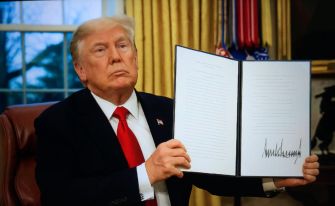
President Donald Trump’s new order restricting birthright citizenship remained in effect Friday after a federal judge declined to immediately block it, while raising questions about whether the president can create new citizenship exceptions following a recent Supreme Court ruling.
U.S. District Judge Deborah Boardman in Maryland denied immigrant-rights advocates’ request for a temporary restraining order on Aug. 28 because their existing lawsuit challenges Trump’s earlier 2025 birthright citizenship directive and has not yet been amended to address the order he signed Aug. 6.
Boardman allowed the plaintiffs to update their complaint and set an expedited schedule for another challenge to the administration’s policy.
“As far as I can tell, this is unprecedented,” Boardman said during Friday’s hearing, according to Reuters. She described the new directive as an attempt to create exceptions to birthright citizenship “with the stroke of a pen.”
The dispute is the latest stage of a constitutional fight that began on Trump’s first day back in office and has already reached the Supreme Court over both the power of lower courts to block presidential policies nationwide and the meaning of the Fourteenth Amendment’s Citizenship Clause.
Trump’s January 2025 executive order sought to deny automatic citizenship to children born in the United States when their mothers were unlawfully present or temporarily in the country and their fathers were neither U.S. citizens nor lawful permanent residents.
Boardman was among several federal judges who blocked that directive. The litigation later produced a nationwide class covering children who would be denied citizenship under the policy.
The Supreme Court first considered the litigation in 2025 in a dispute over universal injunctions, without deciding whether Trump’s citizenship policy itself violated the Constitution.
The constitutional question reached the justices the following year in Trump v. Barbara. On June 30, the Court affirmed a ruling against Trump’s 2025 order.
Chief Justice John Roberts, writing for a five-justice majority, held that children born in the United States to parents who are unlawfully or temporarily present are “subject to the jurisdiction” of the United States and are citizens at birth under the Fourteenth Amendment. Justice Brett Kavanaugh provided a sixth vote to affirm the judgment but concluded that the order violated federal citizenship law rather than the Constitution.
The ruling traced birthright citizenship to the common-law principle of jus soli, or citizenship based on place of birth, and relied heavily on the Supreme Court’s 1898 decision in United States v. Wong Kim Ark.
Under that framework, people temporarily present in the United States generally remain subject to U.S. law, meaning children born to them on American soil qualify for citizenship. The Court recognized narrow historical exceptions involving people outside the ordinary jurisdiction of the United States, including foreign diplomats and enemies present during a hostile military occupation.
The Supreme Court also noted that foreigners who traveled to the United States for “business or pleasure” remained subject to American jurisdiction while in the country and that children born to them were citizens.
Trump responded five weeks later with Executive Order 14418, titled “Continuing to Protect the Meaning and Value of American Citizenship.”
Rather than again denying citizenship based broadly on a parent’s immigration status, the Aug. 6 order identifies narrower categories that the administration argues fall outside the constitutional rule recognized by the Supreme Court.
The directive applies when neither parent is a U.S. citizen and certain additional circumstances are present. It directs federal agencies not to recognize citizenship for some children whose parents are classified as “alien enemies,” children of certain foreign government employees and children whose parents allegedly used fraud or commercial arrangements to obtain birthright citizenship.
The order also targets what the administration calls “birth tourism,” including commercial arrangements intended to ensure that a mother gives birth in the United States. It covers some arrangements involving surrogates and births in U.S. territories where citizenship is not otherwise conferred by federal law.
Its foreign-government category extends beyond ambassadors to include certain embassy and consular employees, people working for foreign governments in an official capacity and some employees of international organizations.
The White House argues the new order follows the Supreme Court’s June ruling rather than conflicts with it. The administration points to the Court’s discussion of people who historically fell outside ordinary U.S. jurisdiction, including diplomats protected by immunity.
Boardman focused on that issue Friday when questioning Justice Department lawyers about birth tourism.
She asked where the Supreme Court’s June decision created an exception for children whose parents traveled to the United States for the purpose of giving birth. The Court had said temporary visitors remained subject to U.S. jurisdiction and cited historical authority involving foreigners who entered for “business or pleasure.”
Trump’s broader treatment of foreign government employees and “alien enemies” could raise similar questions.
The traditional exception for children of diplomats is tied to diplomatic immunity, while the historical enemy exception involves births during hostile military occupation. Trump’s order reaches beyond those categories, including some foreign government employees and members of designated foreign terrorist organizations or people classified as specially designated global terrorists.
Those differences are likely to become central when the court considers a direct challenge to the Aug. 6 order.
The Justice Department urged Boardman not to act immediately, arguing that federal agencies have not completed guidance explaining how the new policy will be implemented.
Trump directed the Departments of State, Justice and Homeland Security, the Social Security Administration and other federal agencies to bring their policies into line with the order and issue public implementation guidance within 30 days. That guidance is due by Sept. 5.
Boardman indicated Friday that she was reluctant to delay consideration of the constitutional questions until those instructions are released.
The plaintiffs include CASA, the Asylum Seeker Advocacy Project and families involved in the earlier birthright citizenship litigation. Their lawsuit previously resulted in certification of a class of children affected by Trump’s 2025 directive.
A separate challenge to the Aug. 6 order is also developing in the New Hampshire litigation that led to the Supreme Court’s decision in Trump v. Barbara. Plaintiffs there contend that the administration’s new restrictions reach people covered by the citizenship rule the Court affirmed in June.
Friday’s ruling leaves Trump’s new birthright citizenship order in place for now. It does not decide whether the restrictions are constitutional.
Boardman has permitted the plaintiffs to amend their complaint to challenge Executive Order 14418 directly. Once they do, the court can consider whether the categories identified by Trump fit within the historical exceptions to birthright citizenship recognized under the Fourteenth Amendment or attempt to create exceptions beyond those the Supreme Court has allowed.