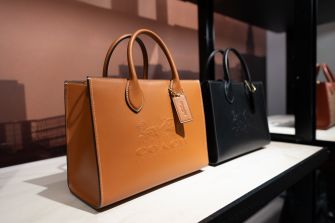
Coach and its parent company, Tapestry, have ended a federal lawsuit accusing Quince of selling lower-priced handbags that allegedly copied the look of two Coach designs.
The companies filed a joint stipulation on June 23 in the U.S. District Court for the Northern District of California, agreeing to dismiss all claims without prejudice. Each side will cover its own attorneys’ fees, costs, and expenses.
The dismissal closes a short-lived dispute over handbags sold by Last Brand Inc., which does business as Quince, a direct-to-consumer brand known for selling apparel, accessories, and home goods at prices often lower than traditional retail brands.
Coach and Tapestry filed the lawsuit in April 2025, claiming Quince’s handbags crossed the line from inspiration into unlawful copying. The case focused on two Coach products, the Rogue bag and the Soho Flap bag. Coach alleged that Quince’s Italian Leather Medium Convertible Satchel and Italian Leather Buckle Detail Shoulder Bag copied combinations of design features tied to those Coach bags.
Court filings claimed the Quince products were “substantially indistinguishable” from Coach’s asserted trade dress and were likely to confuse shoppers about whether the bags came from Coach or were approved by the company. Coach and Tapestry also argued that Quince was trying to benefit from the recognition and goodwill attached to the Coach designs by selling lower-priced lookalike products.
The dispute did not center on Quince’s alleged use of a Coach logo, brand name, or monogram. Coach relied on trade dress, a form of trademark protection that can cover the overall look of a product when consumers connect that look with one brand.
Trade dress can include a product’s shape, structure, layout, stitching, hardware, or other visual details when those features work together as a brand identifier. To prove that kind of claim, a company generally must show that the design is distinctive, that the protected features are not mainly useful, and that the accused product is likely to confuse shoppers about source, sponsorship, or approval.
Coach’s lawsuit relied on federal trademark and unfair competition law, including the Lanham Act, which bars uses of marks or identifying features that are likely to mislead consumers. The same law can apply to false association claims, where one company says another is using a name, symbol, design, or product appearance in a way that wrongly suggests a connection.
Product design claims can be harder to prove when the challenged item does not use the original brand’s visible branding. Handles, flaps, buckles, stitching, straps, pockets, and silhouettes may be common across the market or serve a useful purpose. A brand can seek protection for a specific combination of features, but trademark law does not give companies ownership over broad trends or general style ideas.
Coach and Tapestry framed the Quince bags as unlawful copies of recognizable Coach designs. The complaint claimed Quince reproduced non-functional design elements associated with the Rogue and Soho Flap bags and offered those products at lower prices to attract shoppers looking for similar styles.
Quince did not admit liability through the dismissal. The case ended without a court ruling on whether the Quince handbags infringed Coach’s asserted trade dress or violated unfair competition law.
The parties agreed to dismiss all claims without prejudice, with each side bearing its own attorneys’ fees, costs, and expenses.