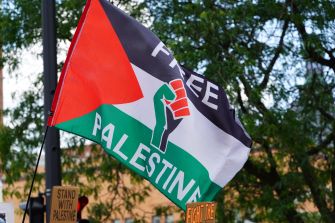
A federal judge in California has ruled that the Trump administration cannot use federal immigration law to revoke visas or pursue deportation against international students because they expressed pro-Palestinian views, criticized Israel or engaged in other political speech protected by the First Amendment.
U.S. District Judge Noël Wise issued the 90-page decision Friday, August 28, finding that portions of two provisions of the Immigration and Nationality Act violate the First and Fifth Amendments when the government uses them to target noncitizens for protected speech.
The ruling follows a campaign that began in March 2025 in which federal immigration officials revoked visas, arrested and detained noncitizen students involved in pro-Palestinian campus advocacy. Among the high-profile cases were Columbia University graduate Mahmoud Khalil, Tufts University student Rümeysa Öztürk and other students whose protests, writings or associations became part of federal immigration proceedings.
Wise concluded that lawfully present noncitizens do not lose First Amendment protection because they hold student visas or other immigration status.
“Stated plainly, in the United States, freedom of speech belongs to the people,” Wise wrote. “It is not the government’s to take.”
The case, Stanford Daily Publishing Corporation v. Rubio, was brought in August 2025 by the organization that publishes The Stanford Daily and two noncitizen students. One student was later dismissed from the case.
The plaintiffs argued that international students had begun censoring themselves because they feared that writing about Gaza, attending pro-Palestinian demonstrations or criticizing Israeli policy could lead to the loss of their visas and eventual deportation.
The Stanford Daily said some noncitizen journalists declined assignments involving protests or the Israel-Palestine conflict, asked that previously published articles be removed and avoided publishing commentary because of those concerns. Wise had previously ruled that those allegations were enough to establish a concrete First Amendment injury and allow the case to proceed.
Friday's ruling reached the merits.
The lawsuit focused on two parts of federal immigration law that provide the secretary of state with substantial authority over noncitizens.
One allows a noncitizen to be deemed deportable when the secretary of state has reasonable grounds to believe the person's presence or activities could have potentially serious adverse consequences for U.S. foreign policy. Federal law ordinarily protects lawful beliefs, statements, and associations from serving as the basis for such a decision, but contains an exception when the Secretary personally determines that the person's presence would compromise a compelling U.S. foreign policy interest.
The second provision, 8 U.S.C. § 1201(i), gives the Secretary of State or a consular officer discretion to revoke a visa after it has been issued. Visa revocation can then contribute to the government's effort to place a noncitizen into removal proceedings.
The Trump administration argued that the government needs broad authority in immigration and foreign affairs and that noncitizens do not necessarily possess constitutional protections identical to those of U.S. citizens.
Wise rejected that argument as it applied to lawfully present noncitizens and protected political expression.
The judge distinguished between people already living lawfully in the United States and foreign nationals seeking admission from outside the country. Supreme Court precedent has historically given the political branches especially broad authority over people seeking initial entry, but people who have entered the United States can invoke constitutional protections that do not depend on citizenship.
Wise cited Ninth Circuit precedent recognizing that student visa holders can bring First Amendment claims. She also found that the Fifth Amendment's protection against unconstitutionally vague laws applies to noncitizens in immigration proceedings.
The First Amendment problem, Wise concluded, arose because the government was using speech itself as the reason for immigration action.
When protected expression becomes the reason for a visa revocation or deportation decision, she wrote, the government is treating speech differently because of its content or viewpoint. Such restrictions are generally subject to strict scrutiny, one of the Constitution's most demanding tests.
Wise found that the government failed to show the challenged provisions, when applied to protected speech, were narrowly tailored to accomplish a compelling government interest.
The ruling does not prevent the federal government from enforcing immigration or national security laws against international students who engage in conduct that provides an independent legal basis for action.
Wise specifically pointed to existing provisions permitting the government to pursue removal of people engaged in terrorist activity, espionage, sabotage and certain conduct threatening national security. The Supreme Court has also distinguished constitutionally protected political advocacy from prohibited material support provided to foreign terrorist organizations.
That distinction limits the reach of Friday's decision. An international student is not immune from immigration enforcement simply because a case has some connection to political activity. The ruling instead prevents protected speech itself from becoming the basis for punishment under the provisions Wise reviewed.
The judge also found a separate constitutional problem under the Fifth Amendment: vagueness.
A law can violate due process when ordinary people cannot determine what conduct it prohibits or when it gives government officials so little guidance that arbitrary or discriminatory enforcement becomes possible.
Wise found both concerns in the challenged immigration provisions when they were used against speech.
The foreign-policy provision left noncitizens unable to determine which otherwise lawful beliefs, statements, or associations might prompt the Secretary of State to conclude that their presence threatened a compelling U.S. interest, the court said.
The visa-revocation provision presented a similar problem. The government acknowledged during the litigation that the law grants the secretary broad discretion to revoke visas. Wise found that, when that discretion is applied to protected expression, the lack of defined standards opens the door to enforcement based on which views government officials favor or oppose.
The factual record was central to the ruling.
Wise relied in part on findings from a separate Massachusetts case that examined the administration's enforcement campaign. According to those findings, federal officials reviewed thousands of names associated largely with campus protests and relied on sources including Canary Mission, a website that tracks people and organizations it describes as hostile to Israel or supportive of antisemitism.
Immigration authorities prepared reports on some individuals based on protest participation, associations with pro-Palestinian groups, social media posts and opinion articles. The record cited by Wise found that the cases involving several prominent students did not rely on violence or material support for terrorist organizations.
A federal judge in Boston had already ruled in September 2025 that the administration violated the First Amendment through a policy of targeting noncitizen students and faculty involved in pro-Palestinian advocacy. Wise's decision goes further in one respect by directly addressing the constitutionality of the statutory provisions themselves when applied to protected speech.
The California ruling does contain an important procedural limitation.
Wise issued a declaratory judgment stating that the challenged portions of both the deportation and visa-revocation provisions violate the First Amendment and are unconstitutionally vague under the Fifth Amendment when enforcement is based on protected speech.
She did not issue a permanent injunction against enforcement of the deportation provision. Under 8 U.S.C. § 1252(f)(1), lower federal courts generally lack authority to issue injunctions restraining operation of certain removal provisions of the Immigration and Nationality Act; that power is reserved to the Supreme Court.
Wise also determined that a separate injunction concerning visa revocation was unnecessary at this stage in light of the declaratory judgment, although she said the plaintiffs otherwise had established the factors needed for such relief.
The decision therefore should not be read as a nationwide injunction against immigration enforcement or as a ruling that every past or future deportation involving a campus activist is unlawful. It establishes that the specific statutory powers challenged in the case cannot constitutionally be applied on the basis of First Amendment-protected speech.
The Justice Department had not announced an appeal as of Saturday, and neither the State Department nor the Department of Homeland Security immediately commented on the ruling, according to Reuters and The Associated Press.
An appeal would place the dispute before the U.S. Court of Appeals for the Ninth Circuit and could eventually present the Supreme Court with a broader question about the intersection between two powerful areas of federal authority: the government's historically broad control over immigration and the Constitution's prohibition against punishing people inside the United States because officials disapprove of their political views.
For international students and universities, the immediate significance is clearer. The ruling recognizes that lawful immigration status does not give the government a free hand to make political conformity a condition of remaining in the United States.
As Wise wrote near the close of her decision, constitutional protection for speech includes speech the government itself strongly opposes.
The case is Stanford Daily Publishing Corporation et al. v. Rubio et al., No. 5:25-cv-06618, in the U.S. District Court for the Northern District of California.