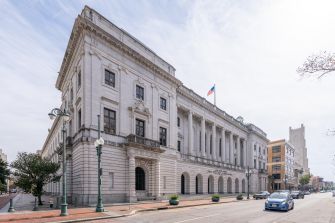
Photo Source: Ajay_suresh, CC BY 4.0, via Wikimedia Commons
A federal judge’s AI-assisted order that named nonexistent people, cited material outside the court record, and misstated Mississippi law is now at the center of a Fifth Circuit fight over whether he should continue presiding over the case.
Mississippi is asking the U.S. Court of Appeals for the Fifth Circuit to overturn a preliminary injunctionA preliminary injunction is a temporary court order issued before a case is finally decided that requires a party to take or stop an action while the litigation continues. Federal courts generally consider the likelihood of success, irreparable harm, the balance of equities, and the public interest before granting one.Read more → issued by U.S. District Judge Henry T. Wingate and send the state’s challenge to a different judge. During August 31 oral arguments, the panel closely questioned attorneys about errors in an earlier order prepared with help from generative artificial intelligence.
“Don’t you think that’s a pretty serious matter?” U.S. Circuit Judge Jerry Smith asked an attorney defending Wingate’s injunction during the hearing in New Orleans.
The errors originated in a July 20, 2025 temporary restraining order that blocked parts of Mississippi House Bill 1193, a law restricting diversity, equity, and inclusion programs and certain instruction involving race and sex in public schools and universities.
Wingate later disclosed that one of his law clerks used the AI platform Perplexity while preparing the order. An early draft was mistakenly filed before completing the chambers’ normal review process.
The version placed on the docket identified people who were not parties to the lawsuit, referred to declarations and other material that did not exist in the record, misquoted portions of Mississippi law, and contained faulty legal citations.
Mississippi officials raised the errors shortly after the ruling was filed. Wingate’s court replaced the order several days later and removed the original version from the public docket while retaining a copy in the litigation record.
The episode drew scrutiny beyond the lawsuit. Senate Judiciary Committee Chairman Chuck Grassley asked Wingate to explain whether artificial intelligence had been used to prepare the ruling and why the original order had been removed.
Wingate acknowledged in an October 2025 response that his clerk used Perplexity as a “foundational drafting assistant” to synthesize publicly available information from the docket. He attributed the errors to a lapse in human oversight and said the draft should never have been filed.
The judge also said no sealed, confidential, or otherwise nonpublic case information had been entered into the AI system. He changed his chambers’ review procedures after the incident.
The Fifth Circuit appeal concerns a separate ruling Wingate issued weeks after the flawed temporary restraining order.
On August 18, 2025, the judge granted a preliminary injunction continuing to block portions of HB 1193 while the constitutional challenge moved forward. Mississippi Attorney General Lynn Fitch and other state officials appealed.
The state is now arguing that the problems surrounding the earlier AI-assisted order raise concerns about Wingate’s continued handling of the litigation.
Deputy Mississippi Solicitor General Anthony Shults asked the Fifth Circuit to reverse the injunction and direct that further proceedings take place before another federal judge. He also argued that an erroneous citation remained after the temporary restraining order was corrected and that Wingate later relied on reasoning from the earlier ruling.
Robert McDuff, representing educators and other plaintiffs challenging HB 1193, argued that the erroneous material did not determine Wingate’s decision to block the state law.
U.S. Circuit Judge Kurt Engelhardt pressed that position, questioning how the appeals court could confidently determine that inaccurate material had not affected the district judge’s analysis.
The reassignment question is separate from whether Wingate reached the correct result when he blocked parts of HB 1193. A federal appeals court can direct that a case continue before a different district judge when circumstances raise sufficient concerns about the administration or appearance of justice.
Reassignment would change the judge overseeing the lawsuit. It would not remove Wingate from the federal bench or amount to judicial discipline.
The underlying case, Jackson Federation of Teachers v. Fitch, was brought by educators, parents, students, and advocacy groups challenging HB 1193 on First Amendment grounds. They argue that portions of the law unlawfully restrict protected speech and instruction in Mississippi’s public educational institutions.
State officials maintain that Mississippi has authority to regulate curriculum and programs within its public education system.
Wingate, who has served on the federal bench since 1985, remains assigned to the district court case while the appeal is pending.
Smith heard the August 31 appeal alongside U.S. Circuit Judges Catharina Haynes and Kurt Engelhardt. The Fifth Circuit has not yet ruled on the preliminary injunction or Mississippi’s request to assign further proceedings to another judge.
Share This Article
If you found this article insightful, consider sharing it with your network.
Alexandra Agraz is a former Diplomatic Aide with firsthand experience in facilitating high-level international events, including the signing of critical economic and political agreements between the United States and Mexico. She holds dual associate degrees in Humanities, Social and Political Sciences, and Film, blending a diverse academic background in diplomacy, culture, and storytelling. This unique combination enables her to provide nuanced perspectives on global relations and cultural narratives.
FIFA is asking a federal judge in Puerto Rico to throw out an antitrust lawsuit after attorneys representing a now-defunct soccer league failed to pay nearly $24,500 in sanctions over court filings containing 55 defective legal citations that raised suspicions of artificial intelligence misuse.In an October 6, 2026, filing, soccer's...
Read
More »
Elon Musk’s artificial intelligence company xAI has won a temporary court order blocking Minnesota from enforcing its first-in-the-nation ban on AI tools that can generate realistic nude images of identifiable people, escalating a First Amendment fight over Grok and AI-generated sexual images.The U.S. Court of Appeals for the Eighth Circuit...
Read
More »
An Arizona appeals court has thrown out a 10.5-year manslaughter sentence after finding that a judge improperly relied on an AI-generated victim impact video that recreated shooting victim Christopher Pelkey speaking at the defendant’s sentencing.In a unanimous published opinion issued September 30 in State v. Horcasitas, the Arizona Court of...
Read
More »
A federal appeals court is moving to tighten its rules on artificial intelligence after judges encountered court filings containing fabricated cases, false quotations and other AI-generated legal errors.The U.S. Court of Appeals for the Tenth Circuit proposed a new rule September 18 that would require lawyers and self-represented litigants to...
Read
More »
Anthropic lost its bid to overturn the Pentagon’s national security “supply chain risk” designation Friday after a federal appeals court upheld the government’s decision to exclude the artificial intelligence company’s Claude models from military systems and contracts.In a 2-1 decision, the U.S. Court of Appeals for the District of Columbia...
Read
More »
We use cookies and similar technologies to help our website function, understand how visitors use our site, and improve your experience. Some cookies are necessary for the website to operate, while others may be used for analytics or advertising.