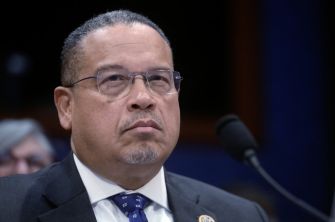
Photo Source: AP Photo/Rod Lamkey, Jr., file via apnews.com
Minnesota is asking a federal judge to reject a bid by Elon Musk’s artificial intelligence company, xAI, to block the state’s AI nudification ban, arguing that Grok Imagine’s nudification feature is a product function rather than speech protected by the First Amendment.
Attorney General Keith Ellison made the argument in an August 14 filing opposing xAI’s request for a preliminary injunctionA preliminary injunction is a temporary court order issued before a case is finally decided that requires a party to take or stop an action while the litigation continues. Federal courts generally consider the likelihood of success, irreparable harm, the balance of equities, and the public interest before granting one.Read more →, which seeks to stop enforcement of the law while the company’s constitutional challenge continues.
The filing is Minnesota’s substantive response to the lawsuit xAI brought in July over the state law, which took effect August 1. The measure targets websites, applications and other services that provide access to automated technology capable of altering or generating an image to depict an intimate body part that was not shown in the original. The resulting image must be realistic enough to appear to belong to an identifiable person.
xAI claims the statute reaches protected expression because it is not limited to images created without consent and does not contain specific exceptions for artistic, political, satirical, educational, and other expressive uses. The company argues that the restriction is based on the content users create and should face the most demanding form of First Amendment review.
Lawmakers adopted the ban after hearing from women whose photographs had been used to create fabricated sexual images, along with evidence involving AI-generated sexual material depicting children.
State lawyers place the function of Grok Imagine at the center of their response. They argue that xAI provides a technological tool that users operate to generate content rather than engaging in protected expression itself. From that view, the law regulates what the automated feature can do rather than the message contained in an image.
First Amendment protections generally leave the government less room to regulate speech because of its message, subject, or viewpoint. Laws aimed at conduct, or rules that affect expression without targeting its message, may receive intermediate scrutiny. Restrictions based on the content of speech generally face the tougher strict scrutiny standard, which requires the government to show that the law is narrowly designed to serve a compelling interest.
Ellison’s office argues intermediate scrutiny should apply because the statute targets automated nudification technology and the harms tied to its use, not a particular message or viewpoint. Minnesota also maintains that the law would survive strict scrutiny because preventing digital sexual victimization is a compelling government interest and existing laws aimed at people who create or distribute unlawful images do not fully address technology that can produce the material quickly and at large scale.
Minnesota also relies on xAI’s own rules, which prohibit users from nudifying real people, to challenge the company’s ability to assert users’ constitutional rights. Courts generally require parties to assert their own rights, although First Amendment cases can allow exceptions. The state argues xAI cannot rely on that exception because its interests conflict with users seeking to create material the company itself prohibits.
xAI is also challenging the statute on its face, meaning it seeks to invalidate the law more broadly rather than only as applied to one enforcement action. First Amendment law allows challenges to statutes that sweep too much protected expression into a restriction, but the challenger must show that the unconstitutional applications are substantial compared with the law’s legitimate reach.
Minnesota argues xAI has not made that showing. The filing points to applications involving child sexual abuse material, obscenity and nonconsensual sexual images that the state says fall outside First Amendment protection. State lawyers contend that xAI has identified potentially protected examples without showing that those uses outweigh the statute’s constitutional applications.
The state separately disputes xAI’s claim that immediate court intervention is necessary. Ellison argues the company waited nearly three months after the law was signed before filing its lawsuit and has primarily identified financial costs associated with compliance, which Minnesota says do not establish the irreparable harm required for a preliminary injunction.
U.S. District Judge Donovan Frank previously declined to stop the law from taking effect while the preliminary injunction request was being briefed. He is scheduled to consider xAI’s request at a hearing Wednesday, August 19, in federal court in St. Paul.
Share This Article
If you found this article insightful, consider sharing it with your network.
Bridget studied Communications and Marketing at California State University, Long Beach. She also has experience in the live music events industry, which has allowed her to travel to festivals around the world. During this period, she acquired valuable expertise in branding, marketing, event planning, and public relations.
OpenAI, Anthropic, Google and SpaceXAI have been hit with a federal antitrust lawsuit accusing the rival artificial intelligence companies of illegally agreeing to slow development of ChatGPT, Claude, Gemini and Grok in the name of AI safety.Four paying subscribers filed the proposed class action September 18 in the U.S. District...
Read
More »
AI-generated nude and sexual deepfakes can now lead to criminal charges under federal law and in a growing number of states, as lawmakers move to punish realistic sexual images created or shared without a person's consent.The rules remain a patchwork. Federal law largely targets publication, while states including Florida, Texas...
Read
More »
A federal judge’s AI-assisted order that named nonexistent people, cited material outside the court record, and misstated Mississippi law is now at the center of a Fifth Circuit fight over whether he should continue presiding over the case.Mississippi is asking the U.S. Court of Appeals for the Fifth Circuit to...
Read
More »
The Seattle Times and Newsday have sued OpenAI and Microsoft, accusing the companies of copying hundreds of thousands of articles without permission to train AI systems and asking a federal court to destroy models and training datasets that incorporate their journalism.The copyright infringement lawsuit, filed September 4 in the U.S....
Read
More »
California lawmakers have approved legislation that would impose new requirements on attorneys who use generative artificial intelligence, including verifying AI-generated work, disclosing its use in court filings, and protecting confidential client information.Senate Bill 574, known as the Court A.I. Protection Act, passed the Legislature and was sent to Gov. Gavin...
Read
More »