We use cookies and similar technologies to help our website function, understand how visitors use our site, and improve your experience. Some cookies are necessary for the website to operate, while others may be used for analytics or advertising.
Nine members of the Kennedy family are seeking to stop President Donald Trump from building a 250-foot triumphal arch near Arlington National Cemetery, arguing that the monument would cast shadows over family gravesites, obstruct views of former President John F. Kennedy's eternal flame and violate federal law.
In a motion filed November 10, 2026, in Washington, D.C., federal court, the relatives asked to join two existing lawsuits challenging the Independence Arch. Their proposed complaint seeks to overturn the Trump administration's November 5 construction approval and prevent the project from proceeding without congressional authorization.
The filing comes five days after U.S. District Judge Tanya Chutkan temporarily halted construction following lawsuits brought by Washington, D.C., Virginia, military veterans and a historic preservation advocate. The judge questioned the administration's authority to build the monument without new approval from Congress.
Among the nine relatives are Kerry Kennedy, Rory Kennedy, Kathleen Kennedy Townsend, former Rep. Joseph P. Kennedy II and former Rep. Joseph P. Kennedy III. The remaining participants are Maxwell Taylor Kennedy, Christopher G. Kennedy, Courtney Kennedy and Edward M. Kennedy Jr. Seven are children of Robert F. Kennedy and Ethel Kennedy, while the other two are descendants of Robert F. Kennedy and Edward M. Kennedy.
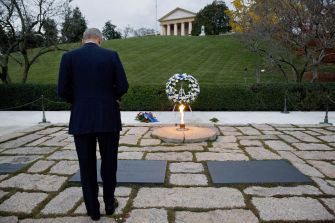
The family argues that the arch, planned for Memorial Circle between the Lincoln Memorial and Arlington National Cemetery, would obstruct a historic view across Arlington Memorial Bridge toward the Kennedy gravesites. Former President Kennedy, Robert F. Kennedy, Edward Kennedy and Ethel Kennedy are buried at Arlington, where the family also established a memorial honoring Joseph P. Kennedy Jr., who died during World War II.
Following President Kennedy's assassination in 1963, relatives helped establish his burial site and the surrounding memorial. The design incorporated views from Arlington Memorial Bridge toward the eternal flame, which Jacqueline Kennedy lit during her husband's funeral. According to the complaint, the arch would permanently disrupt that view.
The filing also cites a shadow analysis finding that the proposed monument would shade the former president's memorial on approximately 50 days each year and reach his eternal flame on 18 days. The analysis found that shadows could extend into Arlington National Cemetery on 284 days annually.
The Interior Department has disputed those findings, saying its own modeling showed additional shade affecting only a small portion of the cemetery for fewer than two weeks annually, generally for less than an hour after sunrise.
Beyond the impact on the gravesites, the relatives accuse the National Park Service and Interior Department of unlawfully authorizing the arch under the Commemorative Works Act, which requires congressional approval for certain monuments on federal land in Washington, D.C. Their complaint also alleges that officials disregarded findings about the project's effects on surrounding memorials and historic views when granting final construction authorization.
The family is asking the court to invalidate that approval under the Administrative Procedure Act and prohibit construction until the federal government obtains the required authorization and complies with applicable laws.
The Trump administration maintains that Congress authorized memorial structures at Memorial Circle under legislation enacted in 1925. White House officials have defended the arch as a tribute to American military service, while spokesman Davis Ingle criticized the Kennedy family's legal challenge and expressed confidence that the administration would prevail.
Chutkan's November 5 order bars construction and site preparation for 14 days while the court considers whether to impose a longer restriction. The order followed the National Capital Planning Commission's approval of the project's site and building plans earlier that day.
The lawsuit filed by Washington, D.C., and Virginia also challenges the administration's authority to build the arch, citing potential traffic disruptions, emergency services concerns and the project's effects on surrounding communities.
The court must also decide whether the Kennedy relatives can participate in the existing litigation. The administration's response to pending requests for a preliminary injunctionA preliminary injunction is a temporary court order issued before a case is finally decided that requires a party to take or stop an action while the litigation continues. Federal courts generally consider the likelihood of success, irreparable harm, the balance of equities, and the public interest before granting one.Read more → is due November 16, with replies due November 18. The temporary construction halt is scheduled to expire November 19 unless the judge extends it or grants further relief.
Share This Article
If you found this article insightful, consider sharing it with your network.
Lawrence is an attorney and CEO of Law Commentary. His legal background includes corporate and general business law, litigation, transactional matters, and law practice management. His litigation experience has included complex matters involving antitrust, insurance bad faith, and medical malpractice. On the transactional side, Lawrence has worked with buy-sell agreements, Regulation D disclosures, stock option plans, and business matters. Lawrence draws on his legal and business experience to help make court decisions, litigation, legislation, public policy, and other legal developments more accessible to the general public and to give readers clear context for understanding the law and how it affects businesses, consumers, and communities.
A federal judge temporarily blocked construction of President Donald Trump's proposed 250-foot triumphal arch near Arlington National Cemetery on Thursday, November 5, 2026, hours after a federal planning commission approved the monument in an 8-4 vote.U.S. District Judge Tanya Chutkan issued a 14-day restraining order stopping excavation, demolition, road closures...
Read
More about Judge Halts Trump's 250-Foot Arch Hours After Federal Approval »
Washington, D.C., and Virginia sued President Donald Trump's administration Saturday, October 31, 2026, seeking an emergency court order to stop construction of his proposed 250-foot triumphal arch near Arlington National Cemetery, with work potentially beginning November 5.D.C. Attorney General Brian Schwalb and Virginia Attorney General Jay Jones accuse federal officials...
Read
More about D.C. and Virginia Sue Trump to Stop His 250-Foot Arch »
The Trump administration appealed a federal judge's order Tuesday, October 27, 2026, barring further tree removal at a historic Washington, D.C., golf course after workers cut down more than 400 trees as part of a disputed overhaul. The ruling also requires advance notice before major changes to the public course...
Read
More about Trump Appeals Judge's Order After 400 Trees Cut Down at DC Golf Course »
A federal lawsuit seeks to block Jared Kushner, President Donald Trump's son-in-law, from serving as a top U.S. diplomatic envoy, alleging that he has exercised government authority without Senate confirmation while maintaining billions of dollars in foreign-backed investments.Citizens for Responsibility and Ethics in Washington (CREW) filed the 45-page complaint on...
Read
More about Jared Kushner Faces Lawsuit to Block His Role as Trump's Diplomatic Envoy »