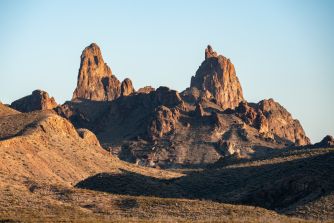
A federal judge has found that the Trump administration likely exceeded its authority when it waived dozens of federal laws to build border barriers in Texas's Big Bend region, citing evidence that the sprawling sector has the lowest migrant apprehension rates along the U.S.-Mexico border.
In a 14-page opinion issued October 14, 2026, U.S. District Judge Kathleen Cardone challenged the Department of Homeland Security's justification for bypassing environmental and other legal protections across the 517-mile sector. Although federal officials cited more than 89,000 apprehensions between 2021 and 2025, the judge found that Big Bend ranked last among southern border sectors in both total apprehensions and apprehensions per mile.
The opinion explains Cardone's October 2 preliminary injunctionA preliminary injunction is a temporary court order issued before a case is finally decided that requires a party to take or stop an action while the litigation continues. Federal courts generally consider the likelihood of success, irreparable harm, the balance of equities, and the public interest before granting one.Read more →, which halted border barrier construction and other ground-disturbing activities unless the administration complies with applicable laws. The order also suspended three DHS waivers affecting Big Bend National Park, Big Bend Ranch State Park and surrounding public and private lands while litigation continues.
Congress granted the DHS secretary broad authority under the Illegal Immigration Reform and Immigrant Responsibility Act of 1996 to waive legal requirements for expedited border construction. However, the statute ties that power to efforts to deter unlawful crossings in areas of high illegal entry, a limitation at the center of Cardone's findings.
Big Bend accounts for more than a quarter of the U.S.-Mexico border but represented only 0.3% to 2.2% of apprehensions along the southern border annually over the past 30 years. Federal officials argued that apprehension figures provide an incomplete measure of illegal crossings, while Cardone found that the comparisons remained relevant to determining whether the sector met the law's requirements.
The judge reasoned that accepting DHS's interpretation would effectively erase Congress's geographic restriction. If the sector with the lowest apprehension rate qualified as an area of high illegal entry, the same authority could extend across the entire southern border.
Cardone also examined the administration's reliance on drug smuggling to justify construction. Evidence showed that Big Bend accounted for approximately 1% of non-marijuana drug seizures during the period reviewed. The judge found that a significant portion of seizures likely involved drugs already moving within the United States, weakening the government's argument that the figures established a need for barriers in the sector.
The findings supported the challengers' claim under the major questions doctrine, which requires clear congressional authorization when federal agencies exercise powers of major economic or political significance. Cardone ruled that the doctrine could support a constitutional challenge to the waivers and that the plaintiffs were likely to succeed in showing DHS had exceeded the authority Congress granted.
The lawsuit was filed April 16 by the Center for Biological Diversity, Friends of the Ruidosa Church and river guide Danny William Miller Jr. They contend that the construction threatens protected wilderness, historic sites, religious practices and livelihoods tied to the Rio Grande.
Testimony at an October 2 hearing detailed the potential consequences. Miller described how proposed barriers could prevent him from launching river tours, while rancher Bill Guerra-Addington warned that losing access to the Rio Grande would leave him without the water needed to grow crops.
An ecologist and soil scientist also testified that construction could disrupt natural water systems, damage vegetation and affect wildlife, with recovery potentially taking decades. Cardone cited that evidence in finding a substantial threat of irreparable harm, a legal standard covering injuries that a later court ruling or financial compensation could not adequately remedy.
The construction plans have also drawn opposition from Texas Republicans, including ranchers, local officials and longtime Trump supporters concerned about potential federal land seizures. Some property owners have received survey-access notices warning that the government could pursue eminent domain proceedings if agreements cannot be reached.
Federal officials are seeking to lift the restrictions. On October 8, the administration asked Cardone to suspend her injunction while pursuing Supreme Court review, arguing that the construction delays impose substantial financial costs.
The government estimated that the order is costing Customs and Border Protection at least $462,800 daily, with another $7 million needed to remove workers and equipment from five projects.
Cardone's written opinion strengthens the legal basis for the construction halt as the administration challenges the order. The government's request to suspend the injunction remains pending, leaving the Big Bend projects subject to the court's restrictions while the dispute continues.
Share This Article
If you found this article insightful, consider sharing it with your network.
Bridget studied Communications and Marketing at California State University, Long Beach. She also has experience in the live music events industry, which has allowed her to travel to festivals around the world. During this period, she acquired valuable expertise in branding, marketing, event planning, and public relations.
Longtime Republican voters in Texas’ Big Bend region say President Donald Trump’s border wall push could drive them to vote Democratic in November, as federal officials seek access to private ranches and warn landowners that property could be acquired through eminent domain.Some residents who have traditionally backed Republicans told MS...
Read
More »
A federal judge in Maryland has blocked the Trump administration from applying President Donald Trump’s latest birthright citizenship order to a class of U.S.-born children, finding that the Supreme Court already settled their constitutional right to citizenship earlier this year.U.S. District Judge Deborah L. Boardman issued a preliminary injunction Wednesday,...
Read
More »
The Supreme Court has temporarily cleared the way for President Donald Trump’s administration to continue construction of the White House ballroom, stopping a lower court injunction from taking effect while the justices consider the administration’s emergency request.Chief Justice John Roberts issued the order Friday, hours before restrictions on much of...
Read
More »
A federal appeals court has ordered the Trump administration to halt most aboveground construction of President Donald Trump’s planned White House ballroom, ruling that a project of that scale cannot proceed without approval from Congress.The 2-1 decision from the U.S. Court of Appeals for the District of Columbia Circuit upheld...
Read
More »
A federal judge has ordered Florida to stop construction at a controversial immigration detention center in the Everglades for 14 days, siding temporarily with environmental groups who warn that the project could damage sensitive wetlands and threaten endangered species.
Judge Kathleen M. Williams of the U.S. District Court in Miami...
Read
More »
We use cookies and similar technologies to help our website function, understand how visitors use our site, and improve your experience. Some cookies are necessary for the website to operate, while others may be used for analytics or advertising.