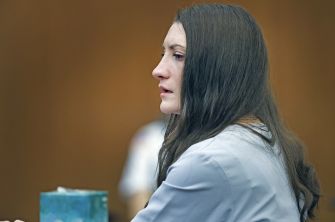
Photo Source: Greg Derr/The Patriot Ledger via AP, Pool via apnews.com
The murder trial of Lindsay Clancy ended without a verdict after seven days of deliberations, even though three jurors now say 11 members of the panel believed she should be found not guilty by reason of insanity.
For families and observers who followed the case closely, that outcome can feel difficult to understand. Eleven jurors reportedly reached the same conclusion, yet one juror’s refusal to join them was enough to leave the case unresolved.
Clancy, 36, was charged with murdering her three children: Cora, 5, Dawson, 3, and Callan, 8 months, at the family’s Duxbury home in January 2023. She acknowledged killing the children. Her defense centered on her mental condition at the time, arguing that she was experiencing postpartum psychosis and was not criminally responsible for what she had done.
The case brought two painful realities into the same courtroom: the deaths of three young children and the question of whether their mother was suffering from a severe mental illness that left her unable to understand or control her actions.
After days of deliberations, jurors told Plymouth Superior Court Judge William Sullivan they could not agree. Sullivan eventually declared a mistrial on September 4 after repeated attempts to help the panel reach a unanimous decision failed.
The public learned more about those deliberations after the trial ended.
The jury foreperson and two other jurors told NBC10 Boston that the panel was divided 11–1. They said 11 jurors favored finding Clancy not guilty by reason of insanity, while one male juror refused to join them.
According to the foreperson, the holdout juror also said he had reasonable doubt about whether Clancy was criminally responsible. Other jurors said they struggled to reconcile that statement with his refusal to vote for the insanity verdict.
The revelation has left many people asking how one juror could prevent an outcome supported by the other 11.
Massachusetts Rule of Criminal Procedure 27 requires a unanimous jury verdict. All 12 jurors must agree before a court can enter either a conviction or an acquittal. An 11–1 split therefore leaves the jury deadlocked, regardless of which side has the larger number.
That rule serves an important purpose in criminal cases. A person cannot be convicted unless every juror agrees that prosecutors have met the required burden of proof.
The same unanimity requirement applies when jurors believe a defendant should be acquitted.
Sullivan repeatedly asked the jurors to continue deliberating and revisited the law governing reasonable doubt after concerns developed over the holdout juror.
Clancy’s lawyers asked the judge to remove him. They argued that the juror was refusing to follow the court’s legal instructions rather than simply viewing the evidence differently. Sullivan declined.
The defense then sought emergency relief from the Massachusetts Supreme Judicial Court in an effort to have the juror removed. The attempt was unsuccessful, and the same 12 jurors continued deliberating until Sullivan determined that they were unlikely to reach agreement.
Courts are cautious about removing jurors during deliberations because disagreement itself is part of the jury process.
A juror can look at the same testimony, expert opinions, and evidence as everyone else and reach a different conclusion. Removing someone simply because 11 other jurors disagree could undermine the independence of the jury.
Clancy’s attorneys argued that something different had happened here. They maintained that a juror who admitted having reasonable doubt about criminal responsibility while refusing to vote accordingly was failing to apply the law the judge had given the panel.
Sullivan concluded there was not enough basis to remove him.
The jurors’ later interviews give the public a rare glimpse into how close the case came to a verdict. Legally, though, those interviews cannot supply the unanimous decision that was missing inside the courtroom.
The case turned on Massachusetts law governing criminal responsibility.
Once evidence raises the issue, prosecutors must prove beyond a reasonable doubt that the defendant was criminally responsible when the crime occurred.
Jurors are instructed that if they have reasonable doubt about criminal responsibility, they must return a verdict of not guilty by reason of lack of criminal responsibility.
Massachusetts follows a standard developed in the state Supreme Judicial Court’s 1967 decision in Commonwealth v. McHoul.
A person lacks criminal responsibility when, because of a mental disease or defect, the person lacked substantial capacity to understand that the conduct was wrong or to conform the conduct to the requirements of the law.
That question became the heart of Clancy’s trial.
Her defense presented evidence that her mental health deteriorated after the birth of her youngest child. Attorneys argued that she was experiencing postpartum psychosis when she killed the children and could not be held criminally responsible under Massachusetts law.
Postpartum psychosis is a rare and serious psychiatric condition that can involve hallucinations, delusions, confusion, and a loss of contact with reality.
Prosecutors argued that Clancy’s conduct showed awareness and planning. They pointed to evidence that she sent her husband, Patrick, away from the home before the killings and took other actions they said showed that she understood what she was doing.
Experts offered competing views of her mental condition.
Defense witnesses supported the position that postpartum psychosis deprived Clancy of criminal responsibility. The prosecution presented evidence supporting its argument that she retained the ability to appreciate the wrongfulness of her conduct.
The reported 11–1 split suggests most jurors ultimately had reasonable doubt about the prosecution’s position on criminal responsibility.
One juror did not agree to the verdict.
That single disagreement had enormous consequences. Clancy did not receive an acquittal. Prosecutors did not receive a conviction. The deaths of Cora, Dawson, and Callan remain at the center of a criminal case that still has no final resolution.
A mistrial allows prosecutors to try the case again because no verdict was entered.
double jeopardyDouble jeopardy is the constitutional protection that generally prevents a person from being prosecuted or punished more than once for the same criminal offense. The protection appears in the Fifth Amendment and applies to both federal and state prosecutions.Read more → generally prevents the government from prosecuting someone again after an acquittal. A jury that cannot reach a verdict creates a different legal situation, leaving prosecutors with the option of presenting the case to another jury.
Plymouth County District Attorney Timothy Cruz has not yet announced whether his office will pursue a second trial. A court hearing is scheduled for September 29 to discuss what happens next.
Prosecutors could seek a retrial, reach a plea agreement or dismiss the charges. Another trial would ask a new group of 12 jurors to confront the same central question about Clancy’s mental state on the day her children died.
Clancy remains in custody at a state psychiatric hospital.
If convicted of first-degree murder, she could face life imprisonment without parole. A verdict of not guilty by reason of insanity would also carry serious consequences. It would not necessarily result in her immediate release, and she could remain committed to a psychiatric facility subject to continuing court review.
The jurors’ public comments have made an already painful case even more difficult to absorb.
Eleven people reportedly believed prosecutors had not proved beyond a reasonable doubt that Clancy was criminally responsible. One juror would not join them.
That is why a trial that came within one vote of an insanity acquittal ended instead with no verdict at all, leaving another difficult decision ahead for prosecutors, and unresolved grief for Clancy’s family and a community that has already spent years living with the loss of three young children.
Share This Article
If you found this article insightful, consider sharing it with your network.
Xiolene is a contributing journalist with more than a decade of experience in management, operations, and client service. Her background spans the veterinary and beauty industries, giving her experience working with businesses, consumers, employees, and service-focused organizations. Xiolene brings a practical business and consumer perspective to her coverage, focusing on making complex news and current events clear and accessible to readers.
Lindsay Clancy’s attorneys are asking a Massachusetts judge to dismiss the murder charges against her, arguing that the September 4 mistrial violated constitutional protections against double jeopardy because the court ended deliberations without sufficiently examining concerns about the lone holdout juror.Attorneys Martin Weinberg and Kevin Reddington filed the motion Monday...
Read
More »
Lindsay Clancy’s murder trial ended in a mistrial Friday after a Massachusetts jury failed to reach a unanimous verdict on whether she was criminally responsible for killing her three young children.Plymouth Superior Court Judge William Sullivan formally discharged the jury after seven days and about 36 hours of deliberations. It...
Read
More »
Lindsay Clancy’s defense lawyer asked President Donald Trump to pardon her after her Massachusetts murder trial ended in a mistrial, even though presidential pardon power does not extend to the state murder charges against her.Attorney Kevin Reddington made the appeal Tuesday on ABC’s “Good Morning America,” asking Trump to consider...
Read
More »
The Ohio Supreme Court on Tuesday denied Mackenzie Shirilla’s latest bid to revive her postconviction challenge, refusing to reconsider its June decision not to hear an appeal stemming from a petition filed one day late.The court issued no opinion explaining the denial. Justices Patrick DeWine and Jennifer Brunner dissented. DeWine...
Read
More »
Jurors in the Lindsay Clancy murder trial told the judge for a second straight day Wednesday that they could not reach a unanimous verdict, prompting a rare jury instruction and moving the case closer to a possible mistrial.The 12-member panel ended its fifth day of deliberations without a verdict after...
Read
More »
We use cookies and similar technologies to help our website function, understand how visitors use our site, and improve your experience. Some cookies are necessary for the website to operate, while others may be used for analytics or advertising.