Attention consumers: The United States Department of Agriculture rang in the New Year with new, mandated food labels. Starting January 1, 2022, “GMO” and “GE” are out and “bioengineered” is in.
Back in the 1970’s scientists began experimenting with ways to introduce more desirable characteristics into plants and animals. In the 1990s research with DNA led to full-fledged bioengineering, a process that allows genetic material to be manipulated. In the 1990s, altered crops like tomatoes and rice were created with features such as increased nutritional value, longer shelf lives, or increased resistance to insects. These foods soon began showing up in the U.S. where they caused mass confusion.
Now, thanks to a new labeling mandate from the United States Department of Agriculture (USDA), consumers should have more information about what is in their food because they will be able to see and identify which foods are “bioengineered.” USDA defines a “bioengineered” food as one that “contains genetic material that has been modified through certain laboratory techniques and for which the modification could not be obtained through conventional breeding or found in nature.” The new name replaces the more familiar “GMO,” which stood for genetically modified organisms, and “GE,” the previous term for “genetically engineered.”
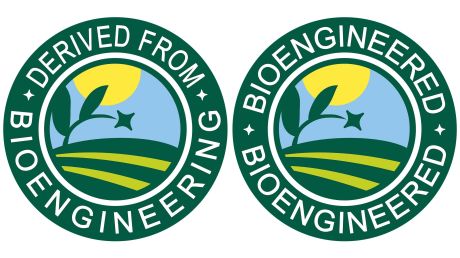
Photo Source: United States Department of Agriculture 2022 Bioengineered Labels
The label mandate gives manufacturers a choice of two new labels, each of which has a happy graphic farm scene that features a plant and a row of crops under a blue sky and shining sun. Each picture is surrounded by a green circle encircled with either the word “bioengineered” or encircled by the words “derived from bioengineering.” If shoppers want more information they can call an included phone number or scan a QR code. A spokesperson for USDA calls the labels “a uniform, national standard.”
USDA hopes the new, standardized name and label will reduce concerns about health and safety. Michigan State University Extension scientist Ronald Goldy partially agrees. He wrote, “This new label will be the most reliable way for consumers to differentiate foods containing GMOs from those that do not.” However, he acknowledged that despite the change, “GMO food labeling can be confusing and misleading.”
The Washington Post reports that the National Academy of Science and the federal government’s Food and Drug Administration (FDA) found that “bioengineered foods pose no risk to human health. But some public health groups remain concerned.” Gregory Jaffee of the Center for Science in the Public Interest, a nonprofit health advocacy organization, told the Post that the term “bioengineered” is unfamiliar and is likely to cause more confusion. He thinks the new name was chosen because the old one, GMO “has come to be perceived as pejorative.”
But scientists weigh in with a history lesson about the process of “human directed genetic manipulation,” that could bring some comfort to those with concerns. They say DNA archeological evidence revealed that innovative breeding practices began around 12,000 BC and led to the domestication of dogs, whose ancestors were grey wolves. Sheep, cattle, pigs and goats followed around 9,000 BC.
Along with the label requirement, USDA released an official List of Bioengineered Foods that contains 13 items: alfalfa, canola, corn, cotton, potatoes, soybeans, and sugarbeets, along with certain varieties of apples, eggplants, papayas, pineapples, salmon and squash.
The Department also explained that their list is not complete because it exempts some “highly refined” ingredients like some sugars and oils, which have genetic material that are below its “detectability threshold of about five percent. Such products have the option of carrying a label that features the green circle and reads “derived from bioengineering.” Food manufacturers with under $2.5 million in yearly sales are also exempt as are restaurants. Larger food manufacturers are not pleased because of the timing of the new mandate. It took effect during the COVID-19 pandemic, which was already causing them serious problems related to supply chain disruptions and safety concerns.
The Center for Food Safety, another national, non-profit public interest and environmental advocacy organization told the Post, the “rules don’t go far enough and will leave the majority of altered foods without labels.” There is also alarm about whether consumers will be able to access information that is only available through smartphones. What if a potential buyer doesn’t have one or if the grocery store lacks access to Wi-Fi. With these requirements, can grandma get what she needs to make an informed decision?
The new term and labels are quite a long time coming. In 2016, Congress ordered the agency to create a “national mandatory standard” to disclose bioengineered foods. It was supposed to be implemented in 2020, but lagged until the mandatory compliance date of January 1, 2022. The inaction led to confusion and worries about safety, short- and long-term health effects, and environmental concerns. Uncertainty was multiplied because individual states were responsible for setting labeling requirements.
Now, seven years later, there is finally one standard and one label. Mostly.
Share This Article
If you found this article insightful, consider sharing it with your network.
Maureen is a graduate of Catholic University Law School and holds a Master's degree from USC. She is a licensed attorney in California and was an Emeritus Professor of Journalism at California State University, Northridge specializing in media law and writing. With a background in both the Carter White House and the U.S. Congress, Maureen enriches her scholarly work with an extensive foundation of real-world knowledge.
Colorado home cooks will soon be able to legally sell tamales, burritos and other refrigerated or meat-filled foods made in their own kitchens under a major expansion of the state’s cottage-food law.The changes take effect January 1 under House Bill 26-1033, known as the “Tamale Act.” Colorado is already preparing...
Read
More »
Hemp-derived THC gummies and beverages legally sold under state law in parts of the country could lose their status as hemp under federal law this fall under a new definition Congress adopted last year.The change is scheduled to take effect Nov. 12 and would exclude finished hemp-derived cannabinoid products containing...
Read
More »
The U.S. Supreme Court ruled Thursday that federal pesticide law bars a Missouri man’s failure-to-warn claim against Monsanto over Roundup, a decision that gives the company a major win in litigation over cancer warnings on the widely used weed killer.In a 7-2 decision, the Court reversed a Missouri appeals court...
Read
More »
California’s ban on consumer-facing “sell by” food labels took effect July 1, making the state the first in the nation to require standardized date language on most food products sold to consumers.The new law, Assembly Bill 660, requires food manufacturers, processors and retailers that use date labels on food manufactured...
Read
More »
As schools and workplaces prepare for post-COVID-19 reopening, people are increasingly concerned about new laws that could impose mandatory vaccination requirements. They wonder whether children and employees will be subject to mandates that call for shots in arms.
To understand the complexity of pertinent regulations, it is necessary to review...
Read
More »