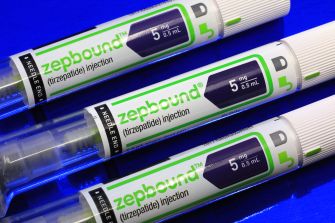
Novo Nordisk has sued Eli Lilly over national advertising campaigns for the companies' competing weight loss and diabetes drugs, alleging that Lilly is misleading consumers by using older clinical trials to claim its treatments are more effective.
The lawsuit, filed Tuesday in U.S. District Court in New Jersey, challenges advertisements comparing Lilly's Zepbound with Novo's Wegovy and Mounjaro with Ozempic. Novo claims the campaigns compare higher doses of Lilly's drugs with lower doses of its own treatments while failing to adequately account for newer doses and clinical data.
At the center of the dispute is a television advertisement comparing Zepbound and Wegovy. The ad states that patients taking Zepbound lost an average of 50 pounds, compared with 33 pounds for patients taking the 2.4 milligram dose of Wegovy. Those figures come from a head-to-head clinical trial comparing the drugs.
Novo does not dispute that the trial produced those results. Instead, the drugmaker argues that using them to suggest Zepbound remains more effective is misleading because a higher 7.2 milligram dose of Wegovy became available in March.
A separate study of that higher dose showed average weight loss of about 19%, or approximately 47 pounds, according to Novo. No head-to-head trial has compared the highest doses of Wegovy and Zepbound currently available, meaning the newer Wegovy results and Lilly's Zepbound results come from different clinical studies.
Lilly's advertisements acknowledge the higher Wegovy dose in a footnote, according to the lawsuit. Novo claims the disclosure is difficult to read and does not adequately tell consumers that the higher dose produced greater weight loss than the dose featured in Lilly's comparison.
Similar allegations involve Mounjaro and Ozempic. Novo claims Lilly advertises weight loss results from the highest Mounjaro dose against results from a lower Ozempic dose without adequately accounting for a higher Ozempic maintenance dose that has been available for several years.
Novo is bringing federal and state false advertising and unfair competition claims, including a claim under the Lanham Act. The federal law allows businesses to sue over commercial advertising that falsely or misleadingly describes the nature, characteristics, or qualities of their own products or those sold by another company.
False advertising law can reach more than claims that are simply made up. An advertisement can also face a legal challenge when the words or figures it uses are accurate, but the way they are presented allegedly gives consumers a misleading impression. That distinction is central to Novo's claims over Lilly's use of earlier clinical trial results.
To pursue a Lanham Act false advertising claim, a business generally must show that the challenged statement is false or misleading, could influence purchasing decisions, and is likely to cause commercial harm. That harm can include lost sales or damage to a company's business reputation.
Prescription drug advertising is also subject to federal oversight. The Food and Drug Administration requires prescription drug promotions to be truthful and not misleading and has identified unsupported claims, omitted material facts, distorted study data, and misleading drug comparisons as potential advertising problems.
FDA oversight is separate from Novo's lawsuit, which relies on the Lanham Act and related state laws rather than an agency enforcement action.
According to the complaint, Lilly's Zepbound television campaign has generated more than 700 million impressions since it began airing around the end of April. Novo cites the reach of the campaign as evidence of the scale of the alleged harm to its business.
Competition between the companies has intensified as Zepbound and Mounjaro have gained ground in the market for GLP-1 drugs used to treat obesity and type 2 diabetes. Novo has responded with newer treatment options, including the higher Wegovy dose at issue in the lawsuit.
Lilly disputes Novo's claims and says its advertisements rely on the strongest available evidence because the cited study directly compared Zepbound and Wegovy. The company says it stands behind the campaign and plans to defend it in court.
Novo is asking a federal judge to stop the challenged advertisements, require corrective advertising and award damages. The company has also said it plans to seek a preliminary injunctionA preliminary injunction is a temporary court order issued before a case is finally decided that requires a party to take or stop an action while the litigation continues. Federal courts generally consider the likelihood of success, irreparable harm, the balance of equities, and the public interest before granting one.Read more → if Lilly does not remove the ads voluntarily. The case remains pending in U.S. District Court for the District of New Jersey, and the court has not yet ruled on Novo's claims.
Share This Article
If you found this article insightful, consider sharing it with your network.
Bridget studied Communications and Marketing at California State University, Long Beach. She also has experience in the live music events industry, which has allowed her to travel to festivals around the world. During this period, she acquired valuable expertise in branding, marketing, event planning, and public relations.
The pharmaceutical industry’s leading trade group is suing the Trump administration over a new Medicare drug-pricing program that could lower out-of-pocket costs for some patients receiving expensive cancer, autoimmune, and other medications administered in medical settings.The Pharmaceutical Research and Manufacturers of America, or PhRMA, filed the lawsuit on October 7,...
Read
More »
A Walgreens whistleblower who received more than $25 million from a federal fraud settlement must turn to state courts to pursue a share of the pharmacy chain’s separate $4.7 billion opioid settlement with states, a federal judge has ruled.U.S. District Judge Joan H. Lefkow of the Northern District of Illinois...
Read
More »
Chobani must face a proposed class action accusing the company of misleading consumers by marketing yogurt as sugar-free even though each serving allegedly contains four grams of allulose, a sweetener that a federal appeals court found qualifies as sugar under federal labeling rules.The 7th U.S. Circuit Court of Appeals in...
Read
More »
Novo Nordisk must face part of a securities fraud lawsuit accusing the drugmaker of misleading investors about dosing and tolerability in a late-stage clinical trial for CagriSema, after a federal judge allowed a narrower set of shareholder claims to move forward.U.S. District Judge Robert Kirsch in New Jersey ruled Tuesday...
Read
More »
GSK (GSK.L) and several other pharmaceutical companies, including Pfizer (PFE.N), Sanofi (SASY.PA), and Boehringer Ingelheim, are requesting permission from a Delaware court to appeal a ruling that allows over 70,000 lawsuits alleging that the heartburn drug Zantac causes cancer to proceed. The appeal, if granted by Judge Vivian Medinilla of...
Read
More »
We use cookies and similar technologies to help our website function, understand how visitors use our site, and improve your experience. Some cookies are necessary for the website to operate, while others may be used for analytics or advertising.