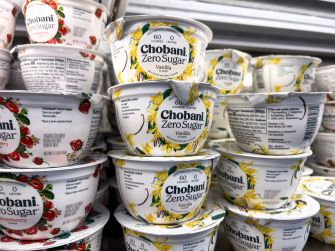
Chobani must face a proposed class action accusing the company of misleading consumers by marketing yogurt as sugar-free even though each serving allegedly contains four grams of allulose, a sweetener that a federal appeals court found qualifies as sugar under federal labeling rules.
The 7th U.S. Circuit Court of Appeals in Chicago revived the lawsuit Monday, reversing a federal judge who had found that Food and Drug Administration guidance protected Chobani’s labeling from state consumer claims. A three-judge panel ruled that the guidance did not change the federal regulation defining sugar.
Jason and Abigail Franco say they bought Chobani Zero Sugar yogurt at a Costco in Oak Brook, Illinois, in 2023 after seeing the product’s zero sugar claims. Their lawsuit alleges they would not have bought the yogurt, or would have paid less, had they known it contained allulose.
Chobani maintains that allulose is a naturally occurring non-sugar sweetener. The New York company said its Nutrition Facts panel accurately reports zero grams of total sugar and zero grams of added sugar.
Federal regulations allow companies to describe food as sugar-free, zero sugar, or no sugar only when it contains less than 0.5 grams of sugar per serving and meets other labeling requirements. A related rule defines total sugars as all free monosaccharides and disaccharides.
Allulose is a monosaccharide, but it affects the body differently from traditional sugars. FDA guidance allows food companies to leave allulose out of the total sugars and added sugars figures on a Nutrition Facts panel. Manufacturers must still include it in the product’s total carbohydrate amount.
The appeal turned on whether that enforcement policy also permitted Chobani to make a broader zero sugar statement elsewhere on the package.
U.S. District Judge John Tharp Jr. dismissed the lawsuit in May 2025 after finding that federal law barred the Francos’ state consumer claims. Tharp relied on the FDA’s treatment of allulose and concluded that the agency had permitted the disputed labeling.
Circuit Judge Thomas Kirsch, writing for the appeals court, reached a different conclusion. The federal regulation lists glucose, fructose, lactose and sucrose as examples of sugars, but the panel found that the list was not meant to exclude other monosaccharides.
The court also relied on the FDA’s position that allulose remains within the rule’s definition of total sugars. While the agency currently allows companies to omit allulose from certain figures on the Nutrition Facts panel, its guidance states that the policy is not legally binding and remains subject to possible rulemaking.
Federal food law can block state labeling lawsuits when they would require a company to follow standards different from those imposed by the FDA. The doctrine, known as federal preemption, is meant to prevent food makers from facing conflicting label rules across the country.
Preemption does not necessarily stop a state consumer lawsuit that seeks to enforce the same standard already found in federal law. The appeals court found that the Francos’ claims fit within that category because they allege Chobani used a zero sugar claim that federal regulations already prohibited.
The distinction between a regulation and enforcement guidance was central to the ruling. A regulation carries the force of law after the agency completes a formal rulemaking process. Guidance generally explains an agency’s current position or how it plans to enforce a rule, but it does not rewrite the regulation itself.
The panel found that the FDA had chosen not to enforce parts of its labeling rules against companies that exclude allulose from the Nutrition Facts sugar figures. That decision did not remove allulose from the legal definition of sugar or expressly authorize every zero sugar statement appearing elsewhere on a package.
Consumer protection laws generally prohibit advertising that is false or likely to mislead a reasonable buyer. Consumers may claim a financial loss by alleging that they bought a product they otherwise would have avoided or paid more because of a disputed statement.
Chobani argued that buyers concerned about sugar would not view allulose the same way as traditional sugar because allulose contains fewer calories and is processed differently by the body. The appeals court found that the argument could not resolve the lawsuit at its earliest stage because the package allegedly made an absolute promise that the yogurt contained no sugar.
The appeals court did not decide whether Chobani’s label actually misled consumers. The Francos must still show that reasonable buyers understood “Zero Sugar” to mean the yogurt contained no sugar and that the statement affected their purchasing decisions.
The case will return to U.S. District Judge John Tharp Jr. in Chicago for further proceedings.