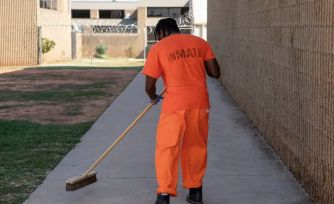
Oklahoma prisoners were paid $2 an hour to make political calls linked to a conservative super PAC while a private contractor paid the state $10 for every inmate hour worked, under a prison call-center program operating inside four state correctional facilities.
The call centers were established through a partnership between the Oklahoma Department of Corrections and HBW Leads. Contracts obtained by Oklahoma Watch through public records requests expressly allow “telemarketing and political polling activity.”
Four incarcerated workers interviewed by Oklahoma Watch described the call-center operation. Some said political scripts went beyond traditional polling, criticizing candidates, promoting their opponents and asking voters for support.
Workers said some scripts identified Make Liberty Win, a Virginia-based conservative super PAC that works to elect conservative state lawmakers, as paying for the calls.
Federal Election Commission records provide a separate financial link. Make Liberty Win paid nearly $600,000 this year to Visible Trends for political calling services. Visible Trends was launched by HBW Leads as a separate political calling business, and the companies share an Ohio address.
HBW Leads operates the prison call centers, while Visible Trends handled the political calling work purchased by Make Liberty Win.
Make Liberty Win Executive Director Barrett Young said the super PAC did not know prison labor was being used. He said the organization had already ended its relationship with the vendor because of poor performance. Its most recent reported payment to Visible Trends was made June 29.
The arrangement raises a legal question: How can incarcerated workers be paid $2 an hour when the federal minimum wage is $7.25?
Oklahoma's prison industry rules allow certain inmate service jobs to be paid differently from prison manufacturing work.
Under current Department of Corrections policy, incarcerated workers producing tangible goods for interstate commerce generally must receive at least the federal minimum wage and wages comparable to similar private-sector jobs. Service operations that do not produce tangible goods, including call centers, fall under a separate system in which Oklahoma correctional industry officials determine the wage.
Those service partnerships operate outside federal Prison Industry Enhancement Certification Program wage requirements that apply to certain prison industries producing goods.
The $2 rate is set within Oklahoma's correctional industries system rather than through an ordinary employment relationship between an inmate and HBW Leads.
Under the company's contracts, HBW Leads pays the Department of Corrections $10 for each hour an inmate works. The worker receives $2 an hour, with possible bonuses for completing surveys or generating leads. The remaining $8 is allocated to Oklahoma Correctional Industries for overhead.
Federal minimum-wage law also does not automatically treat incarcerated workers as ordinary employees.
In 1993, the U.S. Court of Appeals for the Tenth Circuit rejected a Fair Labor Standards Act lawsuit brought by Oklahoma prisoners seeking minimum wages for work performed through the state's correctional industries program. The court found that the inmates were not employees covered by federal wage law because their relationship with the state arose primarily from incarceration rather than ordinary employment.
The ruling does not establish that every prison labor arrangement involving a private business is exempt from federal minimum-wage requirements. Courts have treated some arrangements differently when incarcerated people work directly for outside employers. But the Tenth Circuit decision remains important precedent in Oklahoma and helps explain how the state's correctional industry system can authorize wages below the federal minimum.
Oklahoma policy requires participation in private-sector prison industry programs to be voluntary. One worker told Oklahoma Watch that the call-center job was voluntary and described it as the best-paying work available inside the prison.
Other workers raised concerns about the political content they were asked to deliver.
Steve Wilbanks, an inmate at James Crabtree Correctional Center, told Oklahoma Watch that prisoners were given scripts for political calls without always having much context about the candidates or issues they were discussing.
Some scripts criticized candidates, promoted their opponents and ended by asking voters for support, according to Wilbanks. He said inmates were sometimes discussing political terms and candidates they knew little about after spending years behind bars.
The Department of Corrections said calls advocating for candidates still fall within the contracts' authorization for political polling. The agency also said it regularly reviews call-center materials for compliance with state and federal law.
The centers were operating at James Crabtree Correctional Center, Mabel Bassett Correctional Center, Lexington Correctional Center and Joseph Harp Correctional Center as of Aug. 21. Workers told Oklahoma Watch they could make hundreds of calls in a day.
Oklahoma has faced scrutiny over prison political call centers before.
In 2019, the presidential campaign of former New York City Mayor Mike Bloomberg cut ties with a contractor after learning that incarcerated women in Oklahoma had been used to make campaign calls. Bloomberg's campaign said at the time that it had not known prison labor was involved.
The Oklahoma prison call centers were later temporarily shut down following an unrelated security scandal. The latest contracts show the program has returned, with political polling expressly included among the services incarcerated workers can perform.