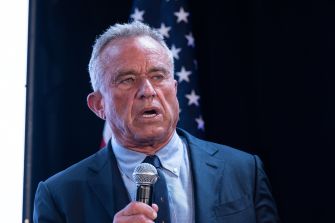
Health and Human Services Secretary Robert F. Kennedy Jr. faces renewed calls for impeachment following Democrats' November 3, 2026, congressional election victories, as lawmakers investigate his testimony about a trip to Samoa and more than $250,000 in reported gifts from a political donor.
Rep. Jim Clyburn, D-S.C., has identified Kennedy as a priority for possible impeachment when Democrats take control of the House in January. Rep. Jamie Raskin, D-Md., a leading contender to chair the House Judiciary Committee, has pledged to pursue congressional oversight of the health secretary's conduct, while Sen. Bernie Sanders, I-Vt., has expressed openness to impeachment proceedings.
The effort could build on an impeachment resolution introduced December 10, 2025, by Rep. Haley Stevens, D-Mich., and co-sponsored by Rep. Eric Swalwell, D-Calif. The measure, H.Res. 944, accuses Kennedy of abusing his authority, weakening federal health agencies and endangering public health. It was referred to the House Judiciary Committee, where it awaits consideration.
Stevens cites cuts to medical research funding, the removal of federal vaccine advisers, and changes to immunization recommendations. Her resolution also accuses Kennedy of failing to carry out responsibilities established under federal law, including oversight of the Food and Drug Administration and the Centers for Disease Control and Prevention.
The impeachment push comes as Sens. Ron Wyden, D-Ore., and Angela Alsobrooks, D-Md., examine whether Kennedy misled Congress about a 2019 trip to Samoa, where a measles outbreak later killed 83 people, most of them children.
During his Senate confirmation hearing, Kennedy testified that the trip had nothing to do with vaccines. Documents concerning his visit have raised questions about that account, prompting the senators on November 12 to request travel records and communications from Children's Health Defense, the vaccine-skeptical organization Kennedy previously chaired.
The inquiry also seeks communications between the organization and the federal government during President Donald Trump's second term. Lawmakers are examining Kennedy's involvement in vaccine-related advocacy during the visit and whether his statements to Congress accurately described its purpose.
HHS has rejected allegations that Kennedy lied to lawmakers, calling claims that he gave false testimony about the Samoa trip false and defamatory.
A separate inquiry announced November 11 concerns luxury travel and lodging reportedly provided to Kennedy by Gavin de Becker, a former campaign donor and employee. The arrangements include an estimated $126,000 in lodging at de Becker's Washington, D.C., property, $97,000 in airfare to Fiji and $45,000 in flights to Greece.
Wyden and Alsobrooks are examining whether the benefits complied with federal ethics rules governing gifts to government officials. In letters to Kennedy and de Becker, they requested details about the travel, accommodations, and financial arrangements, including whether the expenses were treated as personal gifts or business costs.
Under federal ethics rules, government officials generally cannot accept gifts from a prohibited source, which includes someone whose financial interests could be substantially affected by their official duties. The rules allow exceptions for gifts based on genuine personal friendships, but the relationship and circumstances surrounding the gifts determine whether an exception applies. Wyden and Alsobrooks are questioning whether de Becker qualified as a prohibited source and whether Kennedy was permitted to accept the travel and accommodations.
Kennedy's representatives have maintained that he complies with federal ethics and disclosure rules. HHS has also defended his management of the department and its public health policies.
The scrutiny has extended beyond Democratic lawmakers. Sen. Bill Cassidy, R-La., a physician who chairs the Senate committee overseeing health policy, criticized Kennedy's leadership in a November 15 interview, citing a series of failures. Cassidy stopped short of endorsing impeachment, saying lawmakers would have to decide whether to pursue it.
The Constitution permits Congress to impeach Cabinet secretaries for treason, bribery, or other high crimes and misdemeanors, a standard that covers serious abuses of public office and does not require a criminal conviction. The House can approve articles of impeachment by a simple majority, while conviction and removal require a two-thirds Senate vote.
Only two Cabinet secretaries have been impeached in U.S. history. Secretary of War William Belknap was impeached in 1876, and Homeland Security Secretary Alejandro Mayorkas in 2024. Neither was convicted by the Senate.
Kennedy faces a November 30 deadline to respond to the senators' questions about his reported gifts. His responses could inform further congressional scrutiny before Democrats take control of the House in January. Any effort to pursue the existing impeachment allegations in the new Congress would require lawmakers to introduce a new resolution.