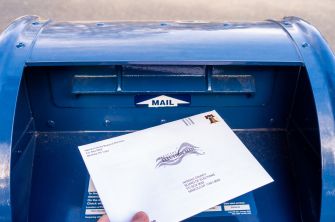
The U.S. Supreme Court upheld a Mississippi mail ballot law Monday, ruling that federal election statutes do not bar the state from counting absentee ballots that are postmarked by Election Day but arrive within five business days.
The 5-to-4 decision in Watson v. Republican National Committee reversed a ruling from the U.S. Court of Appeals for the Fifth Circuit and rejected a challenge brought by the Republican National Committee, the Mississippi Republican Party, the Libertarian Party of Mississippi and several voters. The challengers argued that federal law requires absentee ballots in federal elections to be both cast and received by Election Day.
Justice Amy Coney Barrett wrote the majority opinion, joined by Chief Justice John Roberts and Justices Sonia Sotomayor, Elena Kagan and Ketanji Brown Jackson. Justice Samuel Alito dissented, joined by Justices Clarence Thomas and Neil Gorsuch. Justice Brett Kavanaugh joined most of the dissent.
Mississippi allows certain voters, including senior citizens and college students away from home, to cast absentee ballots in federal elections. Under the state law, absentee ballots must be postmarked on or before Election Day and received by local election officials no more than five business days later.
The ruling preserves Mississippi’s system and could affect other states with similar ballot receipt rules. Several states and territories allow regular mail ballots to arrive after Election Day if voters mailed them on time. A broader group of states also count at least some absentee ballots received after Election Day, including ballots from military and overseas voters.
The case turned on the meaning of federal laws that set a uniform day for the election of the president, senators and members of the House of Representatives. The Republican committees and other challengers claimed that those statutes make Election Day the deadline not only for casting ballots, but also for election officials to receive them.
Barrett wrote that the federal laws do not go that far. The majority said the core act of an election is the voters’ choice, and that choice is made when voting is complete. Because Mississippi requires voters to mail their absentee ballots by Election Day, the Court concluded that the state has not extended the federal election beyond the date Congress set.
The ruling relied heavily on statutory interpretation, the way courts read and apply the words Congress used. The majority said the federal election-day statutes speak to when voters must choose candidates, but do not say when mailed ballots must reach election officials.
The opinion also pointed to federal law governing military and overseas voters, which refers to state ballot receipt deadlines. For the majority, those references showed that Congress has long understood receipt deadlines as an area states may regulate.
The Supreme Court held that Congress set a national Election Day, but did not impose a national deadline for receiving mailed ballots.
Mail voting separates three steps that often happen at once in person. A voter may complete and mail a ballot by the required day. Election officials may receive it later. Counting and certification may take place after that. The Court said the federal statutes regulate the first step, the voter’s act of making a choice, rather than every later step in election administration.
Mississippi and its supporters argued that a contrary ruling would disrupt state systems that account for mail delays, weather events and voters who cannot cast ballots in person. Voting rights groups also warned that an Election Day receipt rule could disqualify ballots that voters mailed on time, but that arrived late because of postal delays.
The challengers argued that late-arriving ballots conflict with the legal meaning of Election Day and could undermine public confidence in election results. Alito’s dissent said the electorate’s choice is not complete until election officials have received the full collection of ballots that will determine the outcome. In his view, accepting ballots after Election Day extends the federal election beyond the date Congress required.
The dissent also raised concerns about election integrity, delayed results and public trust. The majority acknowledged those concerns but said policy arguments about whether late-arriving ballots should be counted belong to lawmakers, not courts, unless Congress has already enacted the rule the challengers sought.
The decision leaves Mississippi’s five-business-day receipt rule in place for absentee ballots postmarked by Election Day. The Court limited its ruling to the federal election-day statutes, holding that those laws do not set a national ballot receipt deadline.
The Supreme Court reversed the Fifth Circuit’s judgment and sent the case back to the lower court for further proceedings consistent with its opinion.