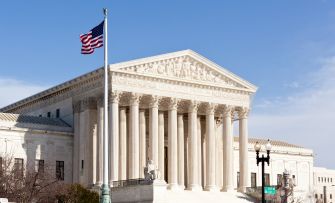
The U.S. Supreme Court has blocked Missouri from using a newly drawn congressional map in the November midterm election, stepping into an escalating legal battle that had produced directly conflicting orders from state and federal courts.
In an unsigned order issued Thursday, September 10, the justices granted an emergency request from People Not Politicians and other opponents of the map. The Court stayed a September 8 order from Chief U.S. District Judge Stephen Clark that required Missouri election officials to use the new districts. No justice publicly dissented.
The ruling gives immediate effect to an earlier decision from the Missouri Supreme Court, which held that the new congressional map never became operative because opponents successfully invoked Missouri’s referendum process. The older congressional districts adopted in 2022 are now expected to govern the November 3 election while the federal litigation continues.
The decision lands less than two months before an election that could determine control of the U.S. House of Representatives.
Missouri Voters Forced the New Map Onto the Ballot
Missouri’s Republican-controlled legislature approved House Bill 1 in September 2025 as part of a mid-decade redistricting effort encouraged by President Donald Trump. The new boundaries substantially reshaped the Kansas City-based 5th Congressional District represented by Democrat Emanuel Cleaver.
Republicans currently hold six of Missouri’s eight congressional seats. The new map was drawn to improve the party’s chances of capturing a seventh seat by breaking apart much of Cleaver’s existing district and combining Kansas City voters with more Republican areas.
People Not Politicians responded by collecting more than 300,000 signatures for a referendum seeking to place HB 1 before Missouri voters. Secretary of State Denny Hoskins rejected the petition, maintaining that Missouri’s referendum provisions did not extend to congressional redistricting.
The Missouri Supreme Court unanimously disagreed on September 3. Missouri’s Constitution reserves to voters the power to approve or reject by referendum “any act of the general assembly,” and the state’s highest court concluded that congressional redistricting falls within that provision.
Because the referendum petition was legal, sufficient, and timely, the court held that HB 1 never took effect. Voters will decide the map’s future in November, while the 2022 districts remain operative for the upcoming congressional election.
A Federal Judge Created a Direct Conflict Between the Courts
Missouri Republicans then pursued another route through federal court.
U.S. Rep. Bob Onder, Missouri state Sen. Rick Brattin and two voters filed a federal lawsuit challenging the consequences of changing congressional maps after Missouri had already conducted its August primary using the 2025 districts.
Judge Clark rejected their argument that Missouri’s referendum process violated the federal Elections Clause. Supreme Court precedent recognizes that states may include voters and referendum procedures within their lawmaking process for congressional elections.
Clark found greater force in a different constitutional argument.
Because Missouri conducted its primary under the HB 1 districts, Clark concluded that switching to another map for the general election could effectively nullify some primary votes. Candidates had already been nominated under districts that would cease to exist, while some voters could find themselves assigned to a district in which they had never participated in choosing the party nominees.
Clark found the plaintiffs likely to succeed on claims under Article I, Section 2 and the Equal Protection Clause. His temporary restraining order prohibited Missouri from using any congressional map other than HB 1 for the November election.
Suddenly, Missouri officials faced two judicial commands pointing in opposite directions.
Supreme Court Steps In After Previously Declining Intervention
The conflict became more unusual because the Supreme Court had already been involved.
On September 8, Justice Brett Kavanaugh rejected an emergency application from Missouri officials seeking to suspend the Missouri Supreme Court’s decision. Hours later, Clark issued his federal order requiring use of the very map the state court had prohibited.
The Eighth U.S. Circuit Court of Appeals declined on September 9 to immediately stay Clark’s order. People Not Politicians then went directly back to the Supreme Court.
This time, Kavanaugh referred the application to the full Court. The justices granted it.
Thursday’s order stays Clark’s ruling while the case proceeds through the Eighth Circuit and potentially returns to the Supreme Court through a petition for review. If the Court eventually declines to hear the case, the stay will terminate automatically. If the justices take the case, the stay remains in place until the Supreme Court sends down its judgment.
The brief order contains no explanation of the justices’ reasoning and does not resolve the underlying federal constitutional claims.
The Supreme Court Has Not Ruled the Missouri Map Unconstitutional
Thursday’s action does not hold that Missouri’s 2025 congressional districts amount to an unconstitutional partisan gerrymander. The Supreme Court has generally treated claims of excessive partisan gerrymandering as beyond the reach of federal courts.
The immediate dispute instead grew from Missouri’s own referendum process and the federal constitutional consequences of conducting a primary under one set of congressional boundaries and a general election under another.
Clark focused heavily on the Supreme Court’s longstanding concern about courts changing election rules close to voting. He reasoned that keeping the HB 1 districts would preserve the rules used during the primary and avoid widespread voter confusion.
The Supreme Court’s stay leaves that reasoning open for appellate review while removing Clark’s order as the immediate obstacle to implementation of the Missouri Supreme Court decision.
The dispute also underscores an unusual feature of American election law. State constitutions, state courts, federal constitutional protections and federal courts can all influence congressional elections, and the lines separating those powers can become particularly consequential when litigation reaches election deadlines.
Missouri Could Now Hold Its Primary and General Election Under Different Maps
The practical result may be a congressional election conducted under two different sets of district boundaries.
Missouri used the 2025 map during its August primary. Unless another court changes the current posture, it will use the 2022 map for the November 3 general election. Candidates and election officials must now adjust to districts that differ from the ones used to select party nominees.
The political stakes extend beyond Missouri. Republicans hold a narrow majority in the U.S. House, and the new Missouri map was part of a broader mid-decade redistricting campaign intended to increase the party’s chances of preserving control of Congress.
Missouri voters will also have their own say. The referendum concerning HB 1 is scheduled to appear on the November ballot.
After a week in which the Missouri Supreme Court, a federal district judge, the Eighth Circuit and the U.S. Supreme Court all became involved, the congressional boundaries for the 2026 general election are finally clearer.
The litigation over who had the authority to put them there is far from finished.