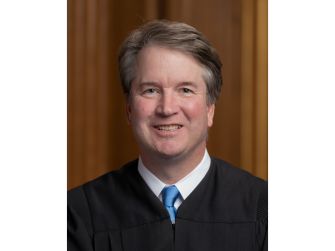
Supreme Court Justice Brett Kavanaugh blocked Missouri’s attempt Tuesday to use a Republican-backed congressional map in the November midterms, only for a federal judge to restore the same map minutes later.
Chief U.S. District Judge Stephen R. Clark ordered Missouri to continue using the districts approved by Republican lawmakers in 2025 and used during the state’s August primary. The map could help the GOP expand its congressional advantage from six of the state’s eight seats to seven.
Clark acted shortly after Kavanaugh declined to block a Missouri Supreme Court ruling requiring officials to return to the state’s 2022 congressional boundaries. The competing orders have pushed Missouri’s Nov. 3 House races back into court eight weeks before Election Day.
Clark’s temporary restraining order remains in effect for 14 days while the federal court considers whether longer relief is warranted. Opponents of the Republican-backed map immediately appealed to the U.S. Court of Appeals for the Eighth Circuit.
The two judges were considering separate cases. Kavanaugh left the Missouri Supreme Court ruling in place. Clark, in a separate federal case, considered whether Missouri could switch congressional maps after already holding its primary under the newer boundaries.
Kavanaugh acted in Hoskins v. von Glahn, an emergency application filed by Missouri Secretary of State Denny Hoskins. The state asked the U.S. Supreme Court to put the Missouri Supreme Court ruling on hold while the case continued.
Kavanaugh, who handles emergency matters from the Eighth Circuit, denied the request without explanation and did not refer the application to the full Supreme Court.
His order kept in place a unanimous Sept. 3 ruling from the Missouri Supreme Court holding that the 2025 redistricting law had not taken effect because opponents successfully used the state’s referendum process before the law took effect.
At the center of the state case is Missouri’s referendum process.
People Not Politicians collected enough signatures to force a statewide vote on the map. Missouri’s Constitution gives voters the power to challenge laws passed by the General Assembly through a referendum, and the state Supreme Court ruled that congressional redistricting is subject to that process.
The court ordered Hoskins to place the referendum on the November ballot and barred the state from using the 2025 boundaries unless voters approve them. The measure will appear as Proposition A.
Because the petition was filed before the new law took effect, the Missouri Supreme Court said the 2022 congressional map remained in force.
Missouri had already conducted its August congressional primary using the newer districts, with about 1.2 million voters casting ballots under boundaries that the state Supreme Court later said never took effect. Candidates were nominated under those districts, and election officials had begun preparations for November, including ballots for military and overseas voters.
Republican U.S. Rep. Bob Onder, state Sen. Rick Brattin and two Missouri voters brought the separate federal lawsuit that led to Clark’s order. They argued that moving candidates and voters into different districts between the primary and general election would disrupt the races and leave voters casting November ballots under boundaries different from those used in August.
Clark agreed that changing maps at this stage could create widespread confusion and disrupt the congressional races. His temporary order requires Missouri to keep using the 2025 boundaries while the federal case continues.
Republicans currently hold six of Missouri’s eight U.S. House seats. The new boundaries are designed to make the Kansas City-based 5th Congressional District held by Democrat Emanuel Cleaver more competitive for the GOP.
President Donald Trump urged Republican-controlled states to redraw congressional boundaries ahead of the 2026 midterms. Republican Gov. Mike Kehoe later called a special legislative session that produced Missouri’s new map.
The biggest changes target Cleaver’s district.
The new boundaries move parts of Kansas City into neighboring Republican-held districts and extend Cleaver’s district farther into more conservative rural areas. Roughly 59% of voters in the reshaped district are new to it, according to an Associated Press analysis.
Cleaver ran unopposed in the Democratic primary under the new boundaries. Brattin won the Republican nomination and is seeking to take the seat from the longtime Democratic congressman.
The seat could also matter in the fight for control of the narrowly divided U.S. House.
Missouri Attorney General Catherine Hanaway said the state would comply with Clark’s federal order. Hoskins also instructed local election officials to proceed using the 2025 districts.
People Not Politicians appealed Clark’s order to the Eighth Circuit and returned to the Missouri Supreme Court seeking to hold Hoskins in contempt for continuing to use boundaries the state court had ordered him to abandon.
For now, Missouri is preparing for the November election under the Republican-backed map as the fight moves to the Eighth Circuit.