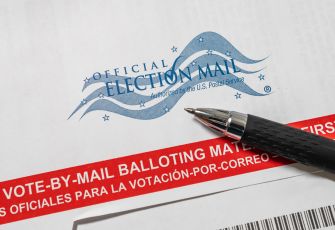
The U.S. Supreme Court on Monday lifted a lower court order blocking parts of President Donald Trump’s election executive order, allowing the administration to move forward with measures affecting mail-in ballots ahead of the 2026 midterm elections.
The ruling focused on whether the states had shown enough immediate harm to bring their challenge, rather than whether Trump has constitutional authority to impose the election measures. A separate nationwide injunction still prevents the U.S. Postal Service from enforcing the order’s mail ballot provisions.
Trump issued the executive order on March 31. It directs the Department of Homeland Security to work toward creating lists of U.S. citizens eligible to vote in each state and tells the Justice Department to prioritize investigations and possible prosecutions involving ballots issued to people who are not eligible to vote in federal elections.
The order also directed the Postal Service to develop new requirements for mail-in ballots. USPS has since issued a final rule requiring participating states to provide voter information and use unique barcodes on ballot envelopes, but a separate nationwide injunction issued Aug. 11 prevents the agency from enforcing those requirements for the November election and earlier federal elections.
California and 22 other states, along with Washington, D.C., brought their own challenge in federal court in Massachusetts. They argued that Trump was attempting to use presidential authority to create election rules in an area where the Constitution gives states and Congress significant power.
U.S. District Judge Indira Talwani sided with the states in June and barred the administration from carrying out the challenged provisions against them for elections through Nov. 3. The administration appealed, arguing that federal agencies had not yet taken enough action for the states to show the kind of injury required to bring the lawsuit.
The Supreme Court agreed with the administration on that point. Federal courts require someone bringing a lawsuit to show an actual or imminent injury caused by the challenged action, a constitutional requirement known as standing. Courts also generally wait until a dispute has developed enough to be decided, a related doctrine known as ripeness.
The justices found that several of the harms identified by the states still depended on what federal agencies would eventually do. Homeland Security had been directed to create citizenship lists, but the states were not required to use them. When the lawsuit was filed, the Postal Service was still developing its ballot rules.
The Court found that the states had not yet shown enough concrete harm to challenge the executive order itself. States or other groups can return to court if later actions under the order create an actual or imminent injury.
The states’ challenge also raises a broader question about who has authority to set election rules. States are primarily responsible for running elections, while Congress has constitutional power to regulate federal elections. The Elections Clause gives states the initial responsibility for setting the time, place, and manner of congressional elections while allowing Congress to change those rules. Talwani found in June that parts of Trump’s directive went beyond enforcing existing federal law and attempted to set election policy through executive action. The Supreme Court did not reach that issue Monday.
The Justice Department also asked the Supreme Court to lift the separate injunction against the Postal Service. The justices left that order in place, so USPS remains barred from enforcing the new mail ballot requirements while the voting rights groups’ lawsuit continues.
Justice Sonia Sotomayor, joined by Justice Elena Kagan, dissented and argued that the states already faced a concrete and imminent injury sufficient to challenge the order. Justice Ketanji Brown Jackson wrote separately, arguing that election officials were already preparing for November while being told that their lawsuit had been filed too early.
The Supreme Court’s stay will remain in effect while the administration’s appeal proceeds in the U.S. Court of Appeals for the First Circuit and through any later request for Supreme Court review. The nationwide injunction against the Postal Service remains in effect in the voting rights groups’ case.