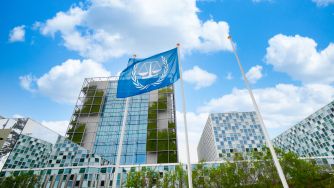
Four human rights organizations filed a federal lawsuit Tuesday challenging the Trump administration’s sanctions against the International Criminal Court, arguing President Donald Trump exceeded his emergency economic powers and violated constitutional protections for speech and due process.
The lawsuit, filed Aug. 11 in the U.S. District Court for the Southern District of New York, was brought by Human Rights Watch, the American Friends Service Committee, the Center for Constitutional Rights and the Open Society Institute. The groups are challenging Trump’s 2025 executive order authorizing sanctions against certain ICC officials and others accused of supporting the court.
Executive Order 14203 allows the government to block property and restrict certain transactions involving people accused of supporting ICC actions against U.S. personnel or nationals of allied countries. The administration has since used the order to sanction ICC judges and prosecutors, U.N. human rights expert Francesca Albanese and three Palestinian rights organizations.
The groups claim the restrictions have forced them to limit research, legal advocacy, humanitarian work and contact with sanctioned people and organizations because violations can carry serious civil or criminal penalties. They argue the sanctions have affected more than financial transactions by interfering with activities that include legal representation, information sharing and collaboration.
A central part of the lawsuit challenges Trump’s use of the International Emergency Economic Powers Act, known as IEEPA. The law gives presidents broad authority to restrict economic transactions after declaring a national emergency involving an unusual and extraordinary foreign threat to U.S. national security, foreign policy or the economy.
Congress has also placed limits on that authority, including protections involving certain communications and informational materials. The organizations argue Trump’s order goes beyond the emergency powers Congress granted and unlawfully reaches activities that should remain outside the government’s sanctions authority.
Their First Amendment claim focuses on the effect the policy has had on speech and association. A government rule does not have to directly ban a statement or publication to raise free speech concerns. Courts can also examine whether the threat of punishment causes people or organizations to stop engaging in constitutionally protected speech or advocacy.
A federal judge in the same district has already found a First Amendment problem with Executive Order 14203 in a separate case. In July 2025, U.S. District Judge Jesse Furman ruled that the order violated the rights of two law professors who wanted to continue speech-based work involving the ICC and permanently barred federal officials from enforcing the challenged restrictions against them. The ruling applied only to those challengers and did not invalidate the executive order nationwide.
The new lawsuit also argues the sanctions are unconstitutionally vague under the Fifth Amendment. Due process generally requires laws carrying serious penalties to give people enough notice of what conduct is prohibited. The groups contend that language restricting the provision of “services” to sanctioned people does not clearly tell them whether activities including advocacy, legal work or information sharing could expose them to punishment.
The American Friends Service Committee raises a separate claim under the Religious Freedom Restoration Act, a federal law that protects religious exercise from substantial government burdens unless the government can meet a demanding legal test. The Quaker organization argues the sanctions interfere with human rights and humanitarian work tied to its religious mission.
The administration imposed the sanctions amid its longstanding dispute with the ICC over the court’s authority. Trump’s executive order cites the court’s warrants for Israeli Prime Minister Benjamin Netanyahu and former Defense Minister Yoav Gallant and says ICC actions involving the United States and Israel threaten U.S. sovereignty and national security. A White House official defended that position Tuesday, saying the court had infringed on the sovereignty of both countries.
The sanctions are part of a broader administration campaign against the court. Secretary of State Marco Rubio said last month that the United States would pressure ICC member countries to distance themselves from the institution, sanction organizations that work with the court and restrict travel by court staff.
Human Rights Watch and the other groups are asking the federal court to declare the challenged sanctions unlawful and block their enforcement, including additional designations under Executive Order 14203.