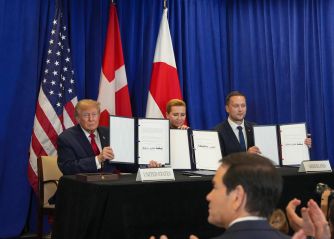
President Donald Trump signed a security agreement with Denmark and Greenland Tuesday that clears the way for two new U.S. military bases on the Arctic island, expanding Washington’s presence after months of tension over his push to acquire Greenland.
Trump joined Danish Prime Minister Mette Frederiksen and Greenland Prime Minister Jens-Frederik Nielsen for the signing during the United Nations General Assembly in New York. Greenland remains a semi-autonomous territory within the Kingdom of Denmark, while the deal gives the United States substantially greater military access.
Washington can expand and modernize operations at Pituffik Space Base in northwestern Greenland and establish new defense areas at Narsarsuaq in the south and Mestersvig on the east coast. Trump said before the signing that the United States would begin developing what he described as two major military bases.
The pact also allows broader U.S. military movement across Greenland, including undersea access, and provides for a missile defense presence tied to the Trump administration’s planned Golden Dome system. Additional defense areas could be established later.
Much of the legal framework dates to 1951, when the United States and Denmark signed the defense agreement that has governed the American military presence in Greenland for more than seven decades. Tuesday’s deal amends that pact rather than replacing it.
One provision gives the arrangement potentially long-lasting reach. It has no fixed end date and would continue if Greenland eventually becomes independent, with Greenland assuming Denmark’s rights and obligations while remaining in NATO.
Greenland already controls many of its domestic affairs, while Denmark retains authority in areas including defense and foreign policy. Greenlanders also have a recognized right to pursue independence, making the provision significant beyond the island’s current relationship with Copenhagen.
Military access from outside NATO is also restricted. Countries outside the alliance generally cannot establish manned or unmanned military installations or maintain a persistent military presence in Greenland unless the parties agree otherwise.
Trump characterized the deal more broadly during his U.N. address, saying it gives the United States “permanent control” over Greenland’s security. Frederiksen emphasized NATO’s role and said the arrangement respects Greenland’s right to self-determination. Nielsen also stressed the importance of NATO security in the Arctic.
The signing follows a diplomatic dispute that intensified earlier this year as Trump repeatedly said the United States needed Greenland for national security. He had declined to rule out military or economic pressure as he pushed for American control of the territory, straining relations with Denmark and other NATO allies.
Greenland’s location between North America and the Arctic has long made it important to U.S. defense planning. Pituffik supports missile warning, missile defense and space surveillance operations for the United States and NATO.
American forces once had a much larger presence on the island. During the Cold War, the United States operated 17 installations and stationed more than 10,000 personnel in Greenland. Pituffik is now the only active U.S. military base there.
Narsarsuaq previously housed the U.S. military’s Bluie West One air base before it closed in the 1950s. Mestersvig is currently used by Denmark’s Sirius Dog Sled Patrol, a special forces unit operating in Greenland’s remote Arctic territory.
The expansion will be the first major increase in U.S. military infrastructure on Greenland since the Cold War, restoring an American presence at locations beyond Pituffik while keeping the island’s defense arrangements within a NATO framework.
Greenland also gains a more direct role in the international arrangement governing its territory. Greenlandic official Naaja Nathanielsen described the pact as the first binding agreement Greenland has signed as a country and said it gives the territory a larger seat at the table as it pursues greater autonomy.