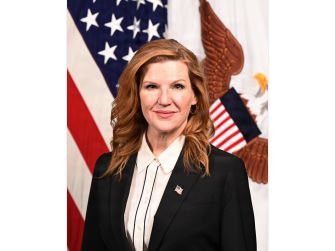
President Donald Trump named Pentagon cybersecurity official Kirsten Davies as acting National Cyber Director on Thursday, November 19, 2026, replacing Sean Cairncross, who was removed from the position following questions within the administration about his cybersecurity credentials.
The leadership change follows a series of technology outages affecting major U.S. companies and government systems. Recent disruptions include a nationwide aviation ground stop, a widespread Microsoft outage, and service interruptions involving JPMorgan Chase, Bank of America, and other financial institutions. Federal officials have said the incidents appear unrelated and have found no evidence of a coordinated cyberattack.
Davies, who previously served as the Pentagon's Chief Information Officer, brings nearly two decades of technology and cybersecurity experience. The White House said she will lead an America First cyber strategy aimed at strengthening national security and addressing growing threats to government and private-sector systems.
Cairncross had served as Trump's principal adviser on national cybersecurity policy and strategy since August 2025. White House Chief of Staff Stephen Miller pushed for his removal over concerns about his technical qualifications, according to reporting from Axios and CBS News. Trump supported the leadership change, which places Davies in charge of coordinating federal cybersecurity policy.
The appointment drew praise from officials across the administration. Director of National Intelligence Jay Clayton welcomed Davies's selection, saying, "With nearly two decades of leadership experience in the technology space, Kirsten Davies will be a strong asset for the Trump administration in her new position with the Office of the National Cyber Director."
Who Is Kirsten Davies, Trump's New Cyber Director?
Before her appointment, Davies advised Pentagon leadership on information technology, cybersecurity, and information management. Her work included modernizing military technology infrastructure, strengthening digital security and improving the department's ability to respond to emerging threats.
She brings nearly two decades of experience in the technology sector, including leadership positions at major companies such as Unilever, Estée Lauder, Siemens and Hewlett Packard.
Her professional background also includes leading global cyber resilience initiatives and working to strengthen technology infrastructure across large organizations.
Davies's technical background differs from that of Cairncross, a longtime Republican political operative and lawyer whose appointment had drawn criticism over his limited professional experience in cybersecurity.
Before joining the Office of the National Cyber Director, Cairncross served as Chief Operating Officer of the Republican National Committee and CEO of the Millennium Challenge Corporation during Trump's first presidential term.
During his tenure as National Cyber Director, Cairncross advocated for collaboration between major technology companies and the federal government. He also helped advance the administration's national cybersecurity strategy and initiatives addressing the security risks associated with artificial intelligence, including government efforts to identify software vulnerabilities with assistance from technology companies.
The Office of the National Cyber Director was established by Congress in 2021 to coordinate federal cybersecurity strategy and advise the president on protecting U.S. digital infrastructure. Davies will oversee those responsibilities in an acting capacity, with Senate confirmation required for a permanent appointment.
Davies Outlines U.S. Cybersecurity Priorities
Following her appointment, Davies shared her priorities for the country's cybersecurity future in a post on X.
"Our nation stands in the crossroad of analog, digital, and quantum technologies, our American way of living increasingly interconnected," she wrote.
Davies emphasized the need to modernize technology infrastructure, strengthen resilience against digital threats and develop a workforce equipped to address emerging cybersecurity challenges.
"Our opportunity is to dominate the cyber landscape for generations to come ... but only if we modernize and drive resilience into the foundations our great nation runs on, as well as build cyber talent for our future," she added.
The leadership transition follows several days of technology failures that disrupted air travel, financial services and government operations. Microsoft's worldwide service interruption affected Outlook, Teams and other platforms, while a separate communications failure prompted the Federal Aviation Administration to temporarily halt departing flights nationwide. Banking customers also experienced interruptions to online services.
Secretary of State Marco Rubio addressed concerns about the incidents on November 18, saying federal officials had found "zero evidence" that the disruptions were connected or involved malicious cyber activity. Microsoft attributed its outage to a technical problem, and officials identified maintenance work as a factor in the aviation disruption.
The outages have also drawn attention to the challenges of maintaining critical technology infrastructure as organizations adopt increasingly complex systems. Sen. Mark Warner, the top Democrat on the Senate Intelligence Committee, warned that advances in artificial intelligence are accelerating the discovery of software vulnerabilities and placing additional pressure on organizations to update their systems.
Davies takes over federal cybersecurity coordination as the administration continues implementing its national cyber strategy, including efforts to protect critical infrastructure, strengthen government networks, and address emerging threats involving artificial intelligence.