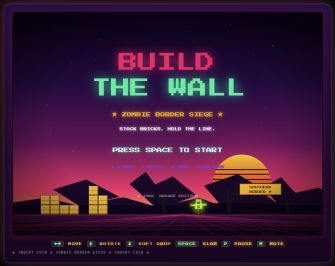
The White House has removed its Tetris-style “Build the Wall” game from its website days after The Tetris Company said it had never authorized the game and was reviewing possible copyright concerns.
The immigration-themed game launched Sept. 3 as part of a White House online arcade promoting President Donald Trump’s policies. Players stacked falling blocks to build a border wall while being told to “hold the line” against what the game called a “zombie border siege.”
“Build the Wall” has since disappeared from the site. The White House has not publicly explained the removal or said whether it was connected to Tetris raising concerns about its intellectual property.
The Tetris Company said it had no role in creating the game and had not licensed its brand or intellectual property for the project. It also said it takes copyright infringement “very seriously” and was “currently reviewing the matter.”
Tetris has confronted similar copying claims before.
In a 2012 federal case, The Tetris Company and Tetris Holding sued Xio Interactive over “Mino,” a puzzle game that closely resembled Tetris. U.S. District Judge Freda L. Wolfson ruled that Xio had copied protected elements of the game, including the appearance and movement of its pieces and the presentation of the playing field.
The decision drew a line that could become relevant if Tetris pursues a claim over the White House game. Copyright law generally does not protect the basic rules or mechanics of a video game, so Tetris does not own the broad idea of arranging falling blocks. Protection can extend to distinctive visual and creative elements used to present those mechanics.
Whether “Build the Wall” crossed that line would depend on how closely it copied protected elements of Tetris rather than the underlying game concept.
Any claim involving the federal government could also follow an unusual path. Federal law generally directs copyright claims against the United States to the U.S. Court of Federal Claims when the government, or someone acting with its authorization, infringes a protected work. Copyright owners can seek monetary compensation through that process.
The White House arcade debuted with five retro-style games tied to administration policies. Other games remained available after “Build the Wall” was removed.
The Tetris Company also sought to distance its brand from the game’s political message, saying Tetris has spent more than four decades bringing people together “across generations and cultures through play and joy.”
Tetris has not announced a lawsuit. The White House game is gone, while the company says it is still reviewing the matter.