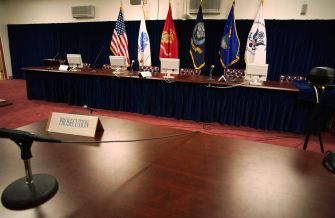
A military judge on Wednesday, October 7, 2026, threw out the FBI confessions of the last remaining defendant in the September 11 terrorism case to have his statements challenged, leaving prosecutors with rulings excluding the disputed confessions of all four men facing the death penalty at Guantánamo Bay, Cuba. The decision undercuts a Bush administration strategy designed to obtain admissible confessions after years of CIA torture and coercive interrogations.
Air Force Lt. Col. Michael Schrama ruled that statements made by Walid bin Attash, who is accused of helping train two of the September 11 hijackers, were involuntary. His decision follows three earlier suppression rulings that have stripped prosecutors of evidence they spent years fighting to introduce at trial.
Schrama found that FBI agents failed to inform bin Attash that statements extracted from him during CIA interrogations between 2003 and 2006 could not be used against him. The judge also identified techniques resembling those employed by the CIA, including offering treats to encourage his cooperation.
Bin Attash made the disputed statements during FBI questioning at Guantánamo in 2007 and 2008, after his transfer from the CIA's secret detention program. On January 24, 2007, the first day of the interviews, he reportedly told federal agents that he was proud of his role in what he called the "Planes Operation."
The Bush administration sent separate teams of FBI agents to question the men at Guantánamo, seeking confessions prosecutors could use despite their earlier treatment in CIA custody. Known as "clean teams," the agents were intended to conduct independent interviews. Prosecutors maintained that the resulting statements were voluntary, while defense attorneys argued that years of torture and coercion continued to influence the prisoners.
Military commission rules require prosecutors to establish that a confession was voluntary before introducing it at trial. The judges found that the defendants' earlier treatment in CIA custody undermined the government's argument that the subsequent FBI interviews were free from coercion.
The first of the four defendants to secure a suppression ruling was Ammar al-Baluchi, a nephew of accused September 11 mastermind Khalid Sheikh Mohammed, in April 2025. Schrama subsequently excluded Mohammed's FBI statements on August 28, 2026, and those of Mustafa al-Hawsawi on October 2, 2026. His October 7 ruling in bin Attash's case completed the series.
In al-Hawsawi's case, Schrama cited the agents' failure to explain his rights and the status of his earlier CIA statements. Mohammed had been waterboarded in secret detention facilities before his September 2006 transfer to Guantánamo, a history the judge considered in excluding his later FBI statements.
Prosecutors appealed the ruling excluding al-Baluchi's statements but declined to challenge Mohammed's, citing concerns that additional litigation could delay the joint trial or require separate proceedings.
The four defendants remain charged in connection with the September 11, 2001, attacks, which killed nearly 3,000 people. Prosecutors can pursue convictions and death sentences using other admissible evidence, although the government is appealing the exclusion of al-Baluchi's FBI statements.
The prosecution has remained in pretrial proceedings since the four defendants and a fifth man were arraigned in 2012. The fifth defendant, Ramzi Binalshibh, was removed from the joint case in 2023 after a military judge found him mentally incompetent to stand trial.
In July 2024, Mohammed, bin Attash and al-Hawsawi agreed to plead guilty in exchange for avoiding the death penalty. Then-Defense Secretary Lloyd Austin attempted to revoke the agreements days later, and a federal appeals court upheld his withdrawal in July 2025. The defendants have asked the Supreme Court to review that decision, leaving the dispute over the agreements unresolved.
The case remains in pretrial proceedings, with jury selection scheduled to begin June 5, 2028. Schrama set the date in August 2026 after rejecting prosecutors' request for an earlier trial, allowing additional time to address evidence disputes and other pending motions.