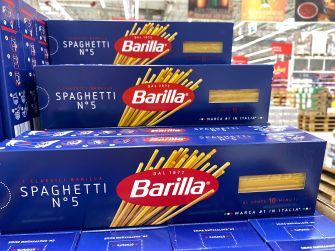
Barilla America has defeated a California consumer class action brought by shoppers who said its “Italy’s #1 Brand of Pasta” label led them to believe the pasta was made in Italy with Italian ingredients.
U.S. Magistrate Judge Ajay Krishnan granted Barilla summary judgment on September 30, 2026, ending the California class claims without a trial. Summary judgment allows a judge to resolve a case when the evidence does not leave a material factual dispute for a jury to decide. The ruling came after the court excluded a survey in which 57% of respondents said the label suggested the ingredients came from Italy.
Plaintiffs Matthew Sinatro and Jessica Prost argued that the phrase, paired with green, white and red packaging, created the impression that Barilla pasta sold in the United States was made in Italy. The pasta was instead produced at plants in Ames, Iowa, and Avon, New York, using wheat sourced from around the world. The boxes also disclosed on a side panel that the product was “Made in the U.S.A. with U.S.A. and imported ingredients.”
Krishnan concluded that “Italy’s #1 Brand of Pasta” was more naturally understood as a claim about Barilla’s popularity in Italy, not where the pasta was made. Evidence showed Barilla held the largest share of Italy’s dry pasta market and had been identified in market research as the country’s leading pasta brand.
California’s consumer protection lawConsumer protection law is the body of federal and state laws designed to protect people from unfair, deceptive, fraudulent, or abusive practices in the marketplace. These laws regulate areas such as advertising, sales, lending, debt collection, credit reporting, warranties, financial services, and consumer products.Read more → claims turned on whether the packaging was likely to mislead a significant portion of reasonable shoppers, not simply whether individual buyers could interpret it that way. Krishnan found that “Italy’s #1 Brand of Pasta” could be ambiguous about origin, but did not clearly state that the product itself was made there.
Because the front label was ambiguous rather than plainly false, the court could consider the side-panel disclosure stating that the pasta was made in the United States with domestic and imported ingredients. Taken together, Krishnan found the evidence did not show that a significant portion of reasonable consumers was likely to be deceived.
The plaintiffs relied on a survey of 582 people in which 57% said the label communicated that the pasta’s ingredients came from Italy. Krishnan excluded the survey, finding that its design pushed respondents toward that interpretation by asking directly whether the phrase referred to Italian ingredients rather than first asking what shoppers understood it to mean.
Barilla submitted its own survey testing several possible interpretations. More than 80% of respondents who passed the survey’s attention checks associated the phrase with Barilla’s popularity in Italy, while about 30% connected it to ingredient sourcing.
With their survey excluded, the plaintiffs were left largely with their own accounts of how they understood the packaging. Krishnan found that individual testimony could not establish the broader consumer reaction needed to keep the deceptive-marketing claims alive.
Sinatro testified that he bought Barilla angel hair pasta in the San Francisco area in 2021 while looking for Italian pasta and relied on the phrase and the green, white and red imagery. Prost said she similarly believed Barilla spaghetti she bought in the Los Angeles area that year had been made in Italy.
The lawsuit was filed in June 2022 under California’s Unfair Competition Law, False Advertising Law and Consumers Legal Remedies Act, along with claims for breach of warranty and unjust enrichment.
The court certified a California class in May 2024 covering residents who bought products carrying the disputed label beginning June 11, 2018. The parties later agreed to dismiss nationwide claims, leaving the California class to continue toward trial before Barilla sought summary judgment.
Krishnan also rejected the warranty claims, finding that the phrase did not promise that Barilla pasta sold in the United States was made in Italy or used Italian ingredients. The unjust enrichment claim failed with the underlying deceptive-marketing theories.
Because Barilla prevailed on summary judgment, its separate request to decertify the class became moot.
Barilla has since removed “Italy’s #1 Brand of Pasta” from its packaging as part of a brand redesign that the company says began before the lawsuit was filed.
Share This Article
If you found this article insightful, consider sharing it with your network.
Xiolene is a contributing journalist with more than a decade of experience in management, operations, and client service. Her background spans the veterinary and beauty industries, giving her experience working with businesses, consumers, employees, and service-focused organizations. Xiolene brings a practical business and consumer perspective to her coverage, focusing on making complex news and current events clear and accessible to readers.
A federal judge has reduced a $23.5 million trademark damages award against Beyond Meat to just $37,500, wiping out nearly all of Vegadelphia Foods’ claimed losses while leaving intact a separate $15.4 million award tied to Beyond Meat’s profits.U.S. District Judge Indira Talwani entered judgment of $15,437,500 on September 18,...
Read
More »
Chobani must face a proposed class action accusing the company of misleading consumers by marketing yogurt as sugar-free even though each serving allegedly contains four grams of allulose, a sweetener that a federal appeals court found qualifies as sugar under federal labeling rules.The 7th U.S. Circuit Court of Appeals in...
Read
More »
Cento Fine Foods is facing a proposed class action lawsuit in California accusing the company of misleading consumers by marketing some of its canned tomato products as “Certified San Marzano” tomatoes without certification from the Italian consortium tied to the protected designation.
The lawsuit, filed by two California consumers, alleges...
Read
More »
McDonald’s Corporation is facing a proposed nationwide class action lawsuit alleging the fast-food chain misled customers by marketing its McRib sandwich as a rib-based product despite allegedly containing no actual pork rib meat. Filed on December 23, 2025, in the U.S. District Court for the Northern District of Illinois, the...
Read
More »
A recent Ninth Circuit opinion raises the question of whether California’s consumer protection laws should perhaps be renamed California’s “consumer unprotection laws.”
In a case where a manufacturer replaced potentially harmful ingredients in its hair dye with “chemicals that are just as unsafe or worse” than those they replaced, the...
Read
More »