A California jury has found that Reedley farmer Cesar Mora breached his agreement with Giumarra Brothers Fruit Co. by selling a licensed variety of white nectarine through another supplier, following a two-week trial in a dispute that drew national attention after Mora gave away more than 180,000 pounds of fruit this summer.
The Fresno County Superior Court jury returned its verdict Thursday after about three hours of deliberations. Jurors found Mora violated his contract with Giumarra but awarded the produce company no damages. They also rejected Mora’s claims that Giumarra failed to fulfill promises made in connection with his decision to grow the Monalise nectarine.
An earlier order from Fresno County Superior Court Judge Jonathan M. Skiles requires Mora to remove the Monalise trees from his orchard. His attorneys have sought to stop the removal while challenging the ruling and said after the verdict that they plan to appeal. Mora has until the end of October to remove the trees.
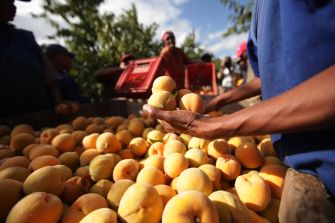
Public attention grew in July when Mora opened his Reedley orchard rather than allow the season’s crop to go unused. More than 180,000 pounds of nectarines were ultimately given away. Mora said the legal dispute had prevented him from finding a commercial buyer willing to take the crop.
Mora’s relationship with Giumarra began with a series of agreements governing the Monalise variety. Court filings show he signed a sublicensing agreement in 2017 allowing him to grow the fruit. A separate marketing agreement signed in 2019 required the nectarines to be packed and sold through Giumarra.
Under the agreements, Mora was required to pay a $2.50 royalty for each tree, a production royalty equal to 4 percent of gross fruit sales, and a sales commission. Mora later sought to end the relationship and sold his 2023 nectarine crop through another packer. Giumarra sued that year, claiming the sale violated the parties’ agreements.
In claims against Giumarra, Mora argued that the company had not delivered what he said was promised when he agreed to grow the fruit. He alleged that portions of earlier crops were discarded and that some nectarines were sent to Taiwan despite contract language concerning sales in the United States and Canada. Giumarra disputed his allegations.
At the center of a breach of contract claim is whether the parties had an enforceable agreement, whether one side failed to meet its obligations, and whether that failure caused harm. Those questions are considered separately, which can allow a party to prove that a contract was breached without establishing a financial loss that warrants damages. That distinction was reflected in Thursday’s verdict, with jurors finding that Mora violated the agreement while awarding Giumarra no money.
Another part of Mora’s case concerned what he said he had been told about the legal protections surrounding the Monalise variety. His attorneys argued in court filings that Giumarra represented the nectarines as an exclusive variety connected to patent rights and that the exclusivity was expected to support premium prices. Giumarra stated in its filings that Monalise is not covered by a U.S. plant patent.
Skiles ruled in May that the patent dispute did not prevent Giumarra from enforcing the agreements. Patent rights and contract rights are separate legal protections. A patent gives its holder rights under federal law, while a contract creates obligations based on what the parties agreed to do. Because Mora’s sublicense did not depend on a patent being issued, the judge found Giumarra could pursue its contract claim without proving that Monalise was covered by a U.S. patent.
Giumarra has maintained that the case concerns enforcement of written agreements governing its fruit program. The company previously said it was committed to honoring its contractual obligations to growers and protecting programs that provide value to its grower partners.
Following the verdict, Mora’s attorneys said they plan to appeal and will continue challenging the order requiring removal of the Monalise trees. He currently faces an end-of-October deadline to remove them.