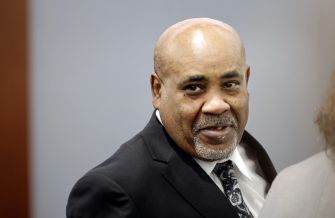
Defense attorneys for Duane “Keffe D” Davis rested their case Thursday after calling three retired Las Vegas police officers in less than two hours, using the brief presentation to challenge the investigation into Tupac Shakur’s 1996 killing and raise questions about whether another vehicle could have been connected to the shooting.
Davis, 63, a former leader of the South Side Compton Crips, is accused of orchestrating the drive-by shooting that fatally wounded Shakur near the Las Vegas Strip. He has pleaded not guilty to murder with use of a deadly weapon and has remained jailed since his September 2023 arrest. Closing arguments are scheduled for Monday.
Defense attorney Michael Sanft focused much of his case on potential gaps in the Las Vegas Metropolitan Police Department’s investigation and testimony involving a light-colored Cadillac seen at the home of Death Row Records co-founder Marion “Suge” Knight shortly before Shakur was shot.
Retired Sgt. Stan Hyt and former Lt. Charlie Mangrum testified that they were working overtime outside Knight’s Las Vegas home on the night of the shooting and saw a light-colored Cadillac arrive at the property. The vehicle later left as part of a convoy that included Knight driving Shakur in his BMW.
Less than an hour later, witnesses reported seeing a similar light-colored Cadillac pull alongside Knight’s BMW near Flamingo Road and Koval Lane. A gunman in the back seat opened fire, striking Shakur multiple times. The rapper died six days later at age 25.
Sanft used the testimony to suggest investigators may not have fully accounted for other vehicles or potential suspects before focusing on Davis and the men prosecutors say were traveling with him. The questioning left jurors with the possibility that the Cadillac seen at Knight’s home could be relevant to competing theories about the shooting.
Under cross-examination by Clark County Chief Deputy District Attorney Marc DiGiacomo, Mangrum acknowledged that his report from the night of the shooting recorded license plate numbers for vehicles entering Knight’s property. He also agreed that homicide investigators at the time would ordinarily have followed up on that information.
The defense does not have to prove that another person killed Shakur. Prosecutors carry the burden of proving Davis’s guilt beyond a reasonable doubt, and the defense can seek an acquittal by convincing jurors that weaknesses or unanswered questions in the evidence leave reasonable doubt about the state’s version of what happened.
Jurors have also heard testimony about other theories that have circulated since Shakur’s death. Earlier in the trial, prosecutors questioned Knight associate James “Mob James” McDonald about a theory involving former Death Row security chief Reggie Wright Jr. McDonald rejected the suggestion that Wright had a financial motive to have Shakur killed, saying Shakur was too valuable to the record label.
Sanft’s final witness, retired LVMPD homicide Detective Dan Long, led the Shakur investigation from 2002 until 2017. His testimony gave the defense another opportunity to focus on the handling of evidence in a case that remained unsolved for nearly three decades.
Long testified that the department’s paper case file was once placed under tighter security because employees who were not involved in the investigation repeatedly accessed it out of curiosity. He also said some reports were lost when the department transferred records to a new electronic storage system.
Sanft then turned to a 2009 interview Long conducted with Davis and the dispute over statements Davis had previously given investigators under a proffer agreement.
About a year earlier, Davis had spoken secretly with a joint Los Angeles Police Department and federal task force investigating the 1997 killing of Christopher Wallace, better known as The Notorious B.I.G. In the December 2008 statement played for jurors, Davis said he was riding in the front passenger seat of the Cadillac used in Shakur’s shooting and passed a loaded .40-caliber Glock to the back seat. Davis said his nephew, Orlando Anderson, took the weapon and fired before the group fled.
Long testified that he did not know about the earlier agreement when he interviewed Davis in 2009. He said he was prepared to seek a murder warrant after the interview but was later instructed to stand down because of the proffer arrangement.
A proffer agreement generally allows a person to provide information to prosecutors or investigators under negotiated restrictions on how those statements may later be used. Its protections depend on the terms of the agreement and do not necessarily amount to complete immunity from prosecution.
Prosecutors contend Davis never received blanket immunity and argue that any protections tied to the confidential statement did not prevent them from using accounts he later repeated publicly, including in a BET docuseries and his 2019 memoir, “Compton Street Legend.”
Sanft has argued that Davis fabricated his account to gain leverage while facing an unrelated drug case and later continued telling the story because he could profit from it.
Before leaving the witness stand Thursday, Long also testified that he once tried to arrange an interview with Knight through a mutual contact. According to Long, Knight hung up on the officer who made the call.
The case now moves to closing arguments, when prosecutors and defense attorneys will make their final presentations to jurors before deliberations begin.