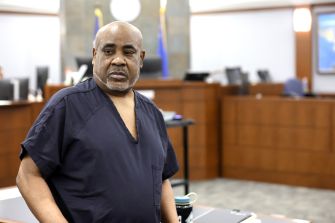
Duane "Keffe D" Davis, the former Compton gang leader convicted of orchestrating the 1996 murder of rapper Tupac Shakur, was sentenced on October 13, 2026, to 40 years to life in prison, nearly three decades after the fatal drive-by shooting in Las Vegas.
Clark County District Court Judge Carli Kierny imposed consecutive terms of 20 years to life for first-degree murder and a deadly weapon enhancement. Davis, 63, was convicted August 31 after prosecutors used his own accounts of the killing, including a recorded police interview and a memoir, to establish his role in the attack. His attorney plans to appeal.
Kierny rejected Davis's claims that he had left gang life behind, become a grandfather, and deserved to spend his remaining years in peace. She told him that moving on with his life did not erase his responsibility for taking Shakur's future from him.
"You don't get to take a man from his family," Kierny said, adding that the world had never forgotten Shakur's death, and neither had Las Vegas.
Davis spoke briefly before sentencing, focusing on personal belongings seized by investigators, including photographs. Asked whether he had anything further to say, he responded, "No, I'm good," but made clear that he intended to appeal.
Shakur's sister, Sekyiwa "Set" Shakur, described her brother as a protector whose ambitions extended beyond music. She said his death deprived the world of someone who hoped to bring about social change and urged the court to impose the maximum punishment.
His brother, Maurice "Mopreme" Shakur, also addressed the court, describing the lasting devastation the killing had caused their family and the rapper's fans. Both siblings called for Davis to receive the harshest sentence available.
Davis was the only person ever charged in the September 7, 1996, shooting, which followed a confrontation between rival gang members at the MGM Grand casino. Hours before the attack, Shakur, Death Row Records co-founder Marion "Suge" Knight and several associates were captured on surveillance footage beating Davis's nephew, Orlando "Baby Lane" Anderson, after a Mike Tyson boxing match.
Prosecutors said Davis, then a leader of the South Side Compton Crips, organized a retaliatory attack against Shakur and Knight, whose record label was associated with the rival Mob Piru Bloods.
According to the prosecution, Davis obtained a .40-caliber handgun and rode in the front passenger seat of a white Cadillac that pulled alongside the BMW carrying Shakur and Knight near the Las Vegas Strip. He passed the weapon to occupants in the back seat, where the fatal shots originated.
Shakur was struck multiple times and died six days later at age 25. Knight was wounded but survived.
Although Davis was never accused of personally firing the weapon, prosecutors argued that he directed the attack and supplied the gun. Under Nevada law, a person who intentionally aids or directs a murder can be held criminally responsible as a principal, even when someone else carries out the shooting.
Central to the case was a recorded 2008 interview Davis gave Los Angeles detectives while seeking leniency in an unrelated narcotics investigation. He described riding in the Cadillac, passing the gun to the back seat and watching Anderson fire at Shakur's vehicle. Davis also said he would have fired the weapon himself had the BMW stopped beside his window.
He later repeated elements of that account in television interviews and his 2019 memoir, Compton Street Legend, providing investigators with statements prosecutors would eventually use against him.
The 2008 interview was conducted under a cooperation arrangement intended to limit how his disclosures could be used. Prosecutors argued that Davis lost those protections when he publicly repeated his account, allowing them to rely on his subsequent admissions. The dispute became a central issue in a case built largely around Davis's own descriptions of the killing.
Defense attorney Michael Sanft challenged the reliability of those statements throughout the two-week trial, arguing that Davis fabricated his involvement to obtain favorable treatment in the drug investigation and later exaggerated the story to make money.
Sanft also pointed to the absence of physical evidence placing Davis inside the Cadillac and inconsistencies between his accounts and witness testimony. Davis maintained his innocence and did not testify.
Jurors rejected those arguments, reaching a unanimous guilty verdict after approximately three hours of deliberation on August 31.
Anderson, who denied involvement in Shakur's murder, died in an unrelated shooting in 1998. The other two alleged occupants of the Cadillac, Deandrae "Big Dre" Smith and Terrence "Bubble Up" Brown, have also died. Authorities have not conclusively established who fired the fatal shots.
Davis was arrested in September 2023, more than 27 years after the killing. His sentence makes him eligible for parole only after serving the required minimum term, with credit for time already spent in custody.
Sanft has said he intends to challenge the conviction on appeal, including the prosecution's use of Davis's statements and the evidence presented at trial.