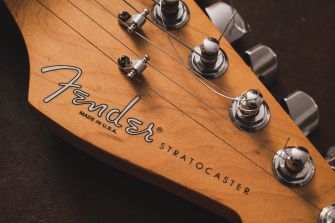
Fender's claim to own the Stratocaster's iconic body shape is now facing its most serious legal test in nearly two decades, as a wave of cease-and-desist letters sent this past May has fractured the global guitar industry into camps of companies settling quietly and others preparing to fight in a German courtroom.
The dispute traces back to a December 2025 default judgment from the Düsseldorf Regional Court, which found that Leo Fender's original Stratocaster design qualifies for copyright protection under German law, a ruling Fender has since used as leverage against instrument makers worldwide, including Yamaha, PRS Guitars, and German retailer Thomann.
Fender's history of trying to lock down the Strat shape stretches back more than two decades. The company first attempted to trademark the design in the United States in 2003, only to face opposition from seventeen guitar manufacturers and distributors. That fight dragged on for years before the U.S. Trademark Trial and Appeal Board ruled against Fender in 2009, finding that the company had waited too long, roughly fifty years, to enforce any exclusive claim over a shape that had become so widespread in the market that consumers no longer associated it specifically with Fender.
The board pointed to examples like Paul Simon and Bruce Springsteen performing with Sadowsky-brand Strats and a Tom Anderson Guitarworks model appearing on The Simpsons as evidence the design had become generic.
The legal landscape shifted dramatically last year when Fender pursued a different strategy in a different country. Rather than relitigating trademark claims in the U.S., the company sued Chinese seller Yiwu Philharmonic Musical Instruments in Germany over copyright infringement, accusing the company of hawking counterfeit Strats on AliExpress.
Yiwu never responded to the suit, and the Düsseldorf court issued a default judgment in Fender's favor, describing the guitar's curves in strikingly poetic terms, comparing the body's silhouette to a female torso and calling the design a "fundamentally new" creation reflecting Leo Fender's personality and artistic vision.
Fender wasted little time capitalizing on that win. In March, the company announced the ruling had secured "broad legal protection" for the Stratocaster shape across the European Union, and by May it had fired off cease-and-desist letters, drafted by Munich-based attorneys at Bird & Bird, to instrument makers across the globe demanding they pull Strat-style guitars from the market immediately.
Not everyone folded. Attorney Ronald Bienstock, who represented Fender's opponents in the original 2009 trademark battle, has since rallied a group of companies to push back, arguing that the Düsseldorf ruling only applies to Yiwu and can't be stretched into a sweeping industry-wide prohibition, especially given that it came from an uncontested default judgment rather than a fully litigated case. Bienstock has raised doubts about the chain of title behind Leo Fender's original design and pointed again to the "generic" designation the shape received from U.S. regulators in 2009.
The conflict escalated further in June when Thomann, one of the companies targeted by Fender's letters, filed its own lawsuit in a German court seeking a declaration that its Harley Benton Strat-style guitars don't infringe on any Fender copyright.
Fender countersued, setting up a direct courtroom battle that will force a German judge to examine the merits of Fender's copyright claim with far more evidence and argument than existed in the original Yiwu case.
Meanwhile, according to Fender's attorneys, several other companies that received the initial warning letters have already agreed to quietly discontinue their Stratocaster-style models rather than risk litigation.
Fender CEO Bud Cole has framed the crackdown as a matter of protecting the brand's legacy while insisting the company remains open to working with partners across the industry.