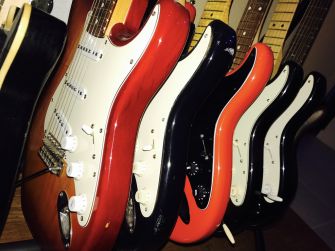
Fender Musical Instruments Corp. has begun sending cease-and-desist letters to guitar manufacturers that make and sell instruments resembling the company’s Stratocaster, escalating a long-running dispute over one of the most recognizable electric guitar designs in popular music.
The move follows a recent ruling from the Regional Court of Düsseldorf in Germany, in which Fender obtained a default judgment against a China-based seller whose guitars were offered on AliExpress and shipped to Germany. Fender and its lawyers have described the ruling as confirming that the Stratocaster body design can qualify as a protected work of applied art under German and European Union copyright law. The company has since relied on that decision in letters to other guitar makers, including U.S.-based builders whose products are sold or distributed in Europe.
The dispute has drawn attention because the Stratocaster body shape is not merely a product silhouette to many guitar players. It is a design language that has been copied, modified, licensed, referenced, and reinterpreted across the industry for decades. “S-style” guitars are sold by small boutique builders, large manufacturers, and parts companies. Some are near replicas. Others use the general double-cutaway outline while changing the proportions, pickguard, contours, headstock, electronics, and hardware.
Fender has said its campaign is not aimed at every double-cutaway or two-horned guitar. The company’s position, according to public reporting and statements attributed to Fender and its counsel, is that it focuses on products that closely or fully replicate the Stratocaster design. Fender has also said it is working with companies on design changes and transition periods rather than seeking immediate destruction of inventory in every instance.
The legal theory Fender appears to be pressing most directly is copyright under German and EU law. In that framework, the company argues that the Stratocaster body is more than a functional guitar shape. Fender’s theory is that the design contains original creative expression and therefore deserves protection as applied art, even though the guitar is also a useful commercial product.
That distinction matters. Copyright law generally protects creative expression, not functional ideas. A song, painting, sculpture, photograph, or original graphic design can be protected because the law recognizes creative authorship in the work. A useful object presents a harder question. A guitar body must hold the neck, pickups, bridge, controls, and strings in a playable arrangement. It must also rest comfortably against the player’s body. If the challenged features exist primarily because they make the guitar work better, copyright protection becomes difficult to obtain. If the features reflect creative choices separable from utility, the copyright argument becomes stronger.
Fender’s German victory gives the company leverage in Europe, but it does not automatically decide the same question in the United States. U.S. copyright law treats useful articles with caution. A useful article can contain protectable pictorial, graphic, or sculptural features, but only when those features can be identified separately from and exist independently of the article’s utilitarian function. Applied to the Stratocaster, a court would likely ask whether the particular curves, horns, contours, and overall body appearance are expressive design elements or whether they are inseparable from the instrument’s function, ergonomics, and playability.
Fender could also try to frame the issue in terms of trademark and trade dress law. Trade dress protects the total image or overall appearance of a product when that appearance identifies the source of the goods. In a guitar dispute, Fender would argue that consumers see the Stratocaster body shape and associate it with Fender, not merely with a category of electric guitar.
U.S. law makes that claim difficult to apply to product designs. The Supreme Court has held that product design is not inherently distinctive. A company trying to protect a product shape as trade dress must show secondary meaning, meaning consumers primarily understand the design as identifying one source. Fender would need to show that the Stratocaster shape, standing alone, signals to buyers that the guitar is from Fender.
That is where Fender’s U.S. history becomes a major problem. In 2009, the Trademark Trial and Appeal Board rejected Fender’s effort to register the body configurations of the Stratocaster, Telecaster, and Precision Bass as trademarks. The TTAB concluded that consumers had been exposed for decades to guitars from third parties with identical or substantially similar body outlines. The Board also found that even “iconic” status does not prove that a design identifies a single source rather than a type of body design used by many manufacturers.
For guitar makers accused by Fender, the 2009 decision is likely to be central to any U.S. defense. They can argue that the Stratocaster body shape has become generic in the guitar market, much like a general product category rather than a brand identifier. They can also argue that widespread third-party use, open sales, visible branding by other manufacturers, and Fender’s long delay in policing the shape undermine any claim that buyers are confused about source.
Confusion is another major issue. A trade dress claim typically requires proof that the defendant’s product is likely to confuse consumers about who made, sponsored, or approved the product. Many S-style guitars display the maker’s own brand on the headstock and are sold as alternatives to Fender, not as counterfeit Fenders. That does not end the analysis, but it gives accused manufacturers a practical defense: buyers may recognize the Stratocaster-inspired shape while still understanding that the guitar comes from another company.
Functionality would also be a likely defense. Trademark law does not allow a company to use trade dress to control useful product features that competitors need to use. If a body shape affects comfort, balance, access to upper frets, weight distribution, or manufacturing compatibility, a defendant may argue that the design is functional and should remain available to competitors. Fender would likely respond that the precise Stratocaster design is not necessary to make a double-cutaway electric guitar and that rivals can use other shapes while avoiding close copying.
The dispute also carries an unfair competition dimension. Fender’s position is that copying the Stratocaster design trades on decades of brand investment and consumer goodwill. Accused builders are likely to answer that they compete openly, sell under their own names, and operate in a market where the S-style guitar has long been understood as a general form rather than an exclusive Fender-owned design.
The PRS Silver Sky shows how complicated the dispute may become. PRS has reportedly received a cease-and-desist letter from Fender and has said it disagrees with Fender’s assessment. The Silver Sky is widely discussed as Stratocaster-inspired, but it also uses PRS branding and has design differences in its contours, proportions, neck joint, and other details. A fight over that model would test whether Fender is pursuing only near clones or whether it is asserting broader control over visual elements that many players consider part of the modern S-style category.
For smaller builders, the immediate pressure may come less from a court ruling than from the cost of litigation. Cease-and-desist letters can force a business to choose between redesigning products, limiting sales in Europe, negotiating a phase-out, or paying lawyers to challenge the claim. Even if a company has strong defenses under U.S. law, defending an international IP dispute can be expensive.
The legal dividing line will likely depend on geography. Fender appears to have stronger leverage in Germany after the Düsseldorf ruling. In the United States, the company would face the 2009 TTAB decision, Supreme Court trade dress rules, functionality defenses, and decades of industry use. The result could be a split market in which certain Stratocaster-style guitars remain available in the United States but face restrictions in Germany or parts of Europe.
The larger question is whether a design can be both iconic and legally exclusive after decades of open use by competitors. Fender says it is protecting a historic design and brand identity. Guitar makers opposing the letters say the Stratocaster body shape has become part of the shared vocabulary of electric guitar manufacturing.
For now, the cease-and-desist campaign is a warning shot. It does not by itself establish Fender’s rights against every S-style guitar maker. Courts, settlement negotiations, and market pressure will determine whether the Stratocaster body remains a broadly available design category or becomes a more tightly controlled form in key markets.