A federal judge in Oklahoma has ruled that a police officer violated a woman’s Fourth Amendment rights when he searched a month of her travel history through Flock’s automated license plate reader network after he began following her because her SUV had a California plate.
U.S. District Judge Sara E. Hill ruled October 1, 2026, that Tulsa County sheriff’s deputy Freddie Alaniz conducted an unconstitutional warrantless search when he queried Flock and other automated license plate reader systems for information about Melisa Kyle. The search returned more than 50 records showing where the vehicle had been detected over roughly a month.
Hill called the technology a form of “indiscriminate mass surveillance” and suppressed the Flock records and evidence obtained from the later search of Kyle’s SUV, where authorities said they found about 91 pounds of methamphetamine.
The ruling came in United States v. Kyle, a federal drug case in the Northern District of Oklahoma. Kyle, 46, of Crane, Missouri, is charged with possessing methamphetamine with intent to distribute.
The case began in May when Alaniz, who also served as a Drug Enforcement Administration task force officer, was parked along Interstate 44 and saw the Mazda SUV Kyle was driving pass with a California license plate.
According to Hill, Alaniz pulled onto the highway and began following the Mazda “for no apparent reason” other than its California registration. He entered the plate number into Flock, giving him access to stored records showing where cameras connected to the network had previously detected the vehicle.
The results showed that the Mazda had traveled from Oklahoma toward the California-Arizona border and was returning toward Missouri after a relatively short trip. Alaniz viewed the route as potentially consistent with drug trafficking.
He later stopped Kyle after observing alleged traffic violations, including a lane change without signaling. During the encounter, Alaniz questioned her about the trip while reviewing the plate-reader records and comparing her answers with the vehicle’s recorded travel.
Kyle declined his request to search the SUV. A narcotics dog later alerted to the vehicle, and officers searched it. Authorities said they found approximately 91 pounds of methamphetamine packed inside luggage, marijuana, and about $7,000 in cash.
Hill ruled that the Fourth Amendment violation occurred when Alaniz searched Kyle’s historical location records.
The query produced more than 50 sightings spanning roughly a month, allowing police to reconstruct a substantial portion of the Mazda’s recent travel before Alaniz obtained a warrant or established probable cause. Hill distinguished that accumulated history from an officer seeing a license plate at a single place and time on a public road.
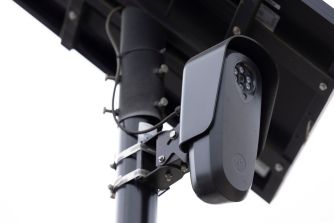
Flock uses automated cameras to photograph passing vehicles and record information including license plates, locations, and timestamps. Law enforcement agencies with access to the network can later search those stored records to identify where a vehicle has appeared and trace portions of its travel history.
“This is a type of indiscriminate mass surveillance,” Hill wrote.
The Supreme Court held in the 1983 case United States v. Knotts that tracking a vehicle traveling on public roads did not violate the Fourth Amendment under the circumstances presented there. Hill found that Flock posed a different issue because its network can collect vehicle sightings before police identify a driver as a suspect and make those historical records available later through a database search.
The U.S. Court of Appeals for the Fifth Circuit took a different approach in United States v. Porter on March 17, 2026, holding that police use of license plate reader data did not amount to a Fourth Amendment search where the system produced periodic sightings of a vehicle traveling on public roads.
Kyle’s case involved more than 50 recorded locations over about a month. Hill found that the volume and duration of those records gave police a detailed enough history of the vehicle’s recent travel to trigger Fourth Amendment protection.
Flock disputed the ruling and emphasized that the company was not a party to Kyle’s criminal case.
A company spokesperson said the decision conflicts with what Flock described as the “overwhelming weight of authority” from other courts, including previous rulings in Oklahoma. The company said it expects the decision to be appealed and characterized Hill’s ruling as limited to the facts of Kyle’s case.
Hill acknowledged that automated license plate readers can assist law enforcement investigations but said their use remains subject to constitutional limits.
“The Fourth Amendment requires courts to draw a line when the cost is too great,” she wrote.
Hill’s suppression order bars prosecutors from using the Flock records and evidence obtained from the subsequent vehicle search in Kyle’s federal case, including the methamphetamine authorities say they found inside the SUV.